
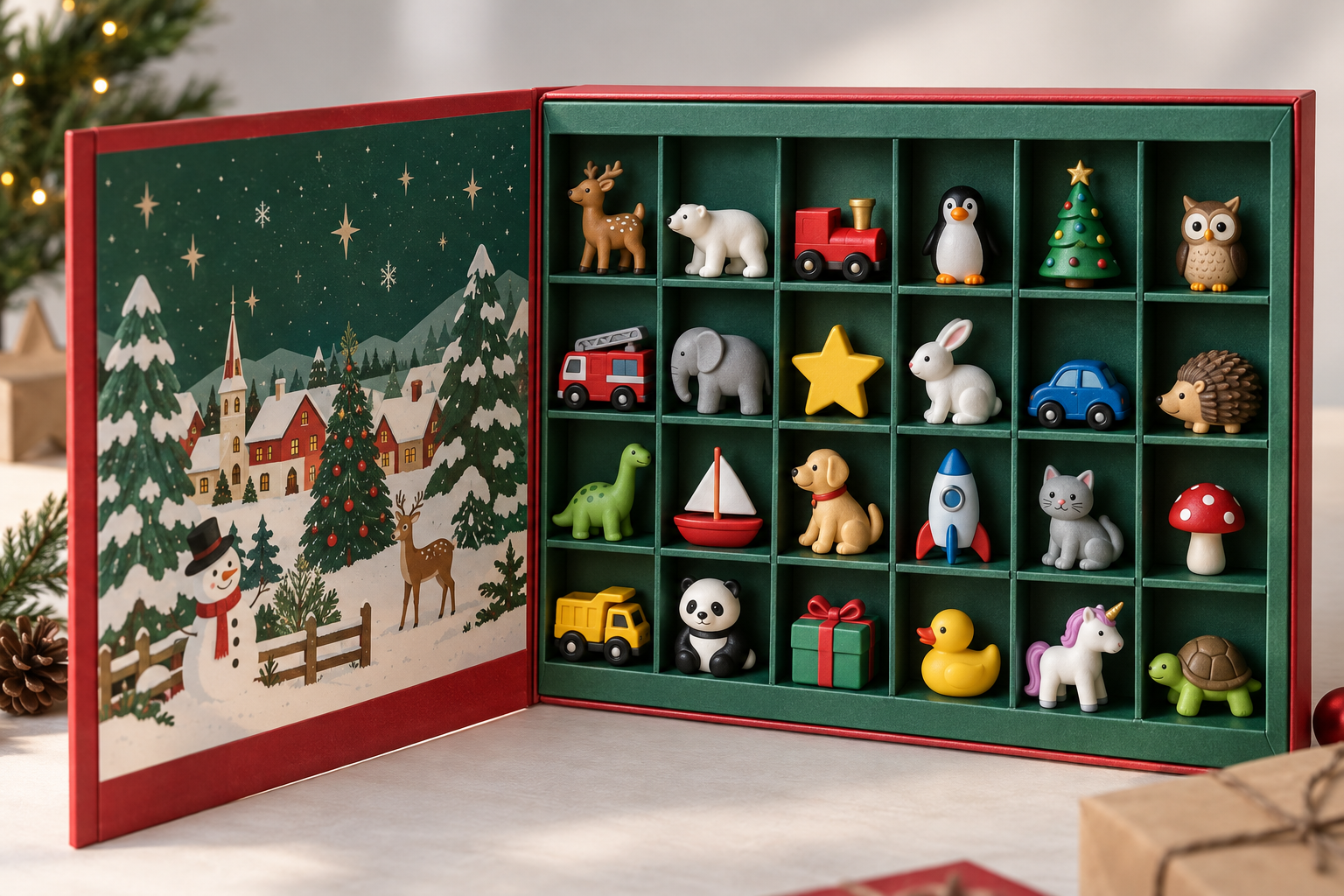
Before you order a custom toy advent calendar, agree on exactly what goes behind each door. Then check a fully packed sample and make sure the factory verifies every tray before sealing it. A calendar can have something in all 24 compartments and still be wrong. Day 18 might contain another Day 6 dinosaur instead of the figure customers expect.
Take an order of 2,000 calendars with 24 doors each. That’s 48,000 compartments to fill correctly. It doesn’t mean 48,000 individual toy pieces; some doors may hold more than one.
Know What Counts as a Packing Error
| Problem | What it looks like | What to check |
|---|---|---|
| Missing item | Door 7 is empty, or one piece is missing from its accessory bag. | Check the toy and piece count against the approved list. |
| Wrong door | The toys for Doors 7 and 12 have been swapped. | Match each door number to its assigned SKU. |
| Unplanned repeat | Door 18 holds the Day 6 figure rather than the toy chosen for Day 18. | Check that repeats appear only where the buyer approved them. |
Be clear about what you’re selling. If the box promises “24 different toys,” the approved assortment needs 24 distinct toys. “24 daily surprises” could include figures, cards, tools or pieces that build one bigger toy. If you plan to repeat an item, say which doors will contain it.
Ask Who Actually Packs the Calendars
A supplier may make the toys but send the trays and boxes somewhere else for assembly. Ask who makes each part and where the finished calendars are packed. You also need to know who can stop the line when something is wrong.
An OEM/ODM toy manufacturer may handle several steps or work with subcontractors. Either way, the production plan should show who’s responsible for the toys, inserts, printed boxes and final packing.
| What you’re ordering | What you need to approve |
|---|---|
| Existing toys in a custom box | Exact toy SKUs, day-by-day contents and printed door layout |
| Existing toys with new colors or details | Separate codes and photos for each version, plus any accessories |
| New toy designs and custom packaging | Drawings, tooling where required, samples and the fitted tray |
When comparing ready-made and custom toys, ask for costs to be broken out. Toys, molds, trays, printed boxes, samples, testing and packing checks shouldn’t be hidden under one vague price. Ask which component sets the minimum order quantity, too.
Get a price for the packed calendar
Send K&M your toy list, order quantity, age group, destination market and required delivery date. Ask what the quote includes for packing checks.
Give Every Door Its Own Place on the Map
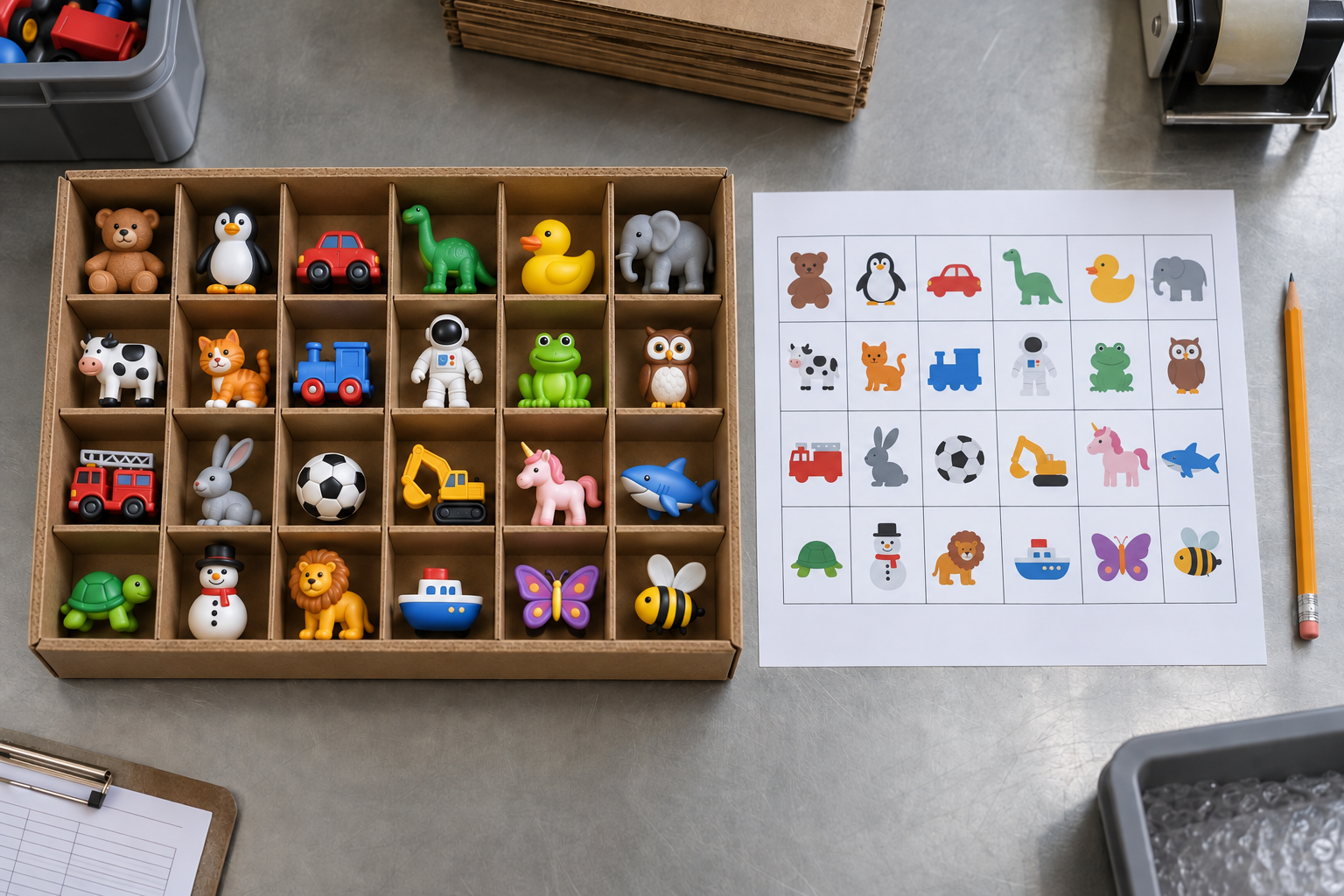
The factory needs more than a photo of 24 toys. For each door, put the SKU, toy photo, number of pieces, toy size, compartment size and loading position in the product specification sheet. The bill of materials (BOM) tells the team how many parts to prepare. The door map tells them where those parts belong.
| Door | SKU | Contents | Pieces | Back-of-tray slot |
|---|---|---|---|---|
| 01 | DINO-01 | Green T-Rex | 1 | A1 |
| 02 | DINO-02 | Triceratops | 1 | A2 |
| 03 | ACC-03 | Fossil model | 1 | A3 |
| 04 | ACC-04 | 1 scoop and 2 tools | 3 | A4 |
| 24 | DINO-24 | Special dinosaur | 1 | D6 |
This is a sample of the list, not a complete 24-door layout. Slot positions must match the actual tray. Notice Door 04: a bag marked “1 tool set” still contains three separate pieces. The packing instructions should show all three.
Here’s an easy mistake to miss. Workers often load the tray from the back, so the positions may look reversed compared with the numbered doors on the front. Mark the top of the tray and check the map from the side the worker actually uses.
Keep the BOM, door map, artwork, toy photos and tray drawing under the same revision. When a toy changes, update the affected files before anyone packs the next batch.
Use One Sample for Checking and One for Shipping Tests
Ask for two fully packed samples made with the intended toys, tray, board, printed artwork and inserts. Open the first sample and check all 24 doors:
- Contents: Is the right toy there? Are all the smaller pieces in its bag?
- Doors: Can each door open without catching on the toy or damaging the next compartment?
- Tray: Does anything slip into another pocket when you stand the box upright?
- Printing: Are the door numbers, product claims, age information and warnings correct?
Leave the second sample sealed for transport testing. The test plan may cover handling, vibration, drops or compression, depending on how the product will ship. Not every calendar needs every type of test. Once the test is finished, open all 24 doors and look for missing, moved or damaged items.[1]
Try the smallest accessory and the largest figure in the real tray before approving the packaging design. A toy that fits in a drawing may not sit properly in the finished insert.
Check the fit before the boxes go to print
Share your toy measurements, tray drawing and door artwork with K&M to discuss a complete packing sample.
Check the Tray Before the Factory Seals It
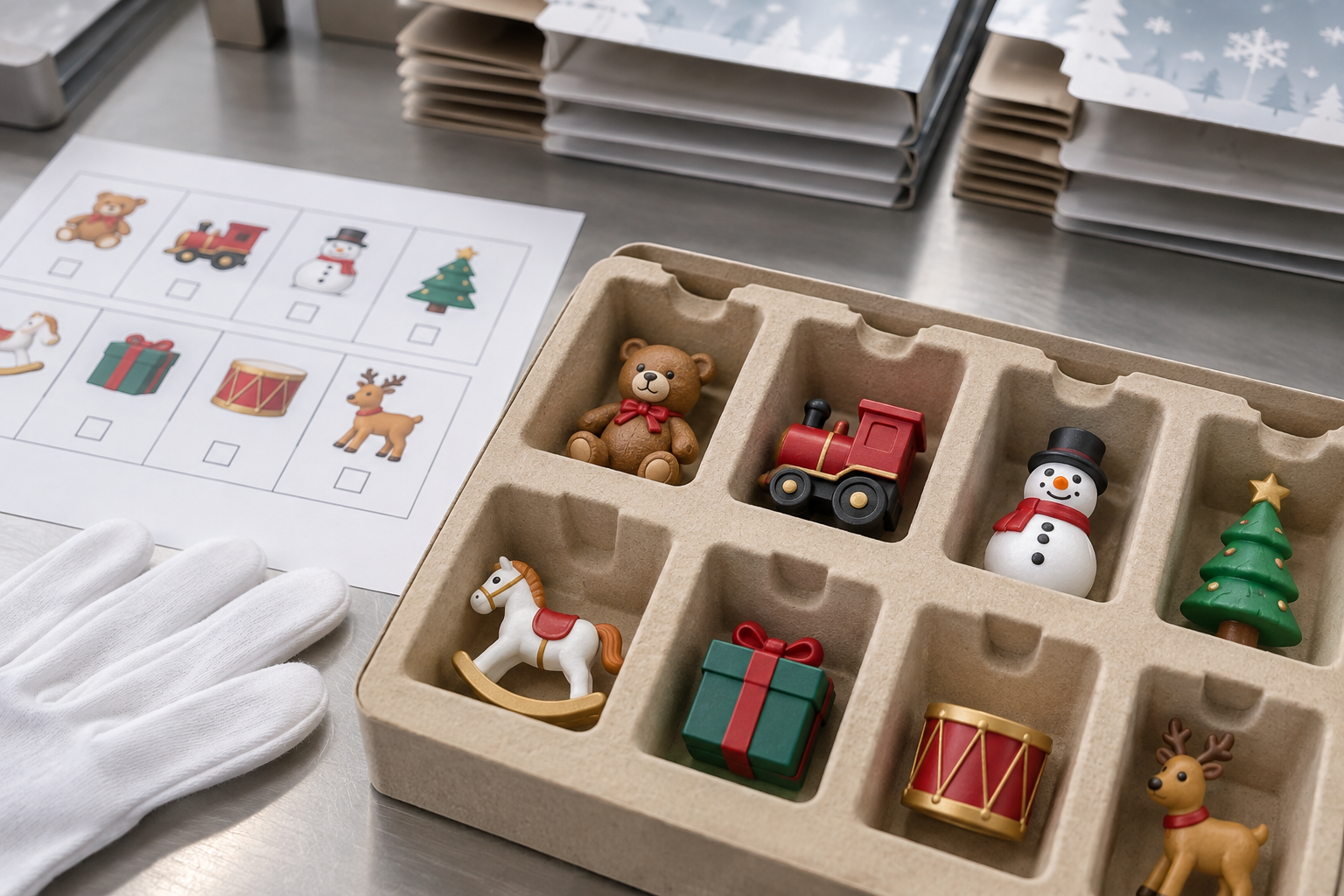
You don’t want workers guessing which green dinosaur goes into which slot. Set up the packing line so the right parts are easy to identify:
- Keep variants apart. Label each parts bin with its SKU and photo. Clear out the previous toy version before switching the line.
- Lay things out in tray order. If a door gets a bag of accessories, check the bag against its own piece list before loading it.
- Check every position. Verify the SKU, piece count and slot for all 24 doors before sealing. Scanning a barcode identifies the part; it doesn’t prove the worker put it in the right pocket.
- Set aside unfinished boxes. A parts shortage or shift change can leave a tray half filled. Label it and recheck the whole tray after it’s completed.
- Count what’s left. Reconcile issued parts, scrap, rework and leftover stock against completed calendars. A difference may reveal a counting problem, though it won’t tell you which two doors were swapped.
This is the same problem manufacturers face with multi-part toy kits. Weighing the box can catch some errors, but not two similar-weight toys in the wrong places. A missing part and an extra part can also cancel each other out on the scale.
Inspect During Packing, Not Just at the End
At the start of a production run, open the first finished calendar and check every door. Do it again after a toy variant or tray changes. During the run, make sure workers are using the current packing map and that reworked trays are being checked.
Before shipment, inspect finished calendars under the agreed sampling plan. Say you open 20 calendars. That’s 480 compartments. In a 2,000-calendar order, you’ve checked 1% of the finished calendars, not the other 1,980. This is only a calculation example, not a recommended sample size. Agree on the actual sample size and acceptance limits before inspection. ISO 2859-1:2026 sets out AQL-indexed sampling plans for inspection by attributes.[2]
If an inspector finds a missing toy or an unwanted duplicate, write down the door number, SKU, lot, line and packing period. Hold the stock that could be affected while the factory checks what went wrong. Your toy quality checklist should say who can approve its release.
Put the Rules in the Purchase Order
Attach the signed door map and its revision number. A simple clause could read:
Every calendar must contain the approved items, in the approved quantities, behind the correct numbered doors. Empty doors, wrong items, unapproved repeats and substitutions are defects. The supplier must get written buyer approval before making changes.
Agree in advance who pays for replacement parts, opening and resealing, repeat inspections and rejected stock. Approve the warnings and private-label box artwork against the same product revision.
Make Sure the Safety Documents Cover What’s in the Box
A test report for one dinosaur doesn’t cover every toy, accessory, paint or material in a 24-day calendar. Check the final assortment and packaging against the rules in the countries where you’ll sell it.
United States
Under 16 CFR Part 1250, covered toys made on or after April 20, 2024 must meet ASTM F963-23. Toys intended mainly for children 12 and under generally need testing by a CPSC-accepted third-party lab for applicable rules and a Children’s Product Certificate (CPC) from the responsible manufacturer or importer. Some testing exemptions may apply.[3][4]
U.S. small-parts rules restrict certain hazards in products for children under 3. Some toys aimed at older children need choking-hazard warnings. Putting an older age on the box doesn’t change who the toy is actually intended for.[5]
If a new material, design, production process or component source could affect compliance, the changed product or component may need new testing and a new CPC.[6]
European Union
In 2026, Directive 2009/48/EC remains the main EU toy-safety framework. Applicable requirements include conformity assessment, technical documents and CE marking.[7] Most provisions of Regulation (EU) 2025/2509 apply from August 1, 2030, while specified provisions took effect on January 1, 2026.[8]
A US and EU toy compliance checklist can help you match the required documents to the actual SKUs in your calendar.
Work Back From the Delivery Date
Set dates for six things: approving the assortment, the packed sample, safety evidence, printed artwork, finished production and pre-shipment inspection. Then add freight time and the date your warehouse needs the stock. If you’re creating brand-new figures, leave room for the toy design and tooling process.
And if the Day 19 figure runs out halfway through packing, don’t let the factory slip in another dinosaur to keep the line moving. Stop the affected work. Approve any replacement in writing and update the packing instructions, labels and safety records where needed.
Have the 24-day assortment ready?
Send K&M the door map, toy photos, planned repeats, order quantity, sales market and warehouse deadline.