
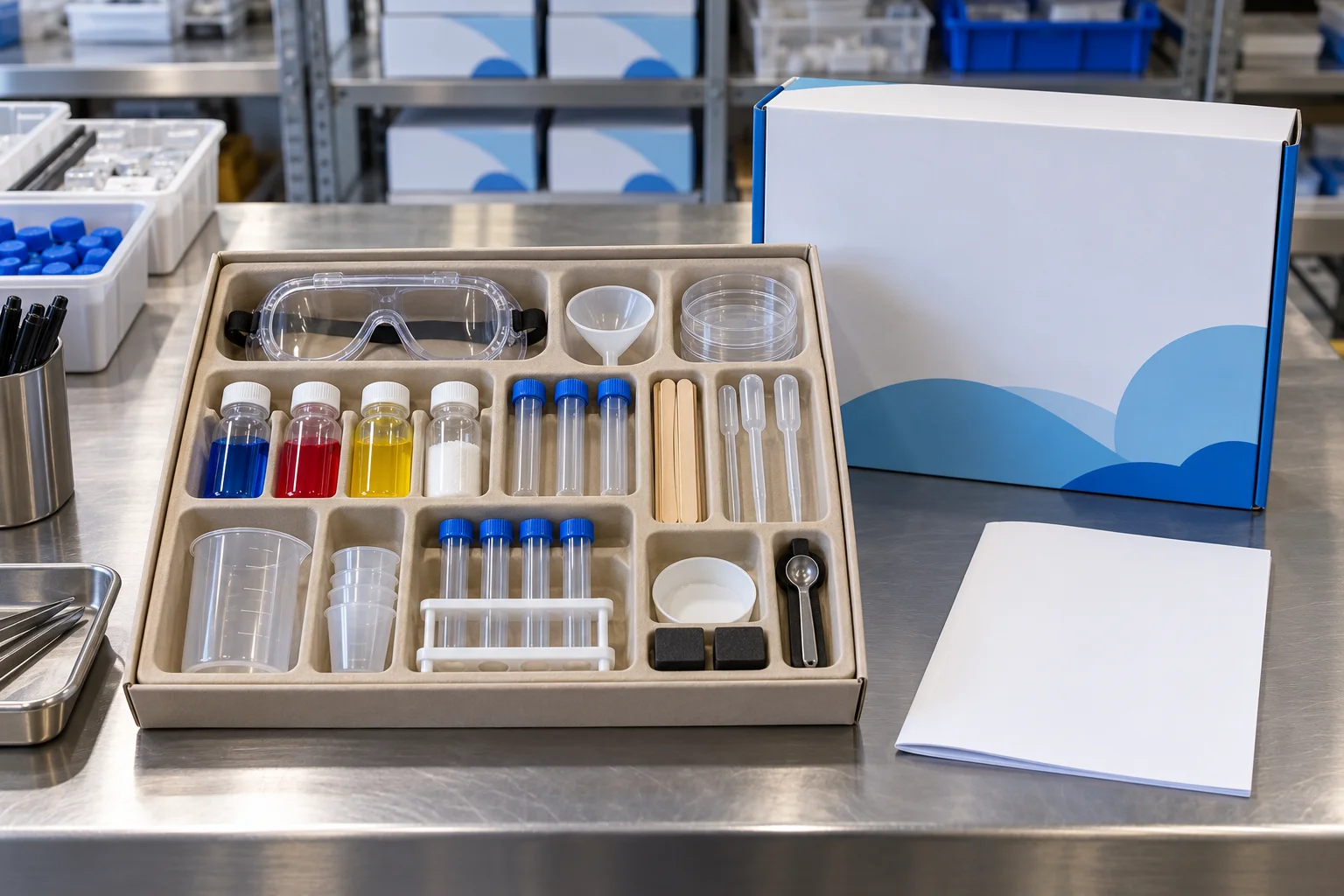
The best place to stop missing parts is on the packing line. Do not leave the job to final inspection. Use a controlled BOM, fixed part locations, one packing order, fewer manual counts, and clear checks for critical items.
For a custom science kit, the packout should be decided before mass production. The BOM, packaging, instructions, labels and QC rules all need to match the same product version.
Start With One Controlled Product Definition
The product BOM, packaging BOM and production files should all point to the same approved SKU.
Each part should have:
- a part number or controlled ID;
- the quantity per kit;
- the required size, material, capacity or other key spec;
- a revision where needed;
- a packing method;
- a check method where needed.
Required component quantity = quantity per kit × production quantity
Then compare what was issued, what is left, what was scrapped and how many finished kits were packed. If the numbers do not line up, something needs checking. This will not tell you which box is wrong, but it can expose a quantity problem early.
A toy product specification sheet can keep the BOM, packaging, artwork, dimensions, materials and inspection rules tied to one approved version.
Keep Revisions Under Control
An old BOM can make a whole run wrong, even if the packing team follows it perfectly.
Control the revision of:
- product BOM;
- packaging BOM;
- packing instructions;
- component drawings;
- retail artwork;
- trays and inserts;
- manuals;
- warnings and labels;
- barcode files;
- master-carton specifications.
Update every affected file before production starts. Do not run a production change from a chat message, email thread or verbal note alone.
Many parts or several SKU versions?
Send K&M the component list, packaging structure, order requirements and target market. The packout can be reviewed before the final production files are locked.
Turn the BOM Into a Simple Packing Instruction

The operator does not need a long engineering document. They need the right part, the right quantity and the right order.
Show:
- component name;
- part number where mix-ups are possible;
- quantity to add;
- a photo for similar-looking parts;
- packing position;
- the required check.
A label such as “PD-03 Dropper — Add 2 pcs” is better than just “Dropper.”
Keep the instruction order the same as the physical workstation order. The packer should not have to jump around the page to work out what comes next.
Remove Extra Choices From the Packing Station
If one SKU needs only one type of dropper, do not leave three similar droppers beside the operator.
Physically separate:
- different dropper capacities;
- different tube sizes;
- different wire lengths;
- different measuring tools;
- similar reagent sachets;
- different specimen sets;
- different language versions;
- different printed-material revisions.
The fewer unnecessary choices on the table, the fewer chances there are to pick the wrong part.
Use One Packing Order
Use the same packing sequence for every unit of the same SKU.
- Place the empty tray or retail box.
- Add parts in workstation order.
- Add controlled accessory packs.
- Add the correct manual and printed material.
- Complete the required presence and quantity checks.
- Run the specified secondary check.
- Seal the pack.
If work stops halfway through, mark the unfinished unit. Do not let it move down the line until the missed step has been completed and checked.
Pre-Pack Repetitive Small Parts
Small parts are where counting gets tiring fast. If a kit uses the same screws, sticks, clips or connectors every time, pre-pack them into a controlled sub-pack.
This can work for:
- screws;
- sticks;
- clips;
- connectors;
- beads;
- washers;
- small molded components.
The sub-pack still needs its own component list and check. You are moving the counting step, not removing it.
Use Counting Fixtures
A simple tray or jig can be more useful than asking someone to count the same tiny parts all day.
If the tray has a fixed slot for every required piece, an empty slot shows the problem at a glance.
Fixtures work best when:
- the quantity is the same for every unit;
- the parts are small;
- the same count is repeated often;
- each part fits a fixed position;
- the wrong part cannot fit unnoticed.
Use Packaging to Make Missing Parts Obvious
Loose parts thrown into one bag are harder to check. Trays, inserts and compartments make empty positions easier to see.
Define:
- which parts stay loose;
- which parts are grouped;
- which parts use dedicated cavities;
- where manuals and cards sit;
- which parts can move during transport;
- which parts must stay visible before sealing.
Packout should be considered while the packaging is being designed. The toy packaging design process should cover loose-part control, product retention, packing steps and inspection access—not just appearance.
Too many loose parts inside one box?
Share the component layout, retail box and insert concept before the artwork is locked. K&M can review whether trays, inner packs or grouped parts can make packing simpler and easier to check.
Scan Parts That Are Easy to Mix Up
Use barcode or QR checks when similar parts are hard to control by position or appearance alone.
- Scan the active SKU.
- Scan the component.
- Match the component code to the SKU.
- Flag or block a mismatch.
- Control quantity separately where needed.
Scanning is useful for:
- similar-looking parts with different specs;
- reagent variants;
- country-specific printed material;
- revision-sensitive items;
- high-value parts;
- components shared across several SKUs.
One thing gets missed quite often here: a correct scan confirms the part, not the quantity. If quantity matters, the system has to control that too.
Use Checkweighing Where It Can Actually Work
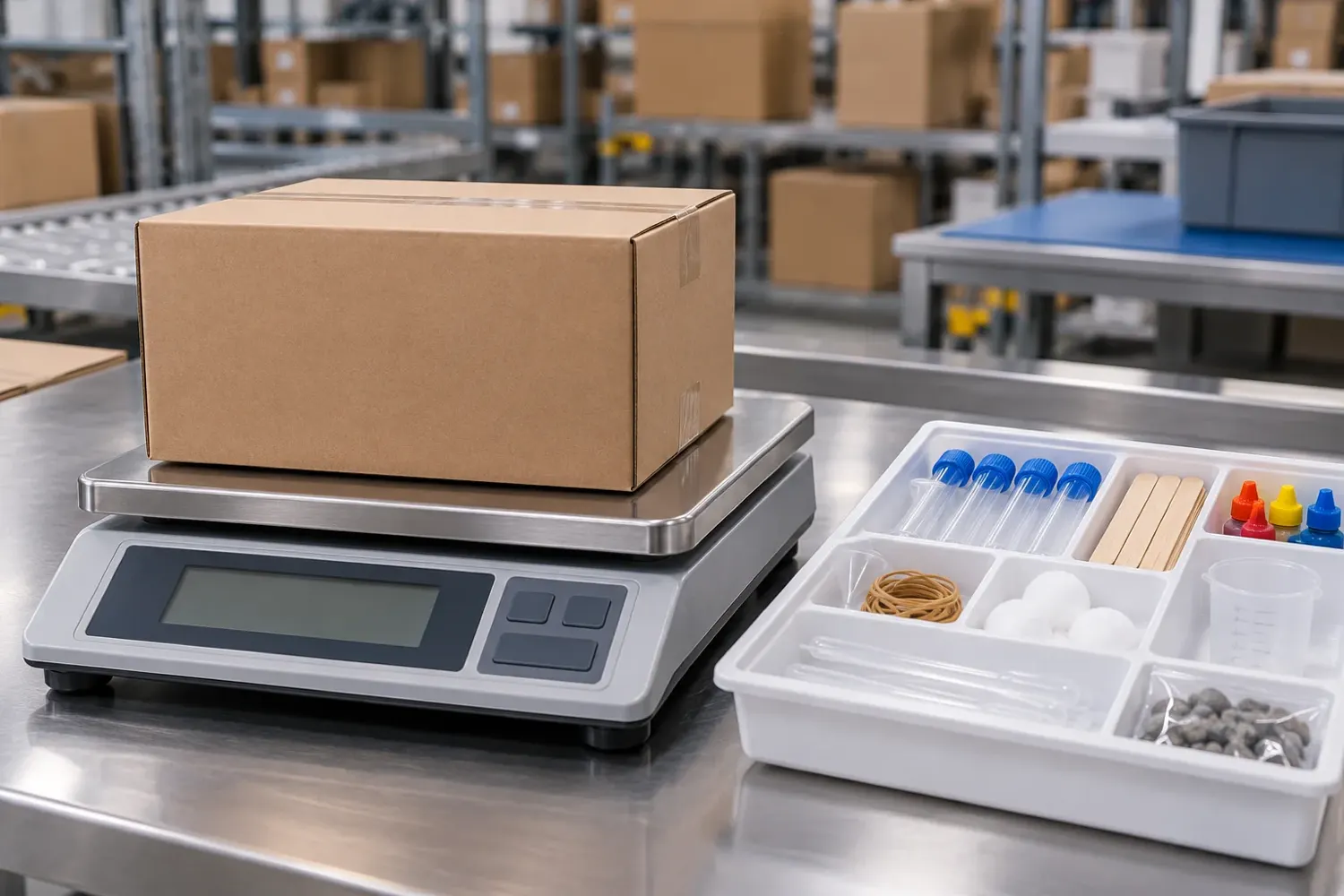
Checkweighing only works when the missing-part weight is large enough to stand out from normal pack variation and measurement uncertainty.
Set the limits from real product and packaging measurements using the actual scale on the line.
Weight checking is weak when:
- the missing part is very light;
- part weights vary;
- packaging variation hides the difference;
- the wrong part has similar mass;
- an extra part offsets the missing weight;
- the scale cannot resolve the difference reliably.
Use weight as a second check. Do not treat it as proof that every part and quantity is correct.
Check Critical Parts on Every Unit
If a missing part stops the experiment or affects safe use, do not leave it to final sampling alone.
Unit-level checks may be needed for:
- required safety information;
- tools needed to complete the experiment;
- measuring devices;
- experiment-specific materials;
- required electrical connectors;
- instructions needed for correct use.
Use a dedicated tray position, controlled dispensing step, scan, sensor, fixture or another proven method.
A quality-control checklist for educational toys should say how the item is checked, what passes, and when the check happens.
Control Manuals, Warnings and Labels Too
A kit can contain every physical part and still be wrong if it has the wrong manual, warning or language version.
Control:
- manual revision;
- language version;
- warning labels;
- age-related information where applicable;
- market-specific labels;
- barcode and SKU labels;
- required inserts and activity cards.
For U.S. children’s toys, ASTM F963 is incorporated into the mandatory federal toy safety rule. ASTM F963-23 applies to children’s toys manufactured after April 20, 2024, and manufacturers must identify which sections apply to the specific product.[1]
Approve the First Packed Unit
Pack one unit with the actual production materials and approve it before normal production starts.
Check:
- SKU;
- component identity;
- component quantity;
- component revision;
- accessory sub-packs;
- manual and printed-material revision;
- retail packaging;
- labels and barcode;
- batch or traceability information;
- weight where specified.
Repeat the first-piece check after changes that can affect packout, such as a SKU change, BOM revision, packaging change, material change, line move or relevant equipment adjustment.
Clear the Line Before Changing SKUs
Before the next SKU comes in, remove the previous one completely.
Clear:
- loose parts;
- accessory bags;
- manuals;
- labels;
- retail boxes;
- trays and inserts;
- samples;
- previous production documents.
A factory audit for educational toys should compare the released product files with what is actually sitting on the production floor.
Control Bin Shortages and Interruptions
A bin can run empty halfway through a pack. That is a simple way to end up with one unit missing a part.
The restart rule should define:
- where the incomplete unit stays;
- how it is marked;
- which step has to restart;
- who checks it before it goes back into normal flow.
Keep Rework Separate
Move incomplete or incorrect packs to a clear rework area. Do not repair them in the middle of finished goods.
Record:
- SKU;
- batch or lot;
- defect;
- part added, removed or replaced;
- rework action;
- re-verification;
- release status.
After rework, check the whole pack again. Fixing the known missing item does not prove everything else is right.
Check the Process While Packing Is Running
Use checks at:
- line start-up;
- defined in-process points;
- restart after an interruption;
- SKU or revision change;
- final inspection.
Pick a check that can actually find the defect. A visual check will miss a hidden part. A weight check cannot confirm identity when two parts weigh almost the same.
Do Not Use Sampling as a Unit-Level Completeness Check
Final sampling cannot confirm every box.
Use sampling to judge the finished lot. Use unit-level controls for parts that must be present in every kit.
Record the Actual Missing Part
Do not write only “packing error.” That tells you almost nothing.
Record the real problem:
- missing dropper;
- missing manual;
- missing reagent pouch;
- wrong accessory bag;
- wrong connector;
- incorrect quantity;
- incorrect manual revision.
Group the data by component, SKU, packing line, batch, rework status and root cause where those fields are useful.
Observed missing-part defect rate = detected missing-part defects ÷ units produced × 100
Use your own verified factory data. A generic industry defect rate will not tell you how your line is performing.
Fix the Failed Control
Sending a replacement part solves the customer’s problem. It does not fix the packing process.
Check:
- Was the released BOM correct?
- Was the current revision used?
- Was the right component staged?
- Could the operator skip the packing position?
- Did a bin shortage interrupt the pack?
- Were similar parts mixed?
- Did the packaging hide the missing position?
- Could the chosen check detect the defect?
- Did the unit go through rework?
- Was line clearance completed?
Fix the control that failed. More training will not fix a bad workstation layout, mixed materials or a check that cannot detect the problem in the first place.
Add Product-Safety Controls for Children’s Science Kits
For U.S. children’s toys, ASTM F963 is a mandatory toy safety standard under CPSC rules. ASTM F963-23 applies to children’s toys manufactured after April 20, 2024. The sections that apply depend on the product.[1]
U.S. small-parts rules prohibit certain products intended for children under three when small parts create a choking, aspiration or ingestion hazard. Separate choking-hazard labeling rules also apply to certain children’s products that contain small parts.[2]
Children’s products covered by U.S. tracking-label rules must carry permanent distinguishing marks on the product and packaging, to the extent practicable, so information such as the manufacturer or private labeler, production location and date, and batch or run can be identified.[3]
For EU toys, Directive 2009/48/EC remains relevant during the current transition period. Regulation (EU) 2025/2509 has entered into force and generally applies from August 1, 2030, when Directive 2009/48/EC is repealed. Certain provisions have applied since January 1, 2026, and transitional rules cover toys placed on the market before August 1, 2030.[4]
The exact rules depend on the age grade, materials, product design and destination market. K&M’s U.S. and EU toy safety compliance guide covers testing, warnings, age grading and documentation in the OEM process.
Preparing a science kit for the U.S. or EU market?
Send the intended age, destination market, experiment type, component list and packaging idea. These details are needed to define the product files, warnings, instructions and testing plan.
Pre-Production Packing Checklist
- Does every component have an approved identity and quantity?
- Are similar parts separated or electronically verified?
- Are repetitive small parts grouped or fixture-counted where practical?
- Which parts need a unit-level presence check?
- Can the second check actually detect the defect it is meant to catch?
- Are manuals, warnings, labels and packaging revisions controlled?
- Is the first packed unit approved before normal production?
- Are interrupted and reworked units clearly separated?
- Does every SKU change include line clearance?
- Can an affected production lot be traced?
Frequently Asked Questions
What is the best way to prevent missing parts in science kits?
Use a controlled BOM, fixed packing positions, one packing order, pre-packed or fixture-counted small parts, and unit-level checks for critical components.
Can checkweighing detect every missing part?
No. It only works when the missing-part weight stands out clearly from normal pack variation and measurement uncertainty.
Is final sampling enough?
No. Sampling checks selected units. Parts that must be present in every kit need controls during packing.
What should happen after a missing-part complaint?
Trace the SKU and lot, identify the missing part, review the packing and rework records, find the failed control, and fix it before the next comparable run.
Conclusion
Do not make the packer remember everything. Control the BOM, cut down unnecessary picks, group repetitive parts, check critical items, and keep interrupted or reworked packs separate.
If an incomplete kit can move through the line without anyone noticing, the packing control still needs work.
Define the packout before mass production
Send K&M the SKU, component list, packaging concept, target market and order requirements. The team can review component grouping, packing order and QC checkpoints before the production version is released.