
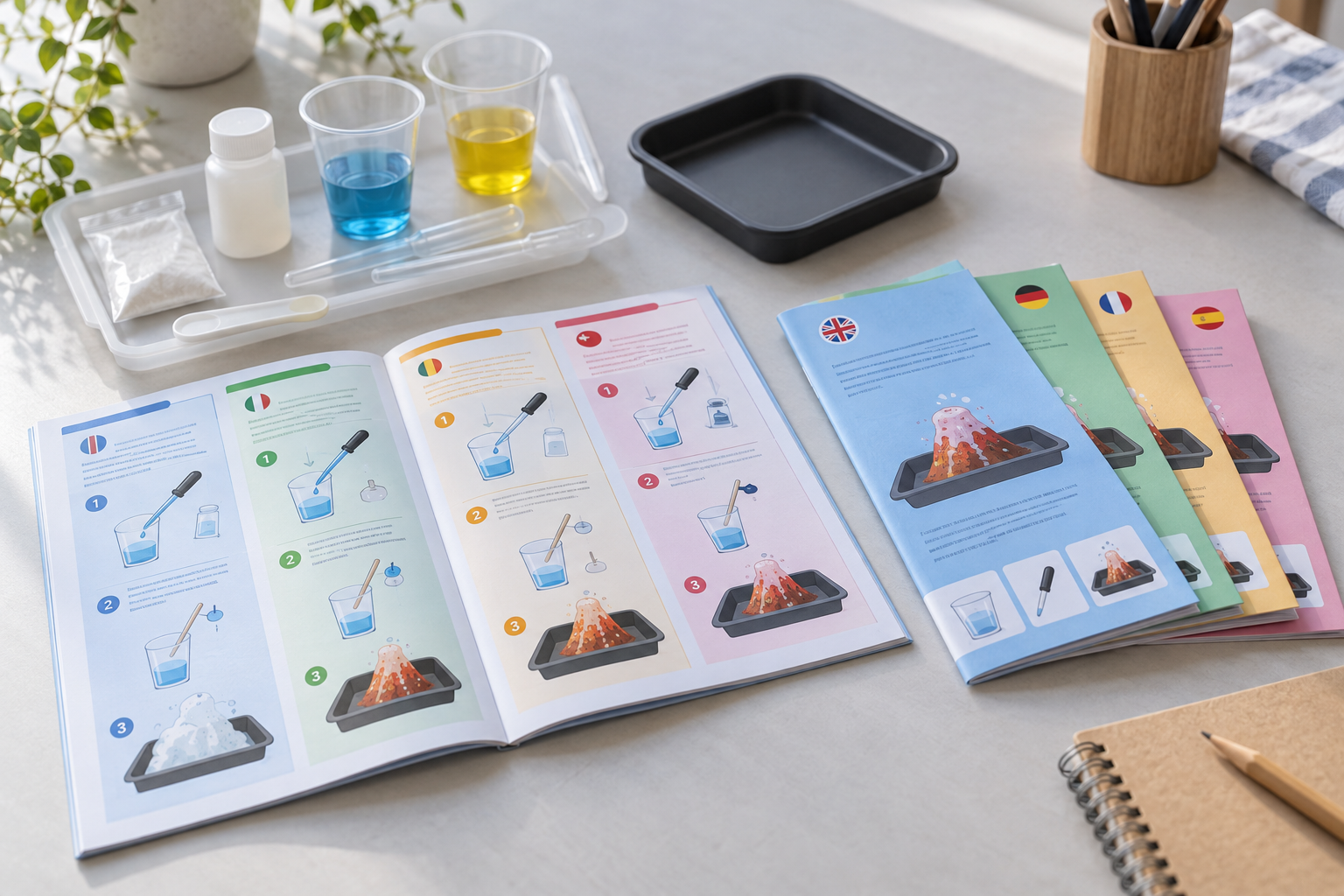
For a simple science kit with short, picture-led activities, one multilingual manual usually works well across several countries. For kits with longer experiments or detailed safety instructions, separate language manuals are often easier to use. There’s a middle option, too: one picture guide with an instruction insert for each market. The right choice also has to meet the language and labeling rules wherever the kit is sold.
Multilingual vs. Separate Manuals
| What matters | One multilingual manual | Separate manuals |
|---|---|---|
| Short, visual activities | One booklet can cover several markets | May suit retailers that want a single-language booklet |
| Long steps or safety warnings | More translations mean more pages | More room for each experiment and its diagrams |
| Small orders in each language | One edition to print and stock | Several print runs may leave spare copies |
| Large order in one language | Every box carries translations it won’t use | Each box gets only the language it needs |
| Packing and updates | Fewer versions, but a change can affect the whole booklet | More versions to check, but each can be updated on its own |
Before choosing, print the manual at its real size. Can someone find the right language, read the measurements, and finish an activity without flipping back and forth? If not, the layout needs work.
Start With the Experiments
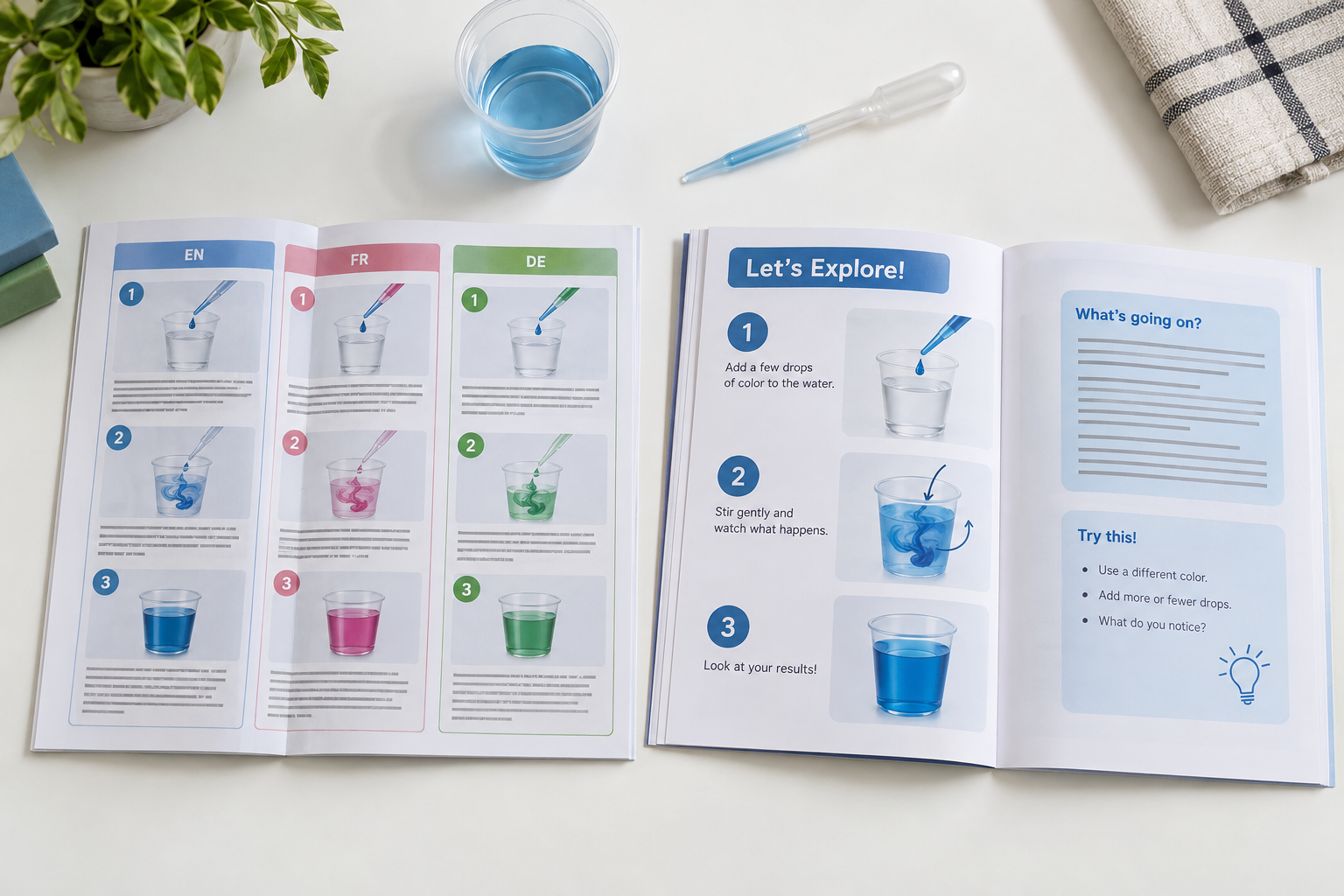
With a dinosaur dig kit, pictures can show most of the process: dig, brush, and identify the find. Short translations can sit beside the numbered pictures, along with any warnings the kit needs.
A crystal-growing kit is different. It may need exact amounts, waiting times, adult supervision, and cleanup instructions. Keep those steps together in each language. Don’t squeeze the warning text down just to fit another translation.
For an electronics kit, put the wiring diagram and polarity markings beside the step that uses them. If a multilingual layout separates the diagram from the instructions, give each language its own section or booklet.
Compare the Full Printing Cost
Here’s a simple calculation, not a printer quote. Say you’re ordering 1,000 identical kits: 250 for each of four language markets. Each language needs 8 pages, and no pages are shared.
- One multilingual edition: 1,000 booklets × 32 pages = 32,000 printed page-sides.
- Four separate editions: 4 languages × 250 booklets × 8 pages = 8,000 printed page-sides.
Those figures count printed page-sides, not press impressions or money. The multilingual version needs one edition; the separate option needs four. Ask the printer to price both using the same booklet size, paper, color, and binding. Include setup, proofs, minimum print runs, packing labor, leftover copies, and later reprints.
The printer’s minimum order for booklets isn’t necessarily the same as the finished private-label science kit MOQ. If the printer requires more than 250 copies of a language, add the unused manuals to the calculation. Then divide each total printing-and-packing quote by 1,000 kits to compare the cost per packed box.
Want to compare both printing options?
Send your kit quantities by country, required languages, page counts, and booklet size. Ask for a combined-manual quote and separate-language quotes, with packing costs listed.
Check What Each Country Requires
These toy safety rules apply when the science kit is legally classified as a toy. Laboratory or educational products outside that category may follow different rules.
European Union. Under Directive 2009/48/EC, toy instructions and safety information must be in languages accepted by the destination Member State. Warnings that affect a buying decision must be visible before purchase, including online. For chemical toys covered by Annex V, instructions must explain relevant hazards, precautions, and first aid for serious accidents. Specified age and adult-supervision warnings must appear on the packaging.[1]
The newer EU Toy Safety Regulation (EU) 2025/2509 generally applies from August 1, 2030, when the older directive is repealed. Some provisions have applied since January 1, 2026.[2]
Great Britain. Required information about toy hazards and how to avoid them must be in English and appear where the rules require it. Northern Ireland has different arrangements.[3]
United States. For children’s toys made on or after April 20, 2024, CPSC identifies ASTM F963-23 as the applicable edition under 16 CFR Part 1250. Testing, certificates, and warnings still depend on the toy and its hazards.[4]
Canada. On September 24, 2025, Health Canada recalled Clementoni Super Chemistry Lab kits because they lacked required bilingual chemical hazard labels and warnings. The company reported 98 affected units sold in Canada. Even a perfectly translated booklet wouldn’t make up for missing labels on the chemical containers.[5]
What About a Shared Picture Guide?
A hybrid setup can keep the illustrations the same while changing the written instructions for each market:
- Shared picture guide: real kit parts and numbered experiment drawings.
- Language insert: full steps, measurements, precautions, and troubleshooting.
- Market-specific packaging: required warnings and labels in the right language and location.
Give each translated step the same number as its picture. If users have to keep turning pages to find a drawing, repeat that drawing in the language section. A QR video is useful for showing an experiment, but don’t assume it can replace required instructions or safety information supplied with the kit.
Check the Printed Manual Against the Real Kit
- Original instructions: approve the steps against the final parts before translating anything.
- Translations: check every amount, unit, waiting time, warning, prohibited action, and storage or disposal instruction.
- Print sample: check page order, language labels, diagram numbers, and text size in the finished booklet.
- Artwork: record the approved SKU, market, language, and revision for each version.
- Packing line: remove old-language booklets before changing markets. Check the first packed box, then check again at final inspection.
Add the manual to the same science kit packing checklist as the tools and other parts. If the powder or liquid packaging changes, check that the material names, amounts, opening steps, and warnings still match what’s inside the box.
Check One Finished Box for Each Market
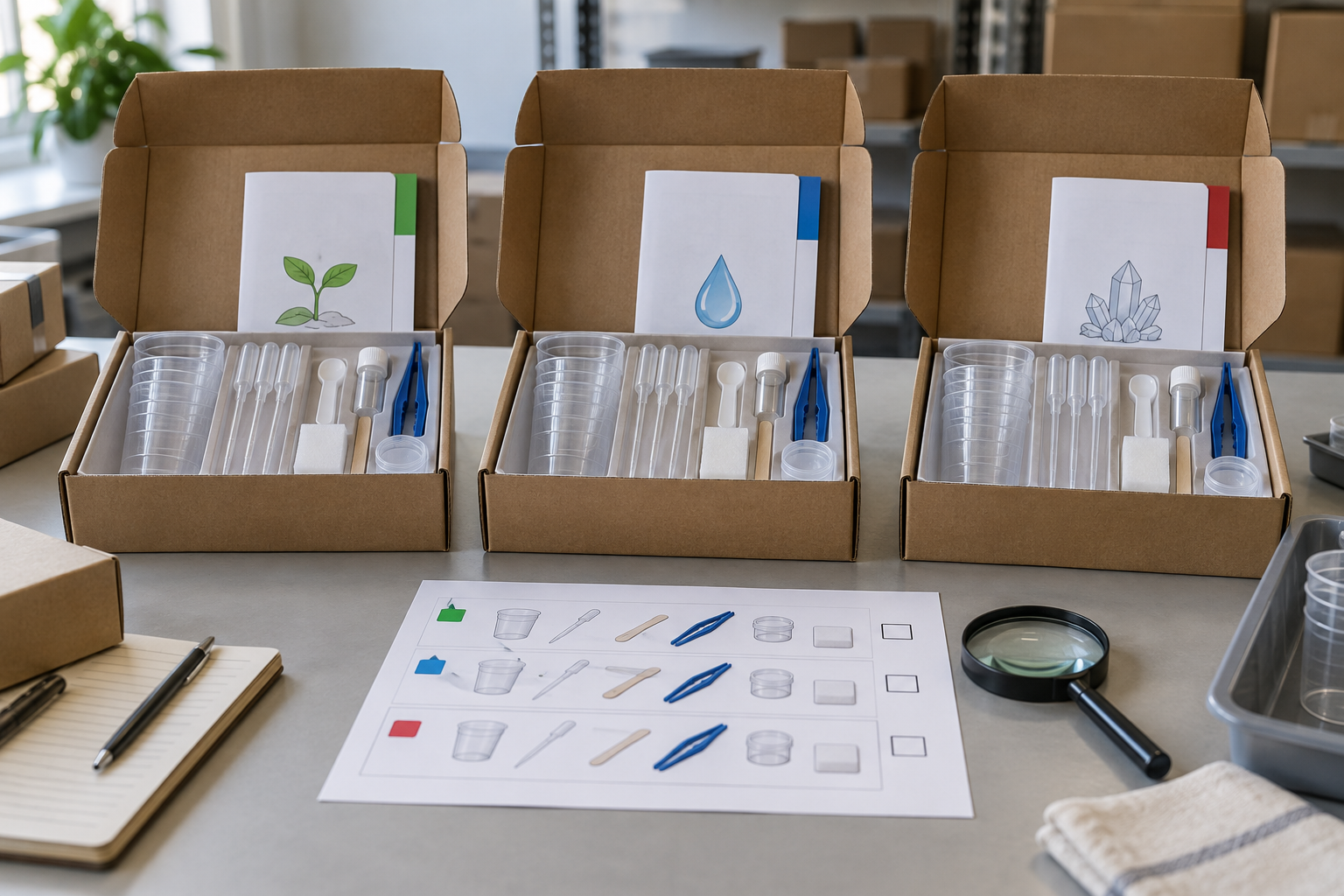
Before mass-producing a custom science kit, open a finished sample for each destination. Check the parts, manual version, box artwork, and required labels against the approved files. Sign off on the printed and packed sample, not just a PDF.
Need market-specific samples before production?
Share the approved manual files, component list, target countries, and packaging details to request booklet-version checks and packed-sample pricing.