
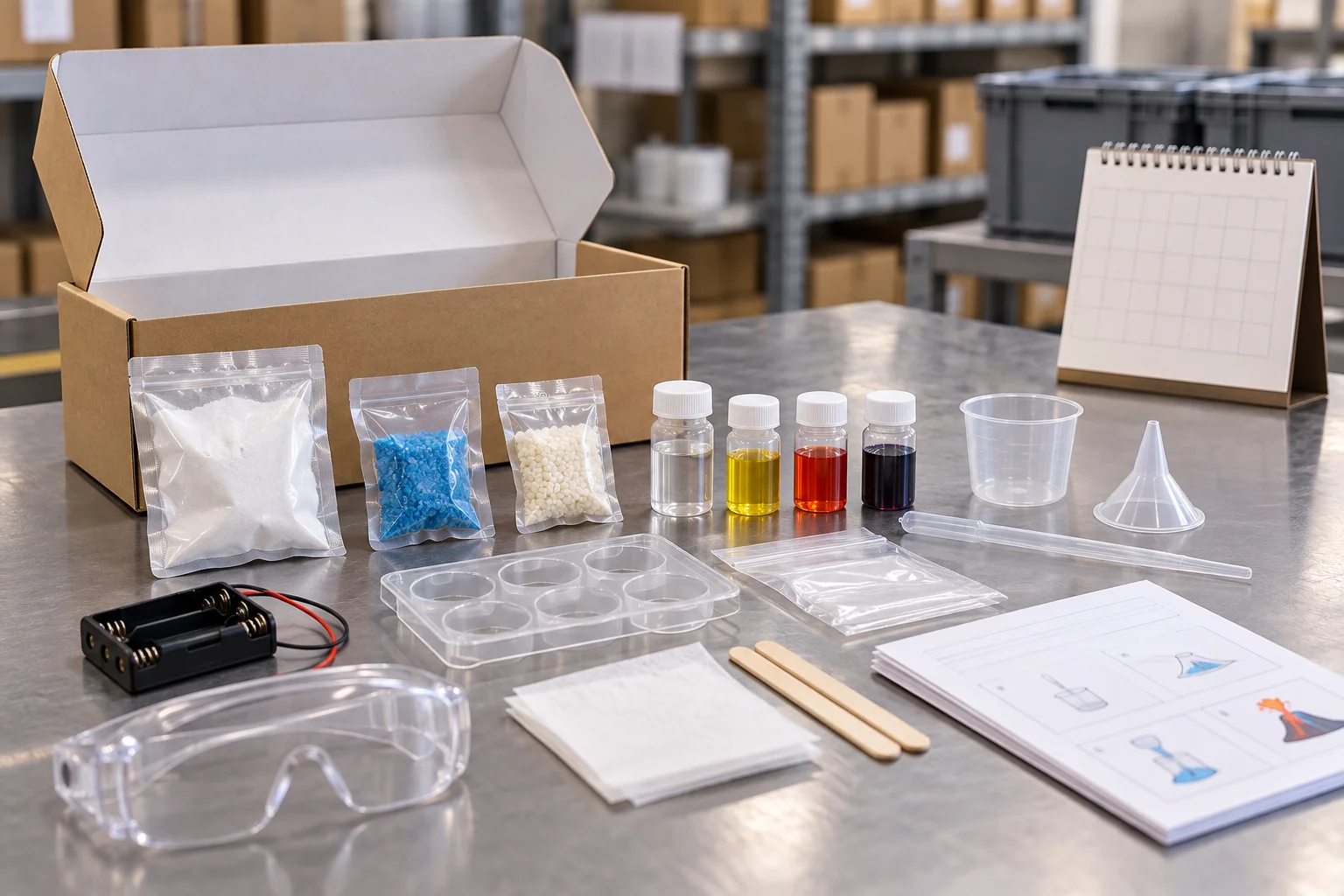
Science kits do not all age the same way. In most cases, the part with the shortest usable life sets the limit for the whole kit.
That is easy to miss. A plastic dropper or metal clip may still be fine years later, while a powder, liquid, adhesive, battery, or seed pack has already started to age.
For wholesale buyers, the useful number is not the original shelf-life claim. It is how much life is left when the goods reach you, and whether that is enough time to sell the stock.
Take a simple example. A consumable has a 24-month shelf life. It is already 4 months old when packed, and another 2 months pass before the shipment reaches your warehouse.
24 − 6 = 18 months remaining at receipt.
If your distribution and retail cycle takes another 8 months:
18 − 8 = 10 months of commercial buffer.
Use two calculations:
Remaining shelf life at receipt = declared shelf life − age of the limiting component at receipt
Commercial buffer = remaining shelf life at receipt − expected distribution and sell-through time
Which Parts Usually Set the Shelf Life?

The piece count does not tell you much. The materials do.
| Component | Main Risk | What to Check |
|---|---|---|
| Dry powder | Moisture, caking, seal failure | Production date, batch, sachet, storage |
| Liquid | Leakage, evaporation, separation, crystallization | Filling date, batch, bottle, closure, storage |
| Adhesive | Drying, thickening, separation | Production date, seal, supported usable period |
| Battery | Self-discharge, leakage, corrosion | Date code, supplier, storage, packing method |
| Seeds or biological materials | Reduced viability | Packing date and specified storage |
| Metal parts | Corrosion | Material, finish, moisture exposure |
| Plastic tools | Heat deformation, cracking, brittleness | Material specification and storage |
| Printed materials | Moisture, fading, physical damage | Print quality and package protection |
One failed liquid can make a 12-piece kit unusable even if the other 11 pieces are fine.
When comparing a wholesale science kit range, ask which component actually sets the finished kit’s shelf life.
If the answer is “24 months,” ask five things:
- Which component sets the 24 months?
- When was it produced or filled?
- What storage conditions apply?
- What supports the 24-month claim?
- How much life will still be left on the agreed shipment date?
Powders, Liquids, and Batteries Need Different Checks
Dry powders
Powder can go bad before the printed expiry date if moisture gets through the sachet.
Check the production or packing date, lot code, sachet material, heat seal, storage requirement, and reject criteria for open or damaged seals.
An order of 10,000 kits with 3 sachets per kit contains:
10,000 × 3 = 30,000 sachets.
At that volume, a repeatable seal problem can spread fast even when the powder itself is fine.
A quality-control checklist for educational toys should keep incoming-material checks, in-process packing checks, and final inspection separate.
Liquids
Liquids bring a different set of problems. They can leak, evaporate, separate, crystallize, become contaminated, or react with the container.
Check:
- approved formulation or material specification;
- filling date and batch number;
- bottle material;
- inner plug where used;
- cap or closure;
- fill level;
- storage conditions;
- secondary containment if a leak could damage the rest of the kit.
For hazardous chemicals covered by OSHA’s Hazard Communication Standard, Safety Data Sheet Section 7 covers handling and storage, while Section 10 covers stability and reactivity.[1]
An SDS does not tell you the shelf life of the finished science kit. It can still show useful storage, incompatibility, and stability information for the chemical.
Check the full package, not just the bottle:
liquid → bottle → plug → cap → protective packaging → tray → retail box → master carton.
Here is why. If one bottle leaks beside two instruction sheets, three paper packets, one experiment card, and the retail carton, it can damage 7 other pieces.
For products such as volcano experiment kits, the consumable and the packaging both have to survive storage and shipping for the activity to work.
Batteries
Batteries are easy to overlook because they may be much older than the finished kit.
If the batteries were made in January, the kits assembled in June, and the shipment received in September, the batteries are already about 8 months old when they reach your warehouse.
Check:
- battery type and size;
- approved supplier;
- manufacturing or date code;
- whether batteries are installed or packed separately;
- terminal and short-circuit protection where applicable;
- storage requirements;
- replacement availability in the destination market.
If batteries are optional, compare what changes in storage and shipping when you include them.
Check Component Dates and Lot Traceability
Production date, kit packing date, and expiry date are three different things.
Example:
Powder produced: March 1
Kit packed: June 15
Finished goods shipped: July 20
The powder was already more than three months old when it went into the kit. Packing it in June does not make it new again.
A finished kit may also pull parts from several suppliers:
- plastic tools from Supplier A;
- bottles from Supplier B;
- powder from Supplier C;
- batteries from Supplier D;
- printed materials from Supplier E.
That is 5 supply sources inside one SKU.
For shelf-life-sensitive parts, keep this trace:
finished-goods lot → packing date → component lot → component supplier.
That makes it much easier to isolate one bad powder, liquid, or battery batch instead of questioning the whole order.
The records should also show whether old and new component lots were mixed in one run.
K&M’s educational toy sourcing guide covers BOM control, approved samples, inspection, packaging, and shipment records in the wider OEM process.
Calculate Remaining Shelf Life Before You Set the Order Quantity
Shipping takes time. So does selling the stock.
| Component age when packed | 3 months |
| Factory holding + export handling | 1 month |
| Transport + customs + local delivery | 2 months |
| Component age at warehouse receipt | 6 months |
If the component has a 30-month declared shelf life:
30 − 6 = 24 months remaining at receipt.
Then look at how quickly you can move the stock.
If you order 12,000 kits and sell 2,000 per month:
12,000 ÷ 2,000 = 6 months of stock.
If sales drop to 750 per month:
12,000 ÷ 750 = 16 months of stock.
A batch arriving with only 14 months remaining does not fit a 16-month sell-through period.
Put this calculation next to the private-label science kit MOQ. A bigger MOQ may cut the unit price, but it can also leave you with stock that ages faster than you can sell it.
Set the minimum from your real timeline
| International transport | 2 months |
| Distributor storage | 3 months |
| Retail sell-through | 7 months |
| Buyer-defined safety buffer | 6 months |
| Required remaining life at shipment | 18 months |
2 + 3 + 7 + 6 = 18 months.
The 18 months here is only an example. It is not an industry standard.
Send K&M the kit type, consumables, order quantity, target market, delivery date, and required remaining shelf life. These details can be checked before MOQ and production timing are fixed.
Storage and Packaging Still Matter
A 24-month shelf-life claim means little if nobody tells you how the product must be stored.
Ask for written requirements covering:
- temperature;
- humidity sensitivity;
- direct sunlight;
- carton orientation where relevant;
- whether primary packaging must stay sealed;
- chemical incompatibilities where relevant;
- storage after opening where relevant.
An expiry date does not fix damaged packaging.
A component can show 18 months remaining and still be unusable because of:
- an open powder sachet;
- a cracked bottle;
- a loose cap;
- a punctured barrier bag;
- a leaking battery;
- water-damaged instructions.
Check expiry status and package condition separately.
Plastic deformation, metal corrosion, paper moisture damage, adhesive aging, and bottle compatibility should also be checked during educational toy material selection.
Inspect Mass Production, Not Just the Approval Sample
A golden sample does not prove that mass production matches it.
For a shelf-life-sensitive kit, inspection can cover:
- production and expiry dates;
- component lot codes;
- powder condition;
- sachet seals;
- liquid fill levels;
- leakage;
- bottle caps and plugs;
- battery date codes;
- instruction version;
- retail-pack condition;
- master-carton condition.
Pull samples from different cartons and pallet positions.
If inspectors access 10 cartons with 24 kits per carton, they can access 240 kits. That does not mean all 240 need destructive testing. Date, label, seal, component, and packaging checks can be spread across the agreed sample.
Set the sample size from the product risk, order size, inspection standard, and buyer specification.
For a new formula, closure, or package, finding a problem after 500 units leaves fewer finished units exposed than finding the same problem after 20,000 units. Those numbers are examples, not fixed pilot quantities.
Manage Expiry-Sensitive Stock by Expiry Date

FIFO sends the oldest received stock first. FEFO—First Expired, First Out—sends the stock with the earliest expiry first.
Example:
Batch A: 14 months remaining
Batch B: 20 months remaining
If Batch B goes out first, Batch A keeps aging.
Six months later:
Batch A: 8 months remaining
Batch B: 14 months remaining
For expiry-sensitive stock, record:
- batch number;
- receipt date;
- expiry date;
- available quantity;
- damaged or quarantined quantity.
Classroom kits may need two inventory cycles. Reusable cups, trays, droppers, magnifiers, and measuring tools can last much longer than powders, tablets, paper parts, or other consumables.
For classroom science kit and refill planning, track reusable hardware and consumables separately.
Compliance Files Must Match the Actual SKU
Shelf-life checks do not replace product-safety compliance.
For the U.S. market, CPSC states that toys designed or intended primarily for children 12 years old and younger are subject to applicable third-party testing and certification requirements. The federal toy safety standard uses the version of ASTM F963 incorporated into 16 CFR Part 1250; ASTM F963-23 applies to relevant toys manufactured on or after April 20, 2024.[2]
For children’s products manufactured overseas, the importer is responsible for issuing the Children’s Product Certificate based on passing test results from a CPSC-accepted third-party laboratory.[3]
Check that the compliance file matches:
- SKU and model;
- age grading;
- materials;
- relevant chemical formulations;
- batteries and accessories;
- warnings;
- actual production configuration.
If the powder, liquid, battery, plastic, coating, or another relevant component changes, an older compliance file may no longer cover the product.
EU orders
Regulation (EU) 2025/2509 on toy safety entered into force on January 1, 2026 and will start applying on August 1, 2030 after its transition period.[4]
For experimental sets for chemistry and related activities, Commission Implementing Decision (EU) 2026/2032 added EN 71-4:2020+A1:2025 to the harmonised standards list in September 2026. The previous EN 71-4:2020 reference is scheduled to be withdrawn on March 14, 2028.[5]
Before reusing an older test file, check that the SKU, formulation, materials, standard version, and current rules still match.
For a custom or private-label science kit, define the target age, destination market, BOM, consumables, packaging, and experiment format before production and testing are locked.
Put Shelf-Life Requirements in the PO
“Shelf life: 24 months” is not enough for a purchase order.
Define:
- which components are shelf-life-sensitive;
- declared shelf life for each relevant component;
- maximum component age at packing;
- minimum remaining shelf life at shipment or receipt;
- production-date format;
- expiry-date format;
- batch-code format;
- storage conditions;
- approved primary packaging;
- acceptance criteria for leaks, damaged seals, caking, corrosion, or other relevant failures.
Example:
“Time-sensitive consumables must have at least 18 months of supported remaining shelf life on the agreed shipment date.”
The 18-month figure is only an example. Set the real number from your transport, distribution, sell-through, and safety-buffer periods.
Questions to Ask Before Ordering
| Supplier Says | Ask Next |
|---|---|
| “The kit lasts three years.” | Which component sets the three-year period, and what supports it? |
| “We can print the expiry date you need.” | What data supports that date? |
| “The kit was packed this month.” | When were the shelf-life-sensitive components produced? |
| “The sample bottle did not leak.” | How do you check closure and leakage in mass production? |
| “One test report covers all models.” | Do this SKU’s materials, formulation, age grade, and configuration match the tested product? |
| “We do not use component lot codes.” | How would you trace a complaint back to the affected material? |
Pre-order checklist
- Identify every time-sensitive component.
- Find the component with the shortest supported life.
- Record production, filling, or packing dates for relevant consumables.
- Check what supports each shelf-life claim.
- Calculate component age at warehouse receipt.
- Calculate remaining shelf life at receipt.
- Subtract expected distribution and sell-through time.
- Set a minimum remaining-life requirement in the PO.
- Define storage and package-integrity requirements.
- Require lot traceability for relevant consumables.
- Inspect dates, seals, leaks, caking, corrosion, and batch codes before shipment.
- Check that compliance files match the actual SKU and destination market.
A kids’ science kit specification should also state the real consumable quantities and final instructions. A kit can seem to “run out early” because the manual gives the wrong quantity even when filling and shelf life are fine.
Final Answer
A science kit’s practical life is usually set by its shortest-life critical component.
First calculate remaining shelf life at receipt. Then subtract the time you expect to use for distribution and sell-through.
A 24-month component that is 6 months old at receipt has 18 months left. If your channel needs another 8 months, you still have a 10-month commercial buffer.
Put the required remaining life, component dates, lot traceability, storage, packaging, and inspection criteria in the PO before production starts.