
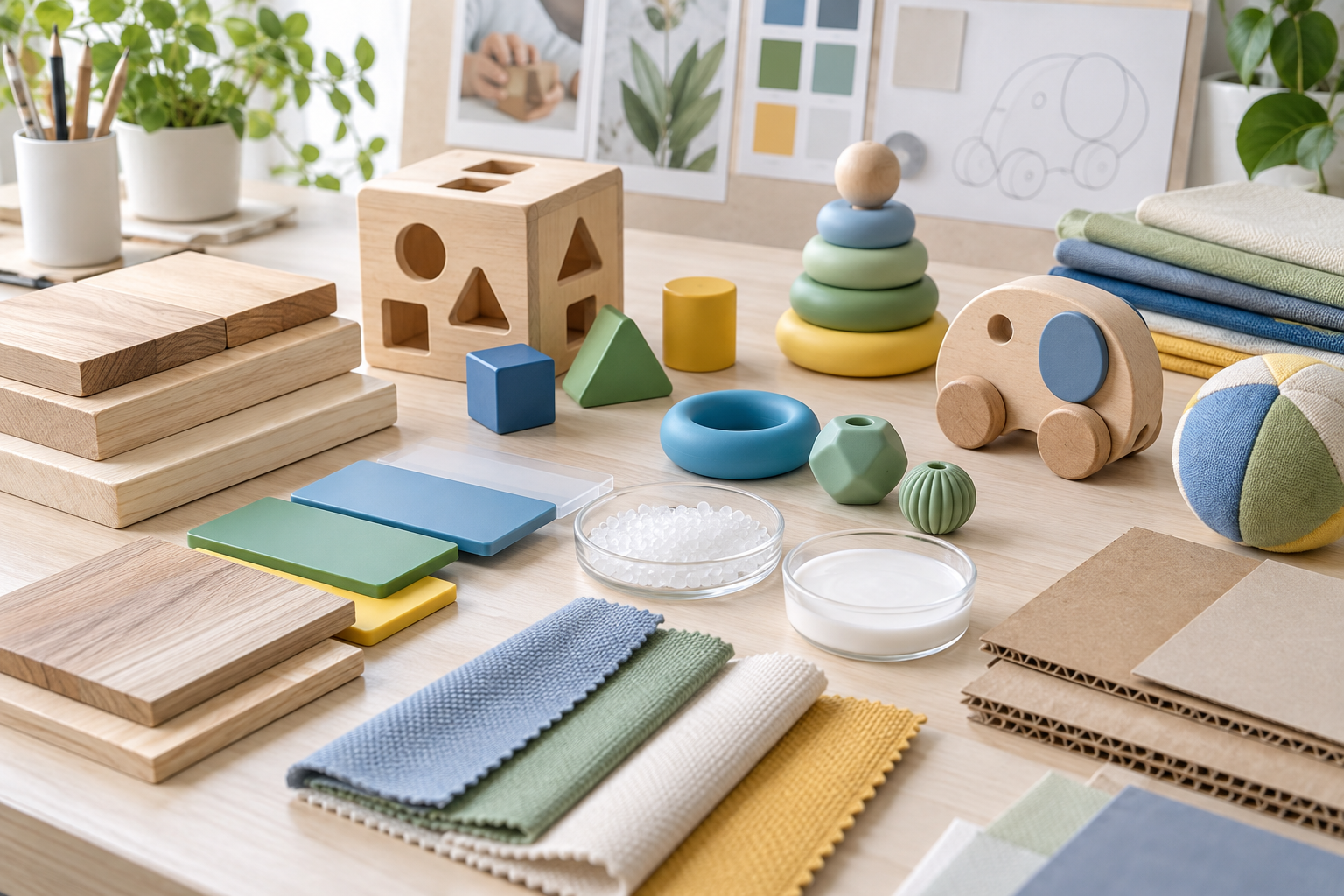
Start with the child, not the material. A toy for a two-year-old has very different needs from a STEM kit for an eight-year-old. For younger children, small parts, paint, mouthing, loose pieces, magnets, and soft materials matter most. For older children, fit, gears, wear, batteries, and repeated assembly become more important. Cost matters too, but raw material price is only one part of the final bill.
Age Changes the Risk
Babies grab, shake, drop, and mouth almost everything. Toddlers go further. They pull, twist, throw, bite, and try to take things apart.
For toys used by children under three, look closely at:
- small detachable parts;
- pieces that may break off;
- paint and coatings;
- soft-material tear strength;
- sharp edges and points;
- magnets;
- glued parts;
- cords and loops;
- saliva and cleaning exposure.
In the United States, the age mark on the box is not the only thing CPSC looks at. The agency also considers how the toy is designed, advertised, packaged, and normally understood by consumers.[1]
For children under three, prohibited small parts cannot be present or come loose during the applicable use-and-abuse tests.[2]
Once children reach roughly 3–6 years old, printing and surface wear start to matter more. Think about a number board. If the numbers rub off after regular cleaning, the board may still be intact, but it no longer works very well as a learning toy.
By ages 6–12, the product can be more complicated. Gears, screws, motors, magnets, batteries, and electronic parts are common in STEM and science kits. At that point, fit, wear, screw strength, friction, and repeated assembly deserve more attention.
For U.S. toys designed or intended mainly for children 12 and under, applicable requirements generally call for third-party testing by a CPSC-accepted laboratory. The domestic manufacturer or importer then issues the Children’s Product Certificate based on the required test results.[3]
Material Has to Match the Activity
| Toy Type | What Matters Most | What Can Go Wrong |
|---|---|---|
| Puzzle | Dimensional stability | Pieces become too tight or too loose. |
| Stacking toy | Weight and grip | Parts slide too easily or feel too heavy. |
| Fine-motor toy | Surface texture | Small fingers cannot grip knobs or sliders well. |
| Gear toy | Wear and fit | Gears become noisy, loose, or hard to turn. |
| Learning cards | Print and edge life | Words, numbers, or images wear away. |
| Sensory toy | Hardness and recovery | The part tears, stays deformed, or feels wrong. |
| Classroom toy | Cleaning and repeated use | Surfaces, joints, or printing wear out too soon. |
Classroom use is a good example. One toy may be handled by several groups of children every week. That changes what “durable enough” means. The same issue shows up in classroom science kits, where parts may be set up, cleaned, packed away, and reused again and again.
For high-use parts, it can be useful to record wear during cycle testing. A classroom mechanism might be checked at 100, 1,000, and 5,000 cycles. Those numbers are internal development examples, not legal limits.
List Every Material First
A wooden activity board is rarely just “wood.” It may contain plywood, three paint colors, ink, plastic gears, screws, elastic cord, and glue.
Write down every material and ask a few basic questions:
- Can the child touch it?
- Can it go into the mouth?
- Can it come loose?
- Does it have a coating?
- Does it hold another part in place?
- What happens if it breaks?
For critical dimensions such as puzzle openings, snap fits, or gear spacing, one sample is not enough. Measuring 5–10 pieces during T1 and again during production gives a much clearer view of variation.
Wood
Wood is common in blocks, puzzles, shape sorters, counting toys, and stacking toys. The main trouble spots are moisture, knots, cracks, rough grain, coatings, and joints.
Beech is often used for blocks, pegs, and puzzle pieces because it is relatively hard and has a fine grain.
Pine is softer and easier to dent. Knots also need closer inspection.
Basswood is light and easy to machine. That is useful for some parts, although thin pieces that take a lot of impact may need something stronger.
Harder wood is not always the better choice. It can add weight and machining cost without helping the toy much.
Wood also moves as moisture changes. USDA’s Forest Products Laboratory explains that moisture affects wood dimensions and that drying, storage, and handling all matter.[4]
This becomes obvious with puzzles. A piece can fit nicely at the factory and later become tight or loose after shipment if the wood changes size.
There is no single moisture number that works for every wooden toy. Species, factory conditions, destination climate, and storage all play a part.
Plywood and MDF
Plywood works well for flat parts such as puzzle boards, activity panels, and dollhouses.
Look at the cut edge. Internal gaps, broken veneer, rough layers, or weak bonding are easy to spot there.
Moisture can expose poor bonding quickly. If a board will be wiped often, test actual finished pieces after repeated cleaning.
MDF gives a smooth painted surface and machines easily, but its edges can swell when they absorb moisture. Thin MDF can also chip after impact. For a toy that will be washed often, it may not be the best choice.
ABS
ABS is widely used for rigid molded parts. Housings, snap fits, and construction pieces are common examples.
Fit depends on more than the resin name. Mold accuracy, wall thickness, gate position, cooling, and processing all affect the final part.
Changing ABS grade can change shrinkage. That can be enough to make a snap fit too loose or too tight.
Screw bosses, snap hooks, thin corners, and sudden wall-thickness changes are common crack points. A good resin cannot fix a poor part design.
For a snap-fit toy, record how the connection feels at the start and again after repeated use. Checking the 100th, 500th, and 1,000th cycle can show whether the fit is changing too quickly.
PP and PE
PP is useful for lids, flexible connectors, lightweight parts, and living hinges.
A living hinge needs the right thickness and radius. Too thick, and it can feel stiff. Too thin, and it may tear.
For a part that opens and closes often, cycle testing at 500, 1,000, and 5,000 cycles can reveal early cracking or stiffness.
PE is often used where toughness and moisture resistance matter. HDPE is generally stiffer, while LDPE is softer.
Printing and gluing can be harder on PE, so decoration needs to be tested on the actual finished surface instead of assuming the ink or adhesive will hold.
POM
POM makes sense for gears, shafts, sliders, and other moving parts where low friction and wear resistance matter.
It is usually better used only where those properties are needed. A STEM gear toy might use ABS for the housing, POM for the gears, and metal for the axle.
For a classroom gear set, watch for tooth wear, noise, looseness, and rising friction during repeated-use testing.
EVA Foam
EVA foam is common in alphabet mats, foam puzzles, bath-learning pieces, and soft building toys.
Thickness is only one part of the picture. Density, tear strength, compression recovery, odor, print adhesion, and edge quality matter too.
Thin letters and narrow interlocking tabs usually fail first. A very soft foam can feel nice in the hand but may tear sooner.
For floor mats, measure several pieces before and after storage or compression. If the tabs change shape or the pieces stop lying flat, the problem will show up quickly.
TPE and Silicone
TPE and silicone are used for soft grips, sensory surfaces, flexible buttons, and other soft parts.
Check hardness, tear strength, compression recovery, tackiness, odor, bonding, and cleaning resistance.
Very soft material may tear or stay deformed. Very hard material can feel uncomfortable or give poor grip.
With overmolded TPE, the soft material itself may be fine while the bond underneath starts peeling. Pulling, twisting, and cleaning tests can expose that problem.
“Food-grade silicone” is not enough as a toy specification. The buyer still needs the actual grade, pigment, hardness, supplier, and test coverage.
A report for clear silicone does not automatically cover every colored version.

PVC and Recycled Plastic
PVC may appear in soft parts, vinyl items, and inflatable products. The exact formulation matters because flexible PVC can contain plasticizers.
In the United States, applicable children’s toys and child-care articles cannot contain more than 0.1% (1,000 ppm) of any regulated phthalate in an accessible component part.[5]
Recycled plastic can work, but its source and consistency need tighter control. Check the resin grade, recycled percentage, odor, color variation, contamination risk, impact consistency, and batch traceability.
A simple cost example shows why this matters. Suppose Resin A is 5% cheaper but raises the reject rate from 1% to 6%. Once scrap, machine time, sorting, and rework are added, the “cheaper” resin may cost more per usable part.
Fabric and Paperboard
For soft books, puppets, learning mats, and sensory panels, fabric strength is only part of the story.
Pull on handles, loops, pockets, labels, and decorations. Weak stitching can release a part even when the fabric itself is fine.
If the item is washable, check shrinkage, color transfer, seam damage, printing, and movement of the filling.
Paperboard toys need good edges, coating, print life, and moisture resistance. A flash card for a three-year-old may see saliva and frequent wiping. A card game for an older child may face more shuffling and surface wear.
For internal cleaning tests, 20–50 wipe cycles can be enough to show obvious problems on many home-use products. Classroom products may need 100 or more wipes if frequent cleaning is expected.
Metal, Magnets, and Batteries
Metal parts include screws, axles, springs, pins, and brackets. Look for burrs, exposed ends, corrosion, and weak surrounding material.
A steel axle may be safely hidden when the toy is new. If the plastic around it cracks after a drop, the same axle can become an exposed point.
Magnets need even tighter control. A small magnet that comes loose can be dangerous if swallowed.
Check the magnet pocket, surrounding wall, adhesive, and mechanical retention. A pocket or enclosure is better than relying on glue alone.
Battery doors need the same kind of attention. Check whether the latch cracks, the screw boss strips, or the door opens after impact.
CPSC states that button-cell and coin-battery products generally have battery-accessibility requirements. Toys designed, manufactured, or marketed for children under 14 have a statutory exemption from 16 CFR part 1263 when they meet the battery-accessibility and labeling requirements of the mandatory toy standard.[6]
These checks are also part of component planning for a kids’ science kit.
Paint, Ink, and Glue
“Water-based paint” is not enough information for production control.
A usable coating specification should identify:
- supplier;
- product code;
- color formulation;
- application method;
- curing conditions;
- adhesion requirement;
- abrasion requirement.
Check corners and edges after rubbing, cleaning, and impact. Coating damage often starts there.
Different colors can use different pigments, so one color report does not always cover the rest.
For printed numbers, measuring scales, letters, or diagrams, rubbing and wiping tests matter because the print is part of the toy’s function.
Glue can cause a bigger problem than it first appears. A weak joint may release a wooden peg, fabric part, magnet, or decoration. For bath toys, test after water exposure. For products stored or shipped in hot conditions, include heat conditioning where it makes sense.
What Happens When It Breaks
| Failure | What Happens | What to Watch |
|---|---|---|
| Bend | The part changes shape but stays in one piece. | Loss of fit or function. |
| Crack | A crack forms. | Sharp areas or later breakage. |
| Fragment | Pieces break away. | Small parts or sharp fragments. |
| Detach | The whole part comes loose. | Magnets, batteries, hardware, or small parts become accessible. |
Production-style samples should be dropped, pulled, twisted, bent, and cycled in ways that match real use.
A simple early check might use 10–20 repeated drops to find weak corners, screw bosses, battery doors, glued parts, or magnet housings before formal testing.
After the drop, look for cracks, sharp edges, loose pieces, exposed screws, loose magnets, and opened battery compartments.
For moving parts, look for looseness, stress whitening, worn gears, cracked hinges, and fading print.
Set the pass/fail rules before the test starts. “Looks okay” is not a useful standard.
Cleaning and Outdoor Use
The cleaning method changes what materials will work.
- dry cloth;
- damp cloth;
- soap and water;
- hand wash;
- machine wash;
- full immersion.
Wood can swell. Paperboard can separate. Ink can fade. Fabric can shrink. Adhesive can weaken.
For home-use products, 20–50 cleaning cycles can show obvious coating, ink, glue, or fabric problems. A classroom product may need 100 or more cycles if it will be wiped every day.
Outdoor products bring another set of problems: UV, rain, temperature swings, corrosion, fading, and water entry. PP or PE used outdoors may need a UV-stabilized grade.
Chemical Safety
“Non-toxic” is too vague for a purchase specification.
For U.S. children’s products, accessible components generally must not contain more than 100 ppm total lead. Paint and similar surface coatings must not contain more than 90 ppm lead.[7]
ISO 8124-3:2020 covers migration of certain elements from toy materials including coatings, polymers, paper, textiles, metals, and wood. ISO lists the 2020 edition as current and confirmed, although a replacement edition is being developed.[8]
ISO 8124-3:2020/Amd 1:2023 adds requirements dealing with boron and other elements in slime and barium in modelling clay.[9]
Use the rules that apply in the country where the toy will be sold. A raw-material report does not cover every paint, pigment, glue, or finished component automatically.
Material approval for U.S. and EU projects should match the same ASTM F963, EN 71, and document requirements used in the U.S. and EU toy safety compliance process.
Check the Test Report
Look past the word “PASS.”
- Does the product name match?
- Does the sample description match?
- Are the right colors included?
- Is the test date current enough for the project?
- Is the correct standard version listed?
- Which components were tested?
- Which test items were actually performed?
A report for clear, uncolored ABS does not prove that a finished toy with five colors, glue, metal, paint, and printing meets every applicable requirement.
If the supplier sends a report for a “similar” product, compare the resin grade, pigment, coating, component structure, supplier, and destination market.
Compliance, Durability, and QC Are Different
| Check | Question It Answers |
|---|---|
| Compliance testing | Does the toy meet the applicable safety rules? |
| Durability testing | Will it still work after repeated use? |
| Production inspection | Does the production batch match the approved product? |
A lab report does not confirm every production unit has the right dimensions, printing, assembly, or packaging. Factory inspection cannot replace required laboratory testing either.
Total Cost Matters More Than Resin Price
Total cost = material + tooling + processing + labor + scrap + finishing + assembly + testing + packaging + freight
| Example Order | What Starts to Matter |
|---|---|
| 2,000 units | High tooling cost may be hard to spread across the order. |
| 20,000 units | Tooling, labor, cycle time, and scrap all matter more. |
| 100,000 units | Automation, yield, cycle time, and assembly efficiency can strongly affect unit cost. |
Injection molding usually needs more money upfront for tooling, but it can cut labor at higher volumes. Wood and paperboard may need less tooling but more cutting, sanding, painting, printing, drying, or assembly.
Secondary work adds up too. Painting, pad printing, UV printing, overmolding, sewing, polishing, and ultrasonic welding can all change the real cost.
If Material A is 5% cheaper but pushes rejects from 1% to 6%, the saving can disappear after scrap and rework.
Freight Can Change the Answer
Suppose one version weighs 300 g and another weighs 500 g. That is only 200 g more per toy, but across 10,000 units it adds about 2,000 kg before cartons and protective packaging are counted.
Order size can also be limited by one small component. A factory may be able to assemble 500 toys, while a custom masterbatch, fabric, molded part, or printed box needs a much larger supplier run. That is why component-level MOQ often affects the final MOQ.
U.S. Requirements
ASTM F963-23 is incorporated into the U.S. mandatory toy-safety rule through 16 CFR part 1250. CPSC states that ASTM F963-23 applies to covered children’s toys manufactured on or after April 20, 2024.[10]
Depending on the toy, the rule can cover small parts, sharp edges, mechanical hazards, chemical requirements, batteries, and other product-specific risks.
Instead of asking a supplier, “Do you have ASTM?”, ask which product was tested, which ASTM F963 version was used, which sections were tested, and whether the tested configuration matches your order.
EU Requirements
Regulation (EU) 2025/2509 entered into force on January 1, 2026 and applies from August 1, 2030. Toys placed on the market in line with Directive 2009/48/EC before August 1, 2030 can continue to be made available under the transition rules.[11]
The Regulation covers toys designed or intended for play by children under 14 and includes safety and chemical requirements.[12]
If the same toy will be sold in the U.S. and EU, tell the laboratory before the final material is approved. Adding a new market after tooling can mean extra testing, labels, documents, or chemical review.
Lock the Material Before Production
“Material: ABS” is too vague for production control.
A toy product specification sheet should identify the material clearly enough that purchasing, production, and QC are working from the same information.
For plastic parts, that can include:
- polymer type;
- approved resin grade;
- approved source;
- color or masterbatch;
- virgin or recycled-content rule;
- important mechanical requirements;
- change-control rules.
For wood, record species, thickness, moisture requirement, defect limits, finish, and coating.
For fabric, record fiber composition, construction, weight, shrinkage, color, and seam requirements.
For TPE or silicone, record grade, hardness, color, tear requirements, and bonding requirements.
If the drawing says “or equivalent,” spell out what equivalent means. Two materials with the same generic name may behave very differently in molding or use.
The BOM should list hidden materials too. “Body – plastic” is not enough. Resin grade, masterbatch, adhesive, magnet, and soft overmold should be listed separately where they matter.
A golden sample is useful for appearance and workmanship, but it cannot show whether an internal resin, pigment, glue, or magnet has changed.
The BOM, approved sample, test report, and inspection criteria should all use the same revision throughout the educational toy sourcing process.
Supplier Answers That Need Checking
“All our materials are non-toxic.”
Ask for the actual material grade and supporting documents.
“We use toy-grade plastic.”
Ask which resin, which grade, and which supplier.
“It is the same material we use for other toys.”
Check whether that material actually matches your design and market.
“The pigment supplier sometimes changes.”
Ask whether color or formulation changes need approval.
“Recycled content depends on availability.”
Ask how source, percentage, performance, and traceability are controlled.
“We will provide the test report after production.”
Material and test-scope questions should be settled before a large production run.
Quick Material Comparison
| Product | Starting Materials | Main Checks |
|---|---|---|
| Wooden puzzle | Solid wood, plywood | Moisture, coating, edges, fit, small parts |
| Building toy | ABS, PP | Fit, impact, fatigue, dimensions |
| Sensory toy | Silicone, TPE | Hardness, tearing, bonding, cleaning |
| Learning cards | Paperboard | Edges, bending, print life, coating |
| Soft book | Fabric | Seams, filling, washing, attachments |
| Mechanical STEM toy | ABS, POM, metal | Gear fit, wear, axle retention, impact |
| Foam alphabet mat | EVA foam | Density, tearing, odor, fit, compression |
| Outdoor learning toy | HDPE, PP, coated metal | UV, moisture, temperature, corrosion |
Three Real-World Choices
Shape sorter for ages 2+: A wooden body can feel solid, while plywood may work well for the flat board. Check the paint, edges, size of loose pieces, moisture movement, drop behavior, and fit. There is no reason the board and the shapes must use the same material.
STEM gear toy for ages 7+: ABS may suit the housing, POM the gears, and metal the axle. Check gear fit, wear, axle retention, and housing cracks. A 1,000-cycle check may catch early wear. A classroom version may justify testing to 5,000 cycles.
Soft sensory toy: Compare TPE and silicone for hardness, tear strength, recovery, surface feel, cleaning, and bonding. The softest sample is not always the one that lasts longest.
Final Checklist
| Area | Check |
|---|---|
| Child | Age, mouthing, grip, rough use, play environment |
| Learning function | Fit, friction, weight, movement, print life |
| Safety | Small parts, sharp areas, magnets, batteries, chemicals, coatings |
| Durability | Drops, pulling, bending, repeated use, cleaning, abrasion |
| Production | Tooling, processing, labor, assembly, scrap, material availability |
| Cost | Material, tooling, finishing, testing, packaging, freight |
| Compliance | Target market, age grade, test scope, traceability, change control |
Conclusion
Material choice should end with the finished toy, not the resin name on a data sheet. For young children, focus first on small parts, coatings, tear strength, magnets, and anything that can come loose. For STEM products, watch fit, gear wear, battery access, and repeated assembly. U.S. limits include 100 ppm total lead for accessible components, 90 ppm for paint and similar coatings, and 0.1% for regulated phthalates in applicable parts. A cheaper material is not cheaper if rejects rise from 1% to 6% or if an extra 200 g per toy adds about 2,000 kg across 10,000 units. Test the real part, then lock the grade, color, coating, supplier, and BOM before mass production.