
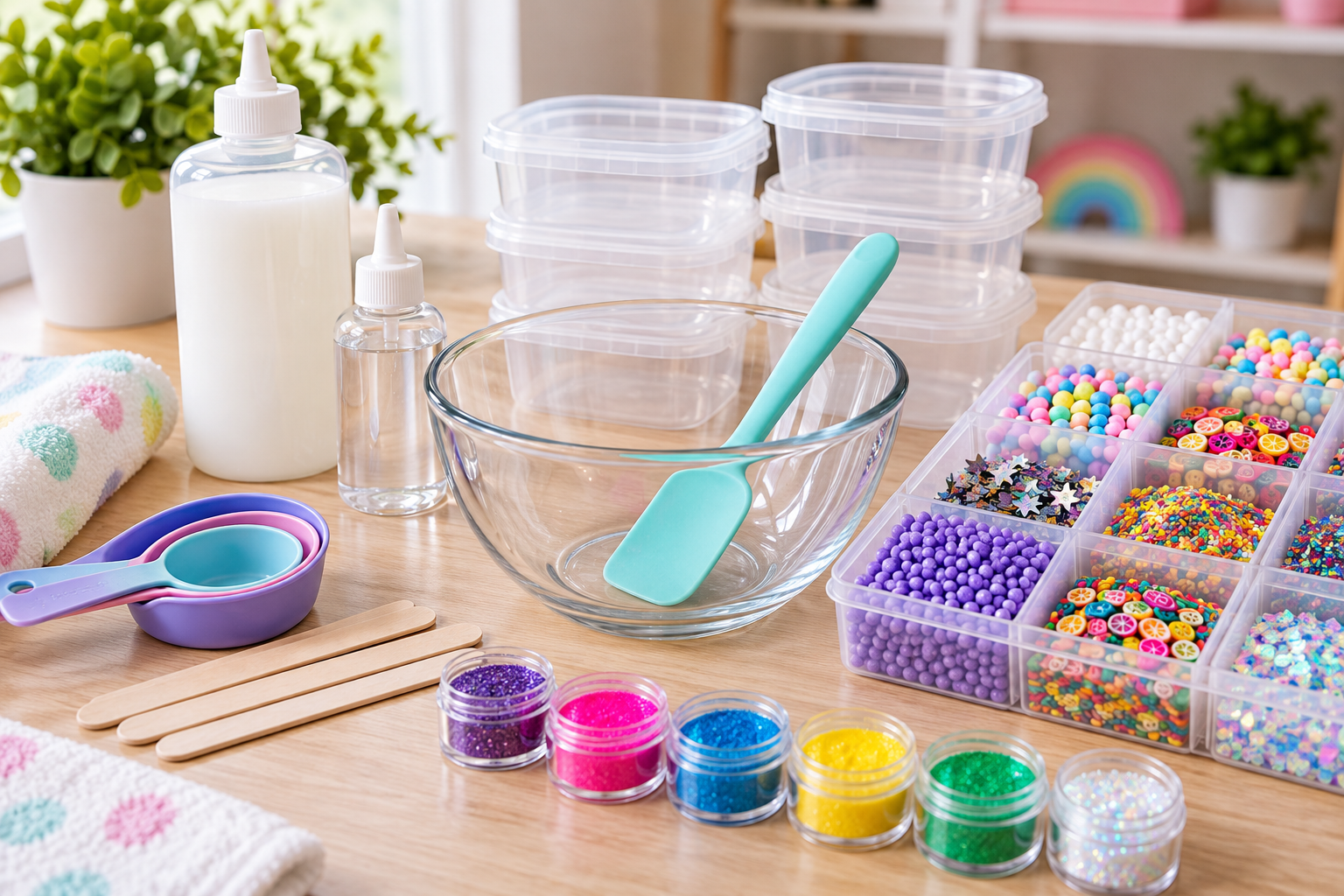
Buying a slime kit looks easy until you compare a few boxes. One says “100 pieces.” Another says “borax-free.” A third comes with dozens of colors and tiny charms. None of those claims tells you, on its own, whether the kit is actually a good fit for a child.
Start with the basics: Is the slime ready-made or DIY? What is in the activator? What age is the kit made for? Are there small parts? How much usable slime is inside? Can it be stored after play?
Ready-made slime is the simpler option. DIY kits add measuring and mixing. Powders, liquid colors, beads, charms, and separate activators add more things to handle and more things to clean up.
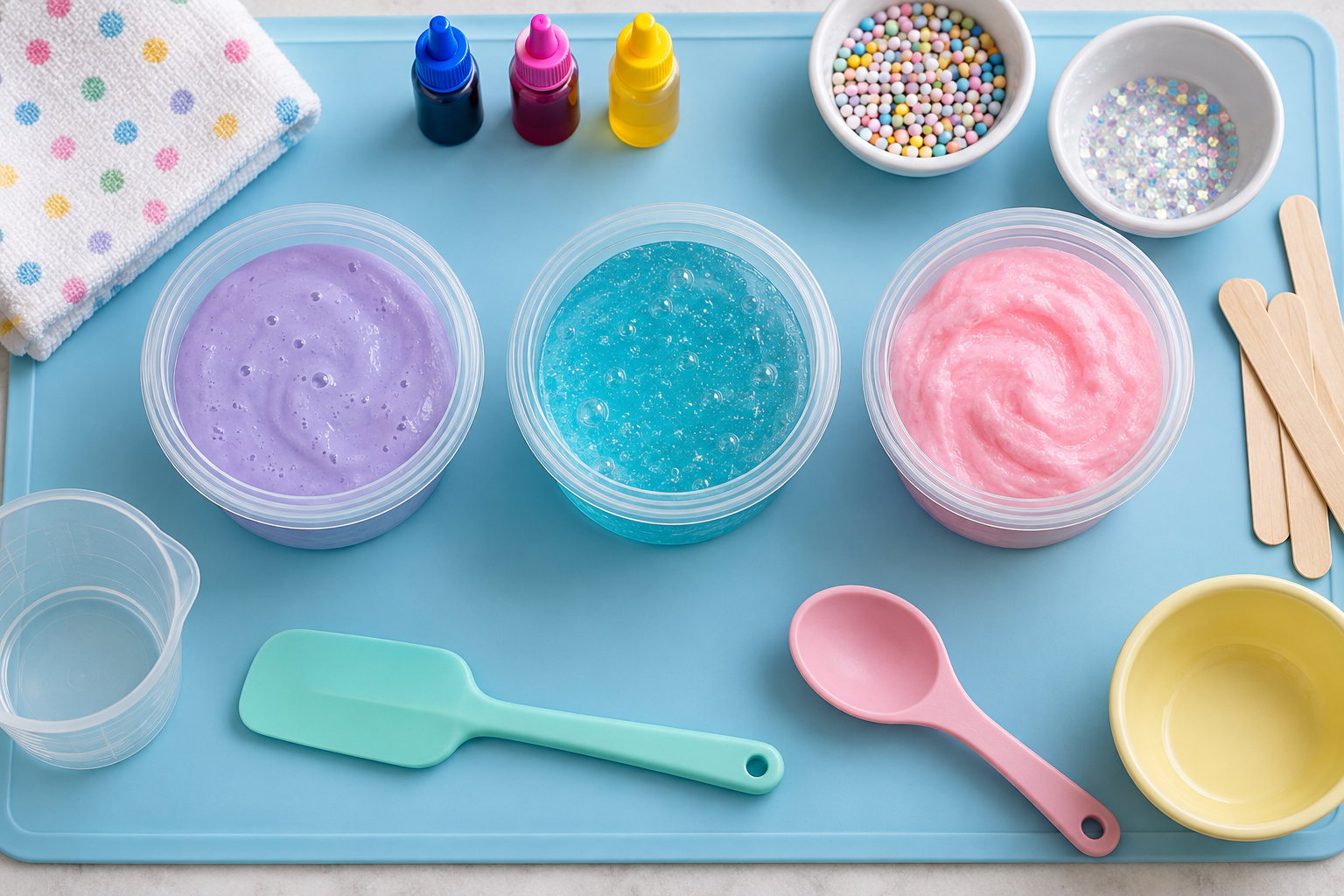
Types of Slime Kits
| Type | What the Child Does | What to Check |
|---|---|---|
| Ready-made slime | Stretches, shapes, or decorates finished slime | Ingredients, texture, accessories, and storage |
| DIY slime | Mixes a base with an activator | Activator, measurements, labels, and instructions |
| Texture slime | Adds clay, foam beads, artificial snow, or similar materials | Extra ingredients, loose materials, and cleanup |
| Decorative slime | Adds glitter, charms, confetti, or color | Small parts, staining, and accessory quantity |
| Experiment-style slime | Changes a variable and compares the result | Whether the activity includes real measurement and observation |
The same rule works when comparing other educational toys and craft kits: look at what the child can actually make or do, not just how many pieces are listed on the box.
Ready-Made Slime vs DIY Slime
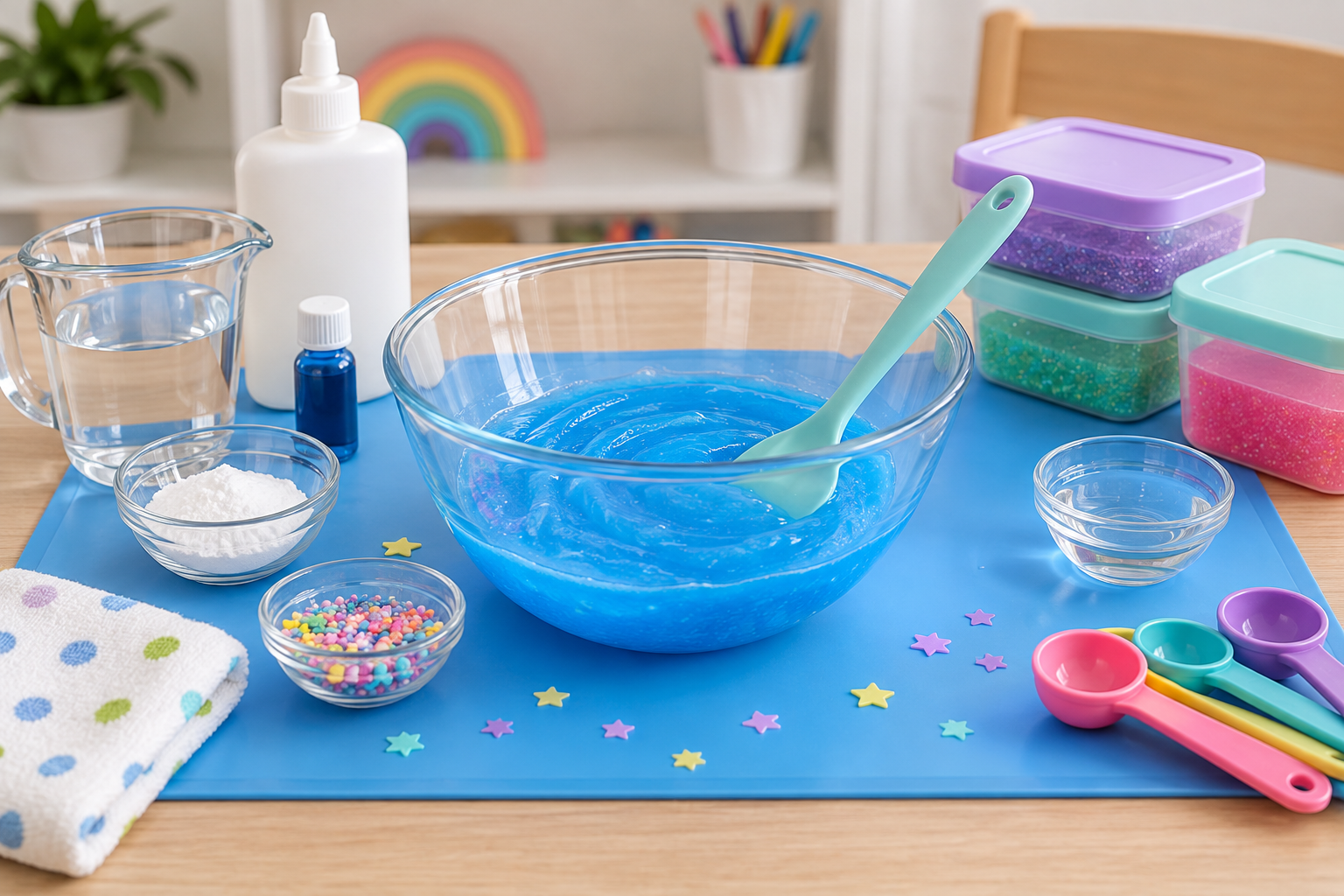
Ready-made slime is exactly what it sounds like. Open the tub and start playing. The child may add charms, color, or other decorations, but there is no base-and-activator step.
DIY slime is more hands-on. The child mixes separate materials to make the slime. That also means the kit needs better instructions. The base, activator, color, and additives should be easy to identify, and the order of use should be clear.
If the fun is in making the slime, DIY makes sense. If the goal is simply stretching, squeezing, and decorating it, ready-made slime is easier.
DIY slime can also become a real science activity. The child might change one measured ingredient, make two samples, and compare the result. That is the same basic idea behind a useful science kit: change something on purpose, then see what happens.
Building a custom slime kit?
Send K&M the target age, sales market, slime format, and planned components. It is easier to fix the kit structure before the packaging and samples are already made.
What Is Inside a Slime Kit?
A slime kit may include:
- finished slime or slime base;
- activator;
- colorants;
- fragrance;
- clay;
- foam beads;
- artificial snow or other texture materials;
- glitter or confetti;
- plastic charms;
- mixing or measuring tools;
- storage containers.
When you compare two kits, split those contents into three groups: materials that make the slime, reusable tools and containers, and decorative extras.
That matters because a packet of glitter and a complete slime portion are both technically “one piece,” but they clearly do not offer the same amount of play.
Slime Base
DIY slime may start with water-based glue, a prepared liquid base, or a powder system made for that particular kit.
Whatever the formula, each bottle or packet should say what it is. “Base,” “Activator,” and “Color” are much more useful than cute names when several little bottles look almost identical.
For manufacturers, material choices also affect testing and production. A cheaper material is not automatically a better choice if it changes the feel, strength, age suitability, or compliance needs of the finished product. K&M’s educational toy material guide explains this in more detail.
Slime Activator
The activator is what turns the base into the stretchy material people recognize as slime.
Health Canada advises against homemade children’s slime recipes that contain boric acid. It also advises avoiding borax and contact lens solution when making homemade slime for children.[1]
This is why the phrase “borax-free” does not tell the whole story. You still need to know what the activator actually is.
The instructions matter too. “Add until it feels right” may sound simple, but it leaves a child guessing. A better kit gives a quantity or tells the user to add the activator in controlled steps.
Colorants
Bright colors make slime more fun, but concentrated dyes can stain hands, clothes, carpet, unfinished wood, and other porous surfaces.
If the kit supplies separate bottles of color, the instructions should say how much to use. Otherwise it is very easy for a child to squeeze in far more than needed.
Also, keep color count separate from slime quantity. Ten colors do not mean ten slime batches if there is only enough base for a few portions.
Fragrance
Scented slime often copies familiar smells such as strawberry, cola, candy, or cake. That can make the product more appealing, but it can also make it seem more food-like.
A slime that smells like candy is still slime. It should not be treated as something edible unless it is specifically manufactured and labeled for consumption.
If fragrance is included, the product information should make that clear instead of hiding it behind a flavor-style name.
Clay, Foam Beads, Artificial Snow, and Other Textures
Texture ingredients change how slime feels in the hand.
Clay can make it firmer and change how it stretches. Foam beads create a rougher, crunchier feel. Artificial snow and other absorbent materials can change the texture after they take up liquid.
Loose powders should come with a clear amount or mixing method. A child should not have to guess how much to pour into the bowl.
Glitter, beads, charms, and confetti are decorative extras. They may improve the activity, but they should not be counted as if each one were a separate slime project.
What Does “Non-Toxic” Mean?
“Non-toxic” is useful information, but it does not mean edible, suitable for every age, or completely risk-free under every type of use.
In the United States, products that meet the legal definition of an art material under the Labeling of Hazardous Art Materials Act must go through a toxicological assessment for chronic hazards at least every five years. Applicable art materials also carry wording such as “Conforms to ASTM D-4236.”[2]
ASTM D-4236 deals with chronic-hazard review and labeling for art materials. It does not mean the product is edible or that nothing can go wrong if it is misused.
Whether a particular slime product falls under art-material rules depends on how the product is represented and sold.
Age Grading
The age printed on a slime kit is not just a suggestion about whether the activity will be interesting. It can affect warnings, small-part requirements, expected use, and applicable safety rules.
For the U.S. market, children’s toys intended primarily for children aged 12 or younger must be certified in a Children’s Product Certificate for applicable children’s product safety requirements. CPSC requires third-party testing for provisions that specifically require it; not every section of ASTM F963 needs laboratory testing.[3]
Two kits can both say “6+” and still be very different. One may contain only finished slime. Another may have liquid activator, powder, beads, and tiny charms. The number on the box does not tell you everything.
Small Parts
Small charms, beads, sequins, bottle caps, and detachable decorations need their own safety check. They are a different issue from the slime formula itself.
Under U.S. CPSC rules, products intended for children under three are subject to small-parts requirements when those parts create choking, aspiration, or ingestion hazards. Certain toys and games intended for children from three to under six must carry choking-hazard labeling when applicable.[4]
There is also the younger-sibling problem. An older child may use the kit correctly, then drop a tiny charm on the floor where a toddler can find it later.
What Official Slime Compliance Data Shows
Health Canada’s 2023–2024 boric-acid compliance project tested 24 toy products. The testing led to 2 recalls, while 22 samples required no corrective action.[5]
Those numbers need context. Health Canada deliberately targeted products considered more likely to have compliance problems. The result is therefore not a failure rate for the whole slime market.[6]
The practical takeaway is simple: do not assume a product has the right formula or documents just because it is already being sold online.
How to Compare Slime Quantity
Forget the big “30 pieces,” “80 pieces,” or “100 pieces” label for a minute. Look at what those pieces actually are.
- How many complete slime portions are supplied or can be made?
- Is there enough base for every intended batch?
- Is there enough activator for all of that base?
- How many pieces are only colors, glitter, beads, or charms?
- Can each finished slime portion be stored after play?
A kit with fewer listed pieces may still give a child more actual slime to make and use.
The same issue appears in larger craft assortments. K&M’s guide to wholesale kids’ craft kits looks at usable projects rather than treating every loose accessory as a full activity.
Storage and Cleanup
Reusable slime is usually kept in a closed container, following the manufacturer’s storage instructions.
If the kit makes several colors or textures, separate containers stop them from turning into one mixed lump after the first play session.
Cleanup is where ready-made and DIY kits feel very different. Ready-made slime may only need a table and a tub. DIY kits can add activator, dye, powder, cups, mixing sticks, glitter, and beads to the same workspace.
Health Canada recommends keeping arts-and-crafts materials away from food and drinks, following the product instructions, and washing hands after use.[7]
A smooth, washable table is much easier to deal with than carpet, bedding, upholstery, or unfinished wood if slime or dye spills.
Slime Kits for Parties and Groups
For a group activity, count children first and accessories second.
Each child needs enough material to finish the activity. If the slime is going home afterward, each finished portion also needs a suitable container.
Pre-portioned ingredients reduce the need for an adult to stand there dividing bulk glue, activator, or slime while everyone waits.
Shared tools are fine when children can use them without long delays or mixing materials from one batch into another.
When Does a Slime Kit Have STEM Value?
A real experiment changes something on purpose and compares the result.
For example, children can:
- change one measured ingredient between two samples;
- compare slime before and after adding clay or another texture material;
- record which sample stretches farther or feels firmer;
- explain which change caused the difference.
Adding more glitter or more colors may make the kit look exciting, but that is decoration, not an experiment.
What Should an Online Product Page Show?
- intended age;
- manufacturer or responsible seller;
- main kit contents;
- slime quantity or number of complete portions;
- ingredient or material information;
- activator information;
- small accessories;
- warnings;
- instructions;
- storage method.
If a listing shows ten attractive lifestyle photos but hides the age, ingredients, quantity, and warnings, you still do not have enough information to judge the product properly.
Red Flags When Buying a Slime Kit
- No clear age grade: you cannot easily tell whether the activity and accessories match the child.
- No identifiable manufacturer or responsible seller: it may be hard to know who to contact if something goes wrong.
- Unmarked liquids or powders: the user cannot tell what each material is.
- No activator information: a core part of the formula is missing from the product information.
- Tiny accessories in a kit for young children: check the small-parts warning and age grade.
- Claims such as “100% safe”: the claim says nothing useful about age limits, ingredients, or misuse.
- Food-like presentation without clear play-material labeling: children should not mistake slime for food.
- The listing pushes “100 pieces” but barely says how much slime is included: much of the count may be tools and decorations.
What Private-Label Buyers Should Check
A parent may buy one box. A private-label buyer may order hundreds or thousands of the same box. A small specification mistake gets repeated through the whole production run.
Before mass production, the specification should identify:
- target age;
- destination market;
- complete formula and material suppliers;
- quantity of each liquid, powder, color, and additive;
- small accessories and relevant dimensions;
- instructions and warning text;
- container and closure specifications;
- retail packaging;
- testing scope;
- approved sample and document revision.
K&M’s educational toy QC checklist explains how the BOM, approved samples, incoming materials, production checks, packaging, and final inspection can all follow the same specification.
Already have a formula and accessory list?
Send the BOM, intended age, sales market, warnings, and packaging concept before sampling. It is much easier to fix a specification on paper than after tooling, printing, and production have started.
U.S. Compliance for Private-Label Slime Kits
For U.S. children’s toys, the manufacturer or importer has to identify which requirements apply to the finished product.
Toys intended primarily for children aged 12 or younger require a Children’s Product Certificate covering applicable children’s product safety rules. CPSC-accepted third-party testing is required where the applicable rule calls for it.[8]
That does not mean every section of ASTM F963 needs a laboratory test. CPSC distinguishes between provisions that require third-party testing and requirements such as some labels, instructions, manufacturing-process controls, and visual assessments that do not.[9]
If the product also meets the U.S. definition of an art material, LHAMA and ASTM D-4236 requirements may apply to that part of the product.[10]
K&M’s U.S. and EU toy compliance guide explains how age grade, materials, testing, certification, and documents fit together.
EU Rules: Note the 2026 Transition Period
In 2026, the EU is in a transition period between Directive 2009/48/EC and the newer Toy Safety Regulation.
Regulation (EU) 2025/2509 applies in full from 1 August 2030, although some provisions have applied since 1 January 2026. Toys placed on the market in conformity with Directive 2009/48/EC before 1 August 2030 may continue to be made available under the Regulation’s transitional rules.[11]
If a product is being developed during this transition, use the rules that apply when the finished toy will actually enter the market. An old test-report template is not enough.
What Happens If the Formula or Components Change?
Testing documents need to match the product that actually goes into production.
For U.S. children’s products, CPSC defines a material change as a change in design, manufacturing process, or component source that could affect compliance. If that change affects an applicable requirement, the affected product or component must be retested as required and a new CPC issued.[12]
This does not mean every small change automatically triggers every test again. The real question is which safety requirements the change could affect.
For example, changing a pigment may raise different questions from changing a small plastic charm, a resin supplier, or the activator formula.
Ready for sampling or quotation?
Send the final kit configuration, target market, age grade, packaging format, and expected order quantity. K&M can quote against a defined product instead of a vague “100-piece slime kit” brief.
Slime Kit Buying Checklist
- Choose the format. Ready-made slime skips mixing. DIY slime makes mixing part of the activity.
- Check the ingredients. Look for the base, activator, colors, fragrance, and texture materials.
- Do not trust one front-label claim. “Borax-free” or “non-toxic” is not the full product story.
- Check the age grade. Match it to both the activity and the accessories.
- Look for small parts. Check charms, beads, sequins, caps, and detachable pieces.
- Count actual slime. Separate usable slime portions from tools, colors, and decorations.
- Read the instructions. Ingredients, amounts, and order of use should be clear.
- Check storage. Make sure reusable slime has somewhere suitable to go after play.
- Check traceability. The manufacturer or responsible seller should be easy to identify.
Frequently Asked Questions
Does “borax-free” fully explain a slime activator?
No. It only tells you something about one named substance. Check what the activator actually contains and how it is used.
What ingredients does Health Canada advise against in homemade children’s slime?
Health Canada advises using homemade children’s slime recipes that do not contain boric acid, borax, or contact lens solution.[13]
Can children eat slime labeled non-toxic?
No. “Non-toxic” is not an edible claim. Slime should be treated as a play material unless it is specifically manufactured and labeled for consumption.
What makes a slime kit educational?
The child should measure something, change one variable, compare results, or explain what changed. Simply decorating slime does not turn it into a science experiment.
What should a private-label buyer confirm before ordering?
Confirm the age grade, sales market, formula, suppliers, complete component list, small parts, warnings, instructions, packaging, testing scope, approved sample, and document revision before mass production.
Final Buying Considerations
Before buying a slime kit, check the ingredients, activator, intended age, small accessories, usable slime quantity, instructions, and storage.
Do not let a big piece count do all the talking. A box with fewer parts may still give a child more actual slime, clearer instructions, and a much easier activity.