
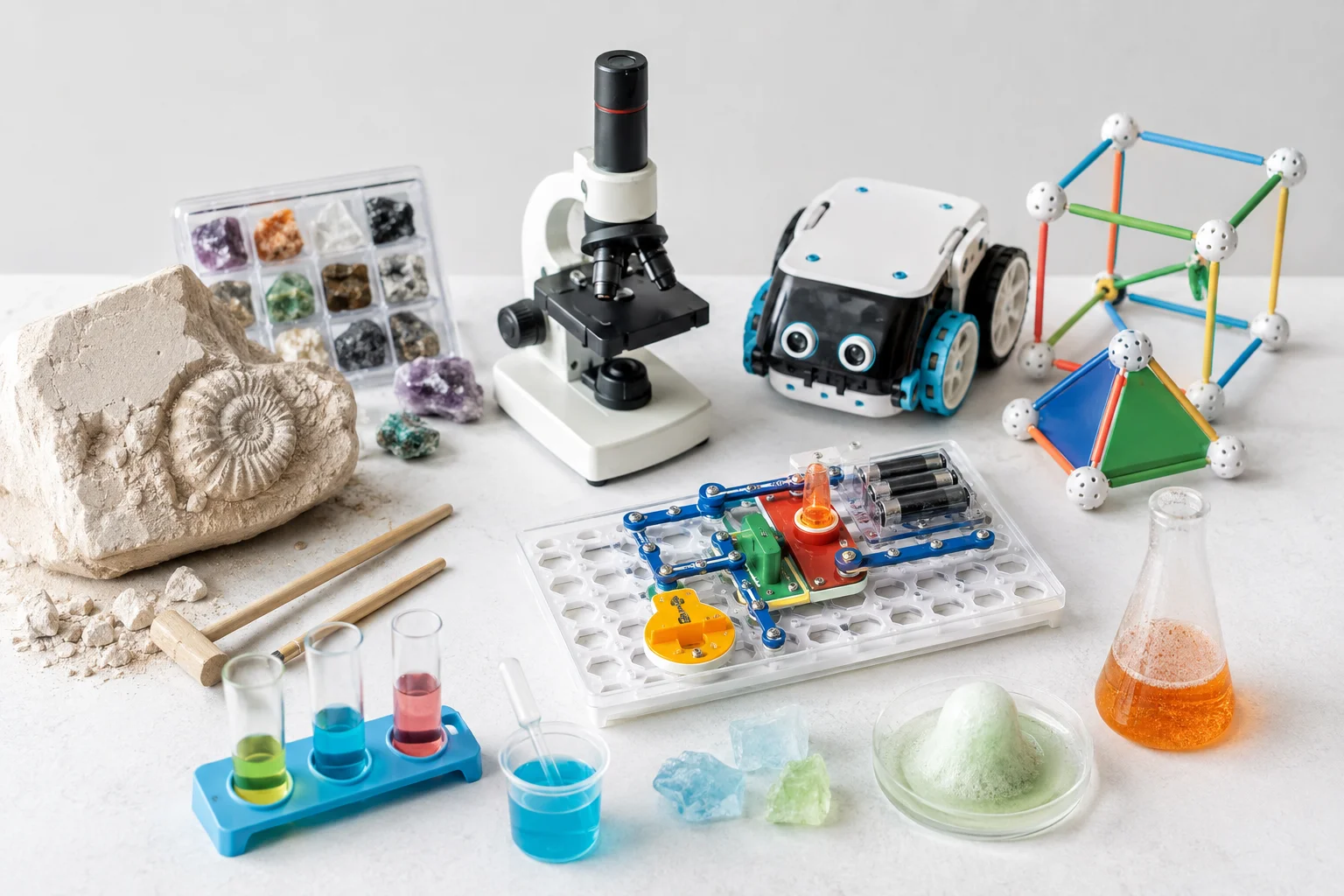
Best choices for 2026: dig kits and logic toys are easier for new sellers to manage; building kits, microscopes, and circuit kits offer strong repeat play; science kits work well with refill products; coding robots can support higher prices but add battery, software, technical-support, and return risks. The Toy Association reports that 78% of surveyed U.S. parents want more toys that help children develop creativity and problem-solving, while its 2026 trends also point to building, customization, maker play, and lower-tech experiences.[1]
When you look at a STEM toy, the label on the box matters less than the activity inside it. The child should be doing something clear: building, testing, digging, measuring, programming, observing, comparing, or solving. That is also the practical difference between a focused science kit and the wider STEM toy category.
The ranges below are practical product-development targets and examples, not legal standards or fixed industry averages.
Best STEM Toy Categories at a Glance
| Category | Useful Planning Range | Repeat Value | Main Business Risk | Seller Difficulty |
|---|---|---|---|---|
| Dig Kits | 20–45 min dig time; about 5–15 identifiable hidden items | Low per block; strong across a series | Dust, tiny specimens, one-time use | Low–Medium |
| Science Kits | 8–15 different experiments for a compact kit; 20–40 for larger sets | Medium–High | Failed experiments, consumables, safety | Medium–High |
| Coding Robots | First useful movement ideally within about 5–10 min of normal setup | High | Apps, batteries, motors, technical support | High |
| Building Kits | 5–10 guided builds plus open-ended use | High | Poor part fit, missing parts | Medium |
| Circuit Kits | About 15–30 meaningfully different beginner projects | High | Component failure, difficult troubleshooting | Medium–High |
| Microscopes | 40×–400× covers many beginner observations | High | Poor optics, difficult focus | Medium |
| Nature & Geology Kits | 20–40 well-chosen specimens for many beginner geology sets | High | Poor specimen variety or weak tools | Low–Medium |
| Logic Toys | About 40–100 challenges with gradual difficulty | High | Weak puzzle design | Low |
Dig Kits: Aim for 20–45 Minutes of Useful Digging
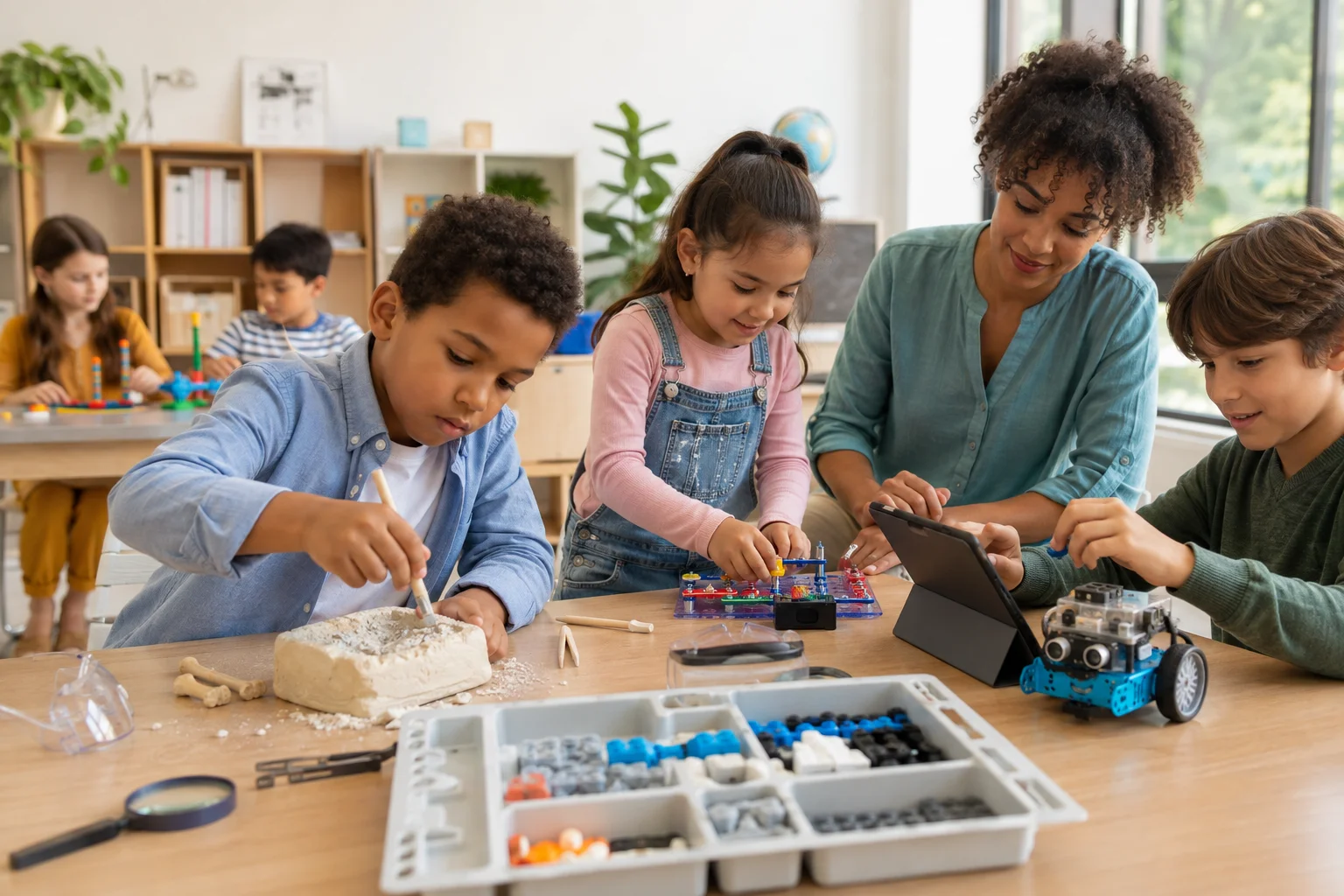
A standard retail dig kit should keep a child busy long enough for the discovery to feel worthwhile, but the block should not be so hard that digging becomes frustrating. For many home-use kits, around 20–45 minutes is a practical target. Small party products may be shorter, while larger shared blocks can run longer. K&M’s dig kit manufacturing guide uses 20–45 minutes as an example range for a standard retail kit and 45–90 minutes for larger formats.
The number of hidden items is only useful when the child can actually see and identify them. Around 5–15 recognizable items can be enough for a normal retail kit when the pieces are large enough to clean, examine, and compare. Twelve useful stones are better than 20 tiny fragments.
Before approving a product, test it the same way a customer would:
- Dig time with the tools actually included in the box.
- Fine dust produced during normal use.
- Tool breakage before the block is finished.
- Hidden-object size and distance from the surface.
- Whether objects are damaged during excavation.
- Whether colored material stains hands or surfaces.
- Cleanup after dry digging and after adding water.
If the kit advertises gemstones, the material needs a clear description. Natural, treated, dyed, synthetic, and imitation stones are not the same thing, so “real gems” is not a useful purchasing specification. The gemstone identification guide for dig kits explains why color alone is not enough to identify a specimen.
Most dig blocks are used once, so repeat sales usually come from building a series rather than selling the same block again. Gemstones, fossils, minerals, dinosaurs, ancient Egypt, marine fossils, archaeology, crystals, and space geology can all sit under one product line while giving the child a different discovery each time.
Science Kits: Count Different Experiments, Not Repeated Reactions
A compact science kit can already offer solid value with 8–15 genuinely different experiments. Larger sets may contain 20–40 activities, but the headline number only matters if those activities produce different results or teach different ideas.
Changing the food coloring in the same reaction five times should not be treated as five strong experiments.
Every activity should make these five points clear:
- What is supplied in the box?
- What must the family provide?
- How long does preparation take?
- What result should appear?
- What should the user check when the result does not appear?
For short experiments, preparation around 5–10 minutes and a main activity around 10–30 minutes can make the kit easier to use. Longer experiments are not a problem when the wait is expected and clearly explained. Crystal growing, for example, may take days rather than minutes.
Reliability needs to be checked outside ideal factory conditions. Water temperature, measurement errors, storage age, humidity, ingredient condition, and room temperature can all change the outcome. The crystal-growing troubleshooting guide shows how water amount, temperature, saturation, seed timing, and evaporation can change crystal growth.
A useful science kit should also leave the customer with equipment that can be used again:
- Droppers.
- Measuring containers.
- Test tubes.
- Funnels.
- Racks.
- Reusable experiment containers.
The tools and the instructions need to match. If the instruction says “measure 5 mL,” the child needs a practical way to measure about 5 mL. Detailed steps do not help when the supplied tools cannot perform them.
Coding Robots: Keep Setup Short and Support Costs Visible
With a beginner coding robot, the first successful action should happen before the child loses interest. For many products, roughly 5–10 minutes from normal setup to the first successful movement is a useful target. When charging, registration, firmware updates, app installation, and Bluetooth troubleshooting regularly push setup toward 20–30 minutes, sellers should expect more support questions and more chances for the customer to give up.
Younger children can work with buttons, cards, colored tiles, or command blocks. Older users can move into loops, conditions, sensors, block-based programming, and beginner text coding.
Extra features only earn their cost when they create extra play. Useful examples include:
- Obstacle sensing.
- Line tracking.
- Challenge maps.
- Programmable lights or sound.
- Replaceable parts.
- Optional sensors.
Battery performance also needs to fit the way the toy is used. For many rechargeable toy robots, 60–120 minutes of active use can be a useful development target, although the actual requirement depends on motor load, battery size, sensors, and price. Play time should be compared with recharge time rather than battery capacity alone.
Before buying inventory, find out who owns the app, who maintains it, whether basic functions work offline, whether firmware can be updated, and what happens when iOS or Android changes.
Connected toys can also involve privacy rules. COPPA applies to operators of websites or online services directed to children under 13 and to other operators that have actual knowledge that they collect personal information online from a child under 13.[2] A seller that simply resells a finished robot is not automatically the operator of its online service. What matters is who runs the app, who collects the data, and how that data is used.
Building Kits: Useful Parts Matter More Than Piece Count
A starter engineering kit does not need hundreds of parts to be worth buying. Around 5–10 guided builds followed by open-ended construction can give children enough examples to learn the system without locking them into instruction-only play.
A kit with 100–200 functional parts can already offer substantial play when those parts include useful beams, wheels, gears, axles, plates, and connectors. A “300-piece” set may offer less value if a large share of the count comes from tiny repeated fasteners.
Connector fit should be tested across several production samples. Slightly loose joints can make towers and machines collapse. Very tight joints can make assembly frustrating for younger users.
One missing specialty part can stop an entire model, so packing control matters. Useful safeguards include:
- A visual inventory of all parts.
- Spare high-loss connectors.
- Accurate part counting during packing.
- Separate storage for specialty pieces.
- A replacement-parts process.
Building sets are also easy to extend. New wheels, motors, gears, tracks, structures, or challenge packs can add more functions without forcing the customer to replace the starter set.
Circuit Kits: 15–30 Good Projects Beat 100 Tiny Variations
A beginner circuit kit can offer plenty of value with around 15–30 clearly different projects. The more useful question is not how many circuits appear in the manual, but how many different results the child can create.
A sensible progression might move through:
- Lighting an LED.
- Operating a switch.
- Running a motor.
- Sounding a buzzer.
- Using a light sensor.
- Building an alarm.
- Powering a simple vehicle.
Troubleshooting should be built into the product. If a circuit fails, the child should have a clear order for checking the battery, switch, connections, component direction, and suspect part.
Cheap components can create expensive returns. Battery holders, connectors, switches, wires, LEDs, and motors should be tested repeatedly. Including one or two spare low-cost parts can make sense when one lost or damaged component would otherwise disable several projects.
Microscopes: 40×–400× Is Enough for Many Beginner Activities
Very high magnification numbers look impressive on packaging, but they do not guarantee a good image. For many beginner activities, roughly 40×–400× already allows children to examine common prepared slides, fibers, plant material, salt crystals, paper, hair, and other suitable samples when the optics and lighting are good.
Image quality should come before the number on the box:
- Can a child find focus without constant adult help?
- Does the image stay in focus when the stage is touched?
- Is the light bright and even?
- Do the slide clips hold samples securely?
- Are the controls large enough for the intended age?
A starter set with 5–10 prepared slides gives children something useful to inspect immediately. A larger set may contain 10–25 slides, but variety is more important than count.
Repeat use does not have to come from more hardware. A list of 20–50 suitable specimens to find at home or outdoors can keep the microscope useful after the included slides have been examined.
Nature and Geology Kits: Buy Visible Differences, Not More Stones
A beginner geology kit does not need a huge specimen count. Around 20–40 well-chosen specimens is enough for many introductory collections, while individual samples around 1–2 inches (2.5–5 cm) work well for many common rocks and minerals because children can see useful surfaces without making the set too bulky.
The rock and mineral selection guide recommends focusing on visible differences such as grain size, layering, hardness, luster, cleavage, fracture, streak, pores, magnetism, and crystal form instead of simply increasing piece count.
For a general 30-piece geology set, a practical mix can include:
- About 10–12 minerals.
- About 5–6 igneous rocks.
- About 5–6 sedimentary rocks.
- About 5–6 metamorphic rocks.
A useful collection should not turn 10 colors of quartz into 10 completely different “minerals.” Material variety and learning value should be counted separately from the number of physical pieces.
The same logic applies to other nature products. A magnifier, weather tool, bug viewer, or soil kit becomes more useful when it includes 10–30 specific observation tasks instead of a thick booklet filled with general facts.
Space and Solar Kits: The Theme Must Produce a Real Task
Space sells the idea, but the activity still has to do the real work. A child needs something that can be observed, compared, built, or tested.
Useful activities include:
- Tracking Moon phases for 7–30 days.
- Comparing planet size or order with a model.
- Building and testing a rocket mechanism several times.
- Comparing rocks and minerals in a planetary-geology activity.
- Using a simple telescope to locate suitable visible targets.
A Mars-colored excavation block with random plastic items is not automatically a strong space-science product. The geology, model, experiment, or observation should support the theme. K&M’s geology and space science kit overview shows how excavation, minerals, models, and observation activities can be combined in one category.
Solar toys need the same level of realism. A car that runs outdoors in direct sunlight may work poorly under room lighting, behind a window, on carpet, or on a rough table. The completed model should be run three to five times under the same conditions to check whether its performance is repeatable.
If direct sunlight or a smooth surface is required, the instructions should say so clearly.
Logic Toys: 40–100 Challenges Need a Real Difficulty Curve
Challenge-based logic toys can offer long repeat use without batteries, apps, or consumables. Around 40–100 challenges is a practical range for many products, but the total only matters when the difficulty develops properly.
One useful planning model is:
- About 25% beginner tasks.
- About 50% intermediate tasks.
- About 25% advanced tasks.
This is not a fixed industry rule. It simply avoids a common problem: the early activities feel almost identical, then the next challenge suddenly becomes too difficult.
Children should also be able to check their own answers. Built-in storage, numbered levels, travel-friendly pieces, and a clear solution system can improve repeat use more than another 50 nearly identical puzzles.
Maker Kits: Give the Child More Than One Correct Result
A maker kit should leave room for the child to make decisions instead of copying one fixed model from start to finish.
A compact kit can work well with one main project and two or three smaller design challenges. Larger kits can include several base projects, but each should allow changes to shape, color, layout, movement, or function.
Useful formats include:
- Mechanical animals.
- Moving sculptures.
- Architecture projects.
- Wooden machines.
- Design-your-own vehicles.
- 3D structures.
This matches the 2026 shift toward building, designing, customization, and creator-style play identified by The Toy Association.[3]
Cleanup should be timed as carefully as the activity itself. A 20-minute project that creates another 20 minutes of glue, paint, or loose-part cleanup may not be used as often as expected.
Preschool STEM: Keep the First Activity to One to Three Main Steps
For younger children, the result should come quickly. Many preschool activities can be built around only one to three main steps: connect two gears and turn one, balance pieces, sort objects, match a pattern, or place a sequence of direction cards.
Useful formats include:
- Large gear sets.
- Balance toys.
- Pattern boards.
- Large building pieces.
- Cause-and-effect products.
- Simple physical coding systems.
Age grading should follow the skills and play behavior the toy actually requires, not be lowered simply to reach more buyers. CPSC’s Age Determination Guidelines consider factors including product characteristics, intended use, play behavior, labeling, and children’s abilities.[4]
For products intended for children under three, U.S. small-parts requirements are especially important. Toys for this age group must not contain or release prohibited small parts under the applicable rules.[5]
Refills, Classroom Packs, and Subscriptions Need Different Math
These formats do not change the STEM subject, but they do change how a product line is planned, packed, and sold.
| Format | Useful Planning Example | Main Check |
|---|---|---|
| Science Refill | 5 genuinely new experiments | Does it add new play rather than replace an incomplete starter kit? |
| Microscope Expansion | 10–20 new prepared slides | Are the specimens meaningfully different? |
| Logic Expansion | 20–40 new challenges | Does difficulty continue from the original set? |
| Classroom Pack | 24 students ÷ 4 per group = 6 working sets | Are teacher equipment and spare parts separate? |
| Subscription | Plan at least 6–12 boxes before launch | Can later boxes remain different without repeating tools? |
Classroom timing is easy to overestimate. A 45-minute lesson does not normally mean 45 minutes of hands-on work. If instructions and material distribution use 10 minutes and cleanup takes another 5–10 minutes, only around 25–30 minutes may remain for the actual project.
For 24 students working in groups of four, the minimum is six working sets. One separate teacher setup or critical spare-parts set can reduce disruption. The classroom science kit planning guide shows how group size, lesson time, consumables, and refills change the order quantity.
Subscriptions need the same planning discipline. The sequence should be designed before the first box is sold. A six-month progression could move from simple machines to gears, motors, circuits, sensors, and basic robotics. If later boxes depend on earlier tools, customers who join late need a clear starter option.
Use Real Costs, Not Factory Price, to Compare Categories
A product that costs $10 at the factory does not create $29.99 of profit when it sells for $39.99.
| Example Cost | Amount |
|---|---|
| Retail price | $39.99 |
| Factory cost | -$10.00 |
| Freight and import cost | -$3.00 |
| Fulfillment and handling | -$5.00 |
| Selling fees | -$6.00 |
| Testing/compliance allocation | -$1.50 |
| Returns and support allowance | -$2.00 |
| Contribution before overhead | $12.49 |
This is a calculation example, not an industry cost benchmark.
That simple calculation can change the category decision. A logic toy may sell for less than a robot but have almost no battery or software problems. A robot may sell for more, yet still need replacement batteries, technical support, firmware maintenance, and more expensive returns.
The supplier setup also affects the total cost. A simple kit may rely mainly on one manufacturer. A robot may involve plastic molding, PCB assembly, motors, sensors, batteries, firmware, and several specialist suppliers. The factory-versus-sourcing-company comparison explains how supplier count, tooling, engineering, and quality control affect this choice.
ASTM F963-23 Applies to U.S. Toys Manufactured From April 20, 2024
In the United States, ASTM F963-23 is the current version incorporated into the federal toy safety rule at 16 CFR Part 1250 for toys manufactured on or after April 20, 2024. Different sections apply depending on the toy’s materials, age group, construction, and functions.[6]
Toys designed or intended primarily for children 12 and under generally require applicable testing by a CPSC-accepted third-party laboratory. Children’s products subject to applicable safety rules also require a Children’s Product Certificate. For imported children’s products, the importer is responsible for issuing the CPC based on compliant supporting evidence.[7]
“Passed ASTM” is not enough information on its own. The paperwork should match:
- The exact SKU.
- The intended age.
- The standard version.
- The applicable sections.
- The tested materials.
- The laboratory.
- The production configuration.
If the factory later changes paint, plastic resin, glue, magnets, batteries, coatings, or another important component, the effect on the existing compliance basis needs to be reviewed. The U.S. and EU toy compliance guide shows how product design, testing, documentation, and production control connect.
U.S. CPSC eFiling Has Applied Since July 8, 2026
Since July 8, 2026, importers of consumer products subject to CPSC certification requirements must electronically file the required certificate data for general imported shipments. Products entered from a Foreign Trade Zone have a later effective date of January 8, 2027.[8]
Product identification, importer data, applicable rules, laboratory information, production information, and the certificate therefore need to match the goods being imported.
Button Batteries and Magnets Need Toy-Specific Checks
Button-battery requirements depend on the product. CPSC states that toys designed, manufactured, or marketed as playthings for children under 14 are exempt from Section 2 of Reese’s Law when they comply with the battery accessibility and labeling requirements of 16 CFR Part 1250, which incorporates ASTM F963. Separate packaging requirements can still apply to button or coin batteries supplied with a product.[9]
For battery toys, check the actual battery type, compartment, accessibility, labeling, charging design, and packaging instead of relying on a general “battery safe” statement from the supplier.
Magnets also fall under different rules depending on the product. Toys subject to 16 CFR Part 1250 are covered by applicable ASTM F963 toy requirements and are excluded from CPSC’s separate 16 CFR Part 1262 magnet standard.[10]
For magnetic toys, test the product after drops, impacts, pulling, twisting, and repeated use. A magnet that is secure in a new sample may become accessible once the plastic housing cracks.
EU Toy Safety Rules Change Again From August 1, 2030
Regulation (EU) 2025/2509 entered into force on January 1, 2026 and generally applies from August 1, 2030 after the transition period. The new framework strengthens toy safety requirements and introduces a digital product passport for toys.[11]
A product being developed for several years of EU sales therefore needs to be checked against the rules that apply during the transition period and the requirements that will apply when the new Regulation becomes fully applicable.
Choose the Category by Risk, Replay, and Product-Line Potential
| If Your Main Goal Is… | Categories to Consider |
|---|---|
| Low technical risk | Dig kits, logic toys, nature kits, simple building kits |
| High repeat play | Building kits, circuit kits, microscopes, logic toys, robots |
| Repeat purchases | Science refills, dig-kit series, microscope slides, modular building systems |
| Higher-price products | Robotics, electronics, microscopes, larger engineering systems |
| Screen-free products | Dig kits, building kits, logic toys, maker kits, nature kits, microscopes |
| Classroom products | Science kits, geology kits, circuits, building systems, group engineering sets |
Before placing a large order, use several production-level samples from start to finish. Record activity time, failed attempts, broken parts, missing pieces, setup steps, cleanup time, replacement needs, and the number of activities a child can complete without adult operation.
For a custom product, these checks should be settled before mass production. The educational toy development process covers product definition, samples, specifications, safety review, tooling, and production control. When comparing factories, the STEM toy OEM factory guide provides practical checks for manufacturing capability, testing support, MOQ, lead time, and quality control.
Finally
The strongest STEM category in 2026 depends on what your business can control. A standard dig kit can target roughly 20–45 minutes of activity, a compact science kit can work with 8–15 genuinely different experiments, a logic toy can support 40–100 well-graded challenges, and many beginner microscope activities need only about 40×–400× useful magnification. For a class of 24 children working four per group, six complete working sets are needed before teacher equipment or spares. Use these numbers to test product value, then compare failure points, repeat use, full landed cost, support workload, and product-specific safety requirements before ordering.