
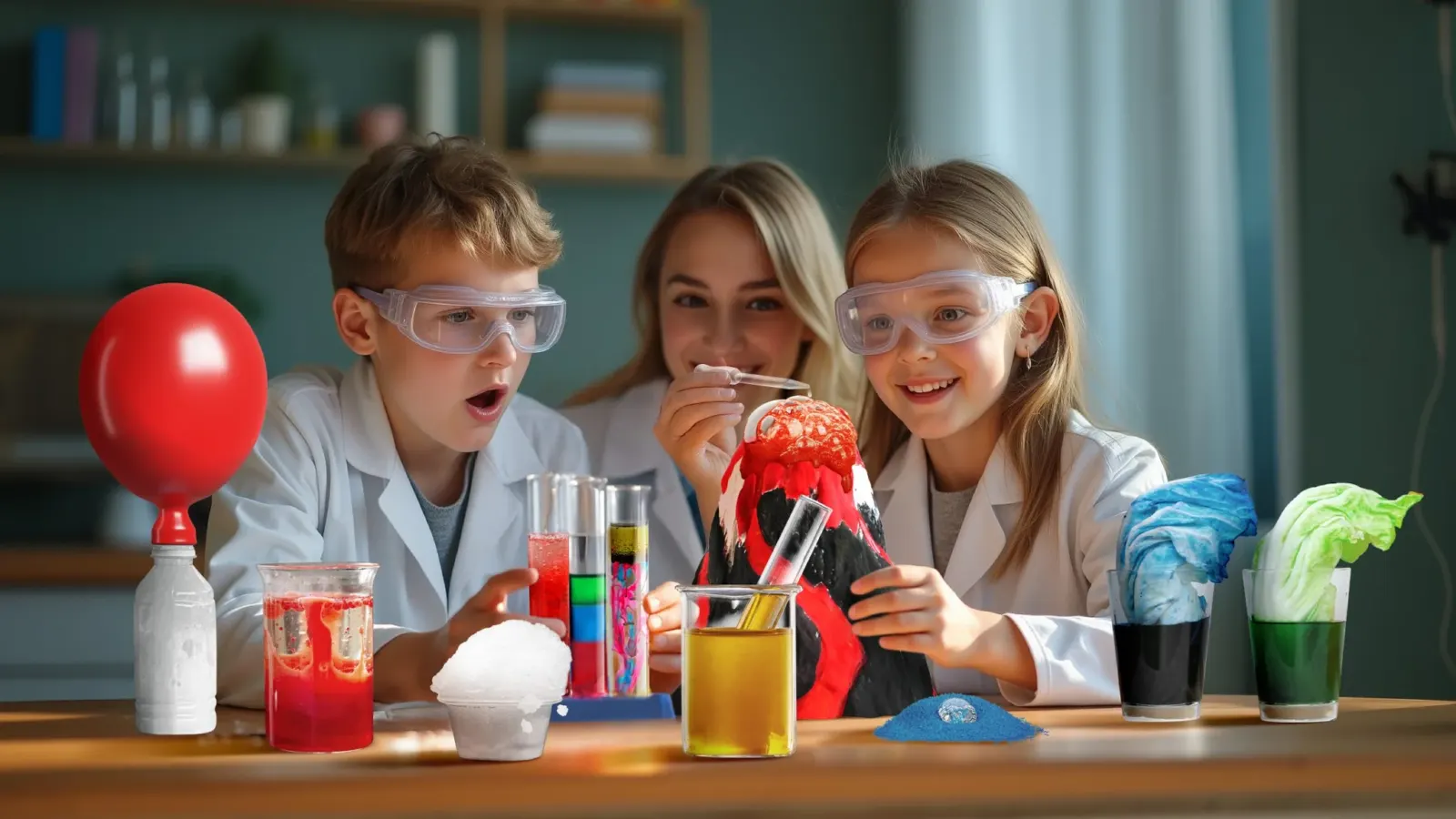
A good kids’ science kit should include accurate measuring tools, observation or building tools, experiments with something to compare or test, clear quantities and steps, reusable parts, and safety information for the stated age. The exact parts depend on the subject: chemistry kits need different equipment from geology, circuits, engineering, or biology kits.
| Check | What to Look For |
|---|---|
| Measuring | Tools can measure the quantities used in the instructions |
| Experiments | The child measures, compares, tests, records, or redesigns |
| Instructions | Exact quantities, clear steps, expected result, and troubleshooting |
| Extra materials | Household items are listed before the activity starts |
| Reuse | Useful tools remain after powders, tablets, seeds, or other consumables run out |
| Safety | Age grade, adult-only steps, chemicals, batteries, magnets, heat, and small parts are clearly addressed |
Different science kit types use different combinations of these parts, so the contents should always be judged against the experiments they are meant to support.
What Should Be in the Box?
| Tool or Material | Useful For | What to Check |
|---|---|---|
| Graduated cup or cylinder | Liquid measurement | Scale matches the quantities in the experiments |
| Droppers or pipettes | Moving small amounts of liquid | More than one is useful when several liquids are used |
| Test tubes or containers | Mixing and comparing samples | Stable, durable, and large enough for the activity |
| Ruler | Length, plant growth, distance | Clear millimeter or centimeter markings where needed |
| Balance | Comparing mass | Easy to zero and sensitive enough for the supplied objects |
| Magnifier | Rocks, leaves, crystals, soil, specimens | Clear image with little distortion |
| Funnels, tweezers, trays | Transferring and sorting materials | Easy for the stated age to grip and control |
| Notebook or worksheets | Predictions, measurements, results | Space for numbers, drawings, repeated trials, or simple graphs |
| Safety equipment | Activities with identified risks | Matches the actual experiment rather than being decorative |
Three or four identical containers are often more useful than one decorative beaker because they allow several conditions to be compared at the same time. A set of reusable tubes, droppers, a ruler, and a magnifier can also remain useful after the original activity cards are finished.
A notebook adds value when children record real observations. For example, three paper-airplane trials might measure 4.2 m, 5.1 m, and 4.7 m. Those results immediately show why one trial is not always enough. Planning investigations, using data, and explaining evidence are recognized parts of science learning.[1]
Do the Tools Match the Measurements?
Compare the numbers in the instructions with the scale on the supplied tools.
If an experiment asks for:
- 10 mL;
- 20 mL;
- 30 mL;
a cup marked only every 25 mL is not suitable. A scale marked every 5 or 10 mL would make those measurements possible.
The same rule applies to rulers, balances, and thermometers. An experiment should not require more precision than the included equipment can provide.
A basic plastic dropper should also not be treated as a precise measuring tool. Drop size changes with the liquid, angle, and squeezing pressure. “Add five drops” is reasonable when an approximate amount is enough. If exact volume matters, the kit should provide a graduated tool.
For comparison experiments, identical containers also matter. Using one narrow test tube and one wide cup can change heating, cooling, evaporation, and visual observations even when the child intends to change only one condition.
Do the Experiments Actually Test Something?
A useful activity gives the child a result that can be compared.
| Weak Activity | Better Activity |
|---|---|
| Add a tablet and watch it fizz | Compare the same tablet under two controlled conditions |
| Build one bridge exactly as shown | Build two designs using the same number of pieces and test both |
| Grow one plant | Change one growing condition and record height every 24 hours |
| Roll a car down a ramp | Use the same ramp and car on several surfaces and measure distance |
| Connect a bulb | Build a circuit, break one connection, find the fault, and repair it |
Three trials are a practical starting point for activities where results naturally vary. A car might travel 112 cm, 105 cm, and 109 cm. A child can then compare the results rather than treating one run as the only possible answer.
Good activities also build on earlier ones. A five-step circuit sequence can move from making a complete circuit to adding a switch, testing conductors, finding a broken connection, and finally building a circuit with less help. The value comes from using earlier knowledge again, not from counting each tiny variation as a completely new experiment. More examples appear in K&M’s article on skills developed through science kits.
What Changes by Kit Type?
Chemistry: Look for measuring containers, droppers, clearly identified experiment materials, exact quantities, storage instructions, cleanup instructions, and activity-specific protective equipment.
A simple dissolving comparison could use 5 g of the same soluble material in 100 mL of water in two similar containers, with only one condition changed. Those numbers are an example, not a required formula; the real kit should provide its own tested quantities.
Crystal-growing kits need particularly clear water measurements. Adding 10 mL extra to an activity that calls for 80 mL increases the water volume by 12.5%, which can noticeably change solution concentration. The crystal-growing guide gives more detailed examples of water volume, concentration, cooling, and growth time.
Children should follow the stated quantities, wear the protection required by the activity, avoid eating or drinking during chemistry work, clean up properly, and wash their hands afterward.[2]
Physics: Useful parts include ramps, wheels, magnets, springs, levers, pulleys, rulers, and low-voltage circuit components. Parts should allow one condition to change while the rest remain similar.
A friction activity, for example, might use the same 50 cm ramp and run the same vehicle three times on cardboard, fabric, and carpet. The exact ramp length is not important; keeping it unchanged between tests is.
Engineering: Look for parts that can be taken apart and rebuilt. A useful bridge activity can keep the gap and number of building pieces fixed while the child changes the shape. Loads can then be added in equal steps, such as 50 g at a time, within the safe limit set by the activity.
Open-ended STEM activities are more useful when the child can test several solutions instead of producing one fixed model.
Biology: Useful materials may include seeds, growing containers, rulers, magnifiers, labels, and recording sheets. A simple plant activity can measure the same stem once every 24 hours for 7 days, producing seven comparable observations.
Unknown environmental microorganism cultures need much tighter control. Once environmental cultures grow, plates should remain sealed and be handled and disposed of according to the activity’s biosafety instructions.[3]
Geology: Look for correctly identified specimens, a magnifier, storage or sorting space, and activities that ask children to compare color, texture, grain size, shine, or other useful properties. A set of 10 accurately identified specimens can be more useful than a much larger collection with weak labels or no observation task. More detail is available in the geology kit guide.
Excavation: Check the digging-tool shape, dust, buried-part size, cleanup, and whether the recovered objects are clearly identified as replicas, minerals, fossils, or other materials. These issues are covered in the guide to dinosaur dig kit age, time, and safety.
Weather and water: Recording temperature or rainfall at roughly the same time once a day for 7–14 days creates enough data for basic comparisons. A filtration experiment can show how particles are removed, but clearer-looking water is not automatically safe to drink. Different water-treatment methods remove different contaminants.[4]
Are the Instructions Usable?
Check one complete experiment before judging the manual.
| Instruction | Useful Version |
|---|---|
| Materials | Separates items included in the box from items supplied at home |
| Quantity | “Add 20 mL” instead of “add a little” when amount matters |
| Steps | One clear action per numbered step |
| Adult action | Marked beside the exact step that requires an adult |
| Result | Explains what should normally happen and what variation is acceptable |
| Troubleshooting | Lists likely reasons for a failed or weak result |
| Science | Explains why the result happened in plain language |
For a beginner, 4–6 clearly numbered actions are often easier to use than one paragraph containing 10 separate actions. This is a practical readability example, not a rule that every experiment must have six steps.
Troubleshooting should be specific. A crystal activity may tell the user to check water volume, temperature, waiting time, or whether the container was moved. A circuit activity may tell the user to check battery direction, LED direction, and loose connections. One loose connection in a four-connection circuit is enough to stop it working.
How Much Time and Extra Material Is Needed?
Check four separate quantities before buying:
| Item | Practical Example |
|---|---|
| Setup | About 5 minutes for a simple tabletop activity |
| Hands-on work | About 15–20 minutes for a short experiment |
| Cleanup | About 5–10 minutes when liquids or several tools are used |
| Waiting | Minutes, hours, or several days depending on the experiment |
These are planning examples, not industry averages. A plant or crystal project may use only 10–15 minutes of hands-on work but need observations for several days.
Extra materials should also be visible before the activity starts. Requiring water, paper towels, and salt is very different from requiring eight separate household items, batteries, a special container, hot water, and cutting tools.
For classroom use, equipment also needs to be divided by working groups rather than total piece count. If one device is available for 10 minutes, two students receive about 5 minutes each, while five students receive only about 2 minutes each. The classroom science-kit planning guide covers group size, activity time, and refills in more detail.
Which Safety Risks Need a Separate Check?
Eye protection: Use the type of protection stated for the activity when splashes, powders, fragments, or particles can reach the eyes. Decorative “scientist glasses” should not automatically be treated as protective equipment.[2]
Small parts: CPSC advises keeping toys with small parts away from children younger than 3 and keeping deflated balloons away from children younger than 8.[5] Check the youngest child who can reach the work area, not only the age of the child using the kit.
Button and coin batteries: CPSC states that toys using these batteries must have a secure closure requiring a screwdriver, coin, or other tool to open.[6] Stop using the component if the battery cover or screw is damaged. Suspected swallowing needs prompt medical attention.
High-powered magnets: CPSC warns that the risk extends from toddlers through teenagers. Two or more swallowed magnets can attract through internal tissue and cause severe or fatal injuries.[7] Check whether magnets are loose, can come out of holders, and can all be counted after use.
Water beads: CPSC states that water beads can grow up to 100 times their original size when exposed to water, and dry beads can be about the size of a pinhead.[8] They can be difficult to find after a spill and can cause serious internal injury if swallowed.
Heat: The instructions should state who prepares hot or warm water, what container is used, and when the child handles it. Young children should not independently use boiling water, open flames, or hot plates.
Household chemicals: Children should not mix random cleaners, medicines, solvents, or unknown liquids. CDC warns that chlorine bleach can release dangerous gases when combined with certain other cleaning products.[9]
Safety claims: Words such as “kid-safe,” “non-toxic,” or “STEM approved” do not cover every type of risk. For toys sold in the United States, ASTM F963 is part of the federal toy-safety framework for products within its scope. Requirements vary with age, materials, design, and market.[10] K&M’s U.S. and EU toy-safety guide covers the main differences between ASTM F963, EN 71, and CE requirements.
Is the Kit Right for the Child?
The product age grade comes first. Academic ability does not cancel a safety age restriction.
| General Stage | Suitable Activity Features |
|---|---|
| Ages 4–6 | Large tools, 3–5 main actions, short comparisons, high adult involvement |
| Ages 7–9 | Simple measuring, 2–3 comparison conditions, basic circuits, ramps, plants |
| Ages 10–12 | Multi-step tests, 3 or more trials, graphs, engineering redesign, age-appropriate chemistry |
| Ages 13+ | More detailed electronics, microscopy, mechanics, data collection, deeper experimental design |
These are general activity examples, not product-safety ratings. Follow the age grade and warnings on the actual product. CPSC also advises choosing toys that match a child’s abilities and following age and safety information on the package.[5]
Reading and hand control matter separately. A child may understand the science but still struggle with a stiff dropper, tiny screw, narrow test tube, small electrical clip, or instructions written several reading levels above the intended user.
The type of activity should also match the child. A builder may get more use from engineering or mechanics; a child who enjoys visible changes may prefer chemistry or crystals; a child who likes collecting and sorting may prefer geology. The important point is what the child actually does with the product, not the educational label on the box. K&M’s article on how educational toys support learning gives more examples of this distinction.
What Runs Out and What Can Be Reused?
Separate the contents into three groups before judging value.
| Type | Examples | What to Check |
|---|---|---|
| Reusable | Ruler, magnifier, tubes, droppers, circuit parts, gears, pulleys | Still useful after the printed experiments are finished |
| Easy replacement | Paper, cardboard, salt, sugar | Instructions state the exact replacement |
| Special refill | Test strips, filters, powders, solutions, crystal chemicals | Correct refill is available and clearly identified |
| One-time | Excavation blocks, single-use reaction packets | Buyer knows the activity cannot simply be repeated |
If 15 of 20 activities depend on one-use packets and almost no useful equipment remains afterward, reuse value is limited. Another 20-activity kit with tubes, measuring tools, a magnifier, circuit parts, or building pieces may continue to support new tests after the original materials run out.
Do not replace a supplied chemical with a different powder or liquid simply because it looks similar.
Is the Experiment Count Real Value?
Use the number of different ideas, not the number printed on the box.
| Example | Kit A | Kit B |
|---|---|---|
| Advertised activities | 60 | 25 |
| Repeated variations | 20 color-mixing variations and 15 versions of one reaction | Few repeated activities |
| Topics | Mainly color and reactions | Measurement, forces, circuits, plants, crystals, engineering |
| Reusable tools | Limited | Several tools used across activities |
The figures above are an example, not market data. They show why “60 experiments” does not automatically mean more learning than 25 well-developed activities.
Check whether later experiments use skills learned earlier, whether the child can repeat the test with new materials, and whether the included equipment remains useful.
Buying Checklist
- Can the included tools measure the quantities in the instructions?
- Does the child measure, compare, test, build, or record rather than only watch?
- Are extra household materials listed before the activity starts?
- How many minutes are needed for setup, hands-on work, and cleanup?
- Do any results require hours or days of waiting?
- Which exact steps require an adult?
- Can the child read the instructions and physically control the tools?
- Are batteries, magnets, water beads, small parts, heat, and chemicals handled appropriately?
- Which materials are single-use?
- Are correct refills available?
- What useful tools remain after the consumables run out?
- Are the advertised experiments genuinely different?
For an older, second-hand, or unfamiliar product sold in the United States, check the official CPSC recall database before use.[11]
FAQ
Does every science kit need goggles?
No. Eye protection should match the activity. Use the protection specified when splashes, powders, fragments, or particles can reach the eyes.[2]
Does a good science kit need a microscope?
No. A clear magnifier can be more useful to a young child than a poor microscope. If a microscope is included, check focus, lighting, image clarity, slide handling, and ease of use rather than only the magnification number.
How many experiments are enough?
There is no useful target number. Compare different concepts, reusable tools, repeated testing, and the amount of work the child actually performs. Twenty deep activities can be more useful than 60 small variations of the same effect.
What if an experiment does not work?
Check the quantities, temperature, connections, waiting time, and any condition listed in the troubleshooting section. A beginner experiment should not require accuracy that the supplied tools cannot provide.
What should I do if a safety problem occurs?
Stop the activity, move the child away from the material or equipment, and follow the product-specific first-aid directions. Seek appropriate medical or poison-safety help when harmful exposure or ingestion may have occurred. Suspected swallowing of a button battery or high-powered magnet requires prompt medical attention.
Finally
Check the numbers before the marketing claims. If an experiment needs 10, 20, and 30 mL samples, the measuring tool must show those amounts. If results vary, three trials give more information than one. A short activity may need 5 minutes of setup, 15–20 minutes of work, and another 5–10 minutes of cleanup, while plant or crystal projects may continue for days. Count reusable tools separately from one-use packets, check what must be supplied at home, and identify battery, magnet, small-part, chemical, and heat risks before use. A smaller kit with accurate tools and 20 useful experiments can provide more value than a box claiming 60 repetitive activities.