
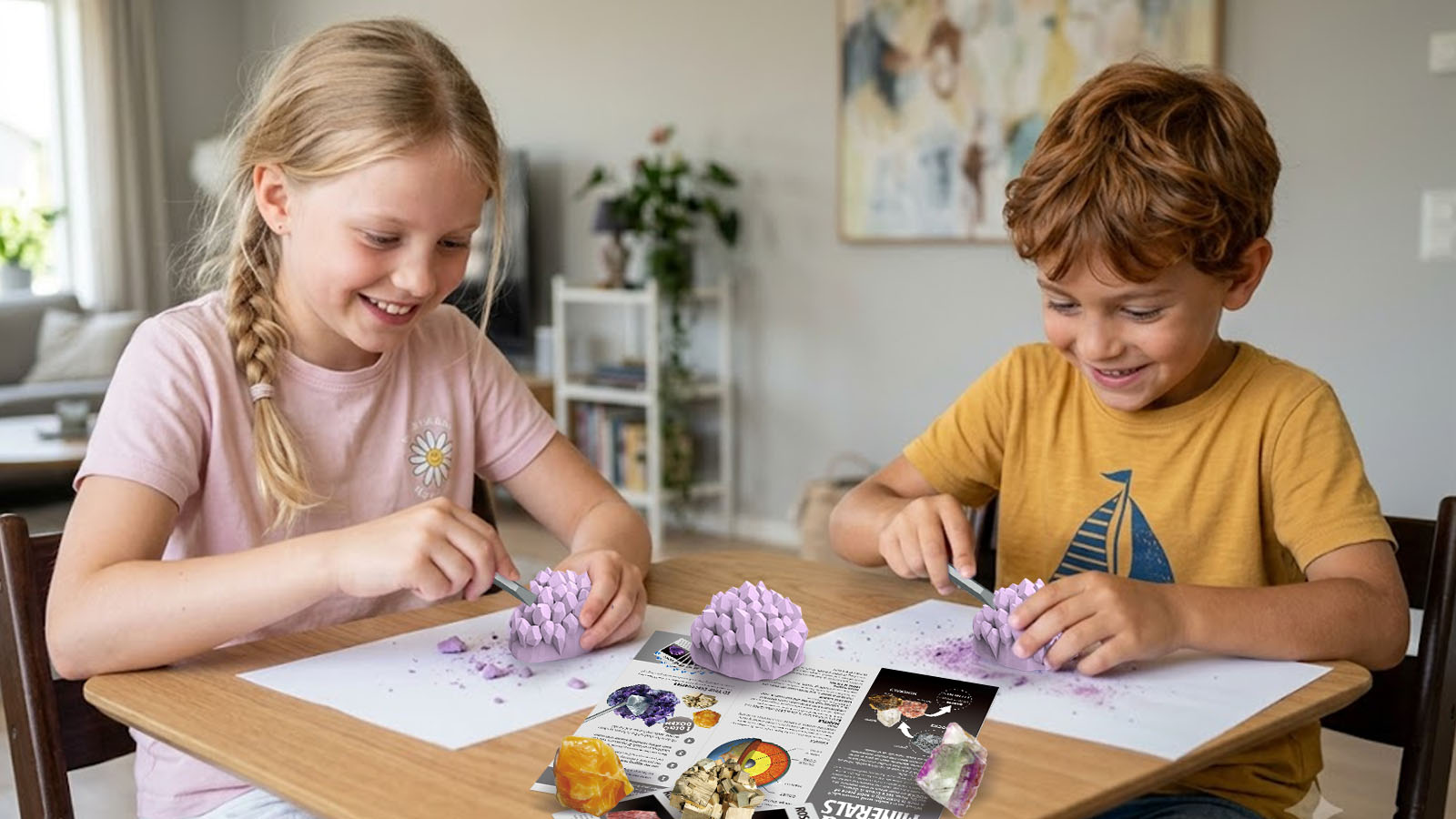
A good private label geology kit needs correctly named specimens, useful activities, safe components, strong packaging, and stable mass-production quality. Before requesting a quote, the buyer should confirm the target age, sales countries, specimen list, packaging, order quantity, and target landed cost. These details decide which materials can be used, which tests are needed, and whether the supplier can repeat the approved quality in every batch.
- Define the intended user and age range.
- List the countries where the kit will be sold.
- Decide what users should learn or collect.
- Set the number, type, and size range of specimens.
- Confirm the tools, guide, tray, and outer packaging.
- Set the first order quantity and annual forecast.
- Calculate a target landed cost, not only a factory price.
What Is a Private Label Geology Kit?
A private label geology kit is made by a supplier and sold under the buyer’s brand. The buyer may provide the logo, product name, artwork, age range, target price, and sales market. The supplier sources the specimens, prepares the tools, prints the packaging, assembles the kits, and packs the finished order.
K&M’s educational toy products and OEM/ODM services show how a project can range from adding a logo to an existing kit to developing a new product from the first idea.
Basic private label production uses an existing product structure. The buyer normally changes the logo, label, instruction sheet, sleeve, or color box. This can reduce development time and order risk, but the basic product may also be sold to other brands.
OEM production means the buyer provides a detailed product specification. The buyer may choose the specimens, tools, activities, packaging, colors, and product size. OEM gives the buyer more control, but it also requires more sample checks, testing, and written approvals.
ODM development gives the supplier a larger role. The buyer may provide only the theme, target customer, expected retail price, and sales channel. The supplier then helps prepare the specimen list, activities, packaging, and production plan.
Before development starts, both parties should agree on who approves the age grade, scientific content, testing, artwork, specimen changes, custom tools, molds, and final shipment.
Choose the Right Type of Geology Kit
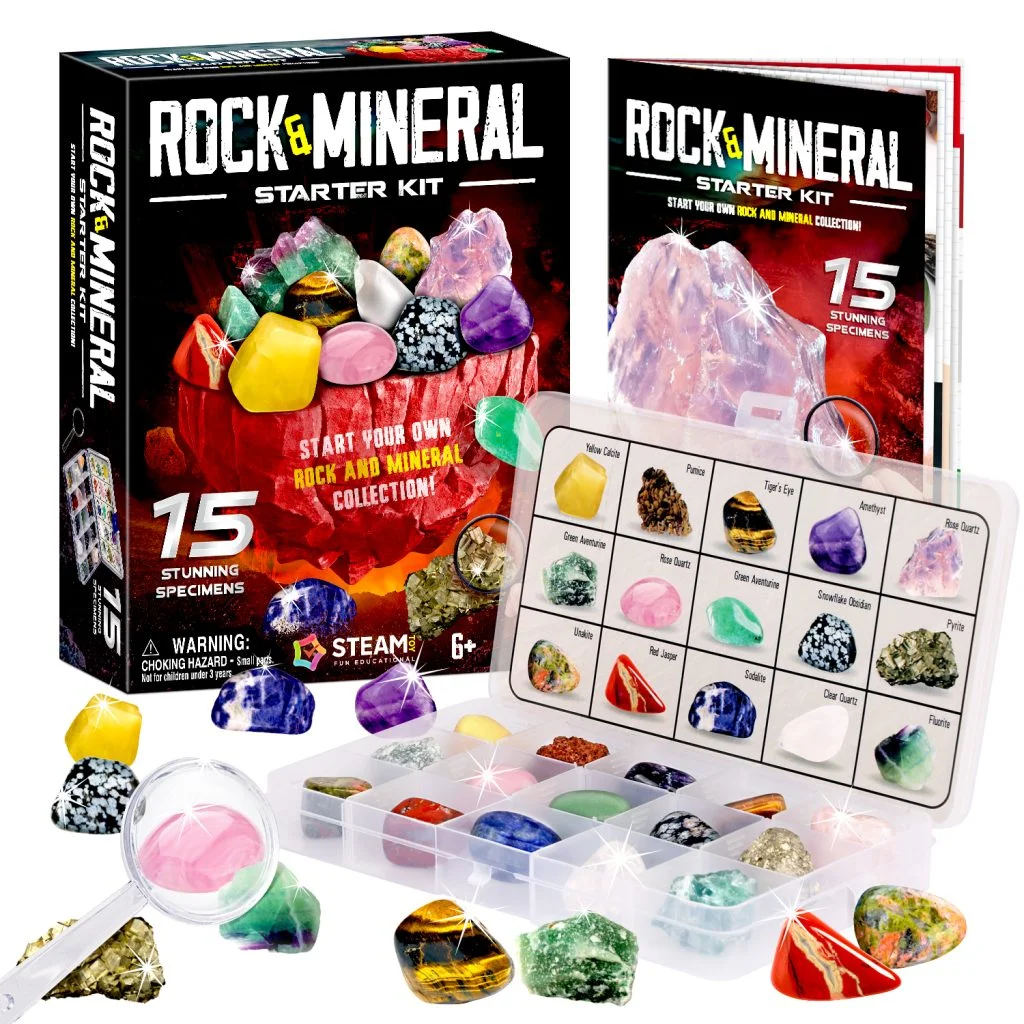
Rock and mineral collection kits contain labeled specimens in bags, trays, display boxes, or reusable cases. Common materials may include quartz, calcite, pyrite, granite, basalt, sandstone, pumice, gypsum, jasper, agate, and amethyst.
A mineral is a naturally occurring inorganic element or compound with an orderly internal structure and characteristic properties. A rock is an aggregate of one or more minerals or mineral matter.[1] A beginner kit should explain this difference instead of using “rock,” “mineral,” and “crystal” as if they mean the same thing.
Mineral identification kits help users compare color, luster, streak, hardness, cleavage, fracture, transparency, and magnetism. The included tools and specimens must produce clear results. A kit should not advertise hardness or streak testing if the supplied materials cannot support those activities.
Gemstone and crystal kits focus on colorful crystals, polished stones, decorative minerals, or jewelry materials. The product specification should state whether each piece is natural, polished, dyed, coated, stabilized, reconstructed, synthetic, or an imitation.
Geode and excavation kits let users open a geode or dig specimens out of a block. These products need extra checks for dust, block hardness, tool shape, sharp fragments, cleanup, eye protection, adult supervision, and age grading.
K&M’s Jumbo Gems Gem Dig Kit is one example of a product format that combines embedded gemstones, excavation tools, identification materials, and retail packaging.
Classroom geology sets normally include more specimens, teacher notes, worksheets, and reusable storage. Specimen numbers should remain the same across production runs so schools can replace missing pieces without changing their lesson materials.
Field geology kits may include a hand lens, notebook, specimen bags, identification cards, pencil, and scale card. Geological hammers, sharp probes, acids, and professional hardness tools need a separate safety review and may not be suitable for a general children’s kit.
Match the Kit to the Sales Channel
- School suppliers: need consistent specimen numbers, durable storage, answer sheets, and replacement pieces.
- Museum shops: need accurate names and evidence for claims about origin, rarity, or geological age.
- E-commerce sellers: need parcel-ready packaging and photos that show normal specimen size and quality.
- Subscription businesses: need repeat supply and enough specimen options to avoid frequent duplication.
- Large retailers: need stable capacity, batch records, efficient cartons, and clear delivery schedules.
A kit for a six-year-old beginner should not use the same specimen sizes, terms, tools, or activities as a kit for teenagers or adult collectors.
Use a Sample Project to Define the Product
The following example shows how a buyer can turn a general idea into a product that a manufacturer can quote. The figures are for explanation only and are not industry standards.
- Product: 24-piece rock and mineral identification kit
- Intended age: 8 years and older
- Markets: United States and European Union
- Contents: 24 labeled specimens, one hand lens, one magnet, one approved streak-testing component, one observation sheet, and one identification guide
- Packaging: reusable compartment box inside a printed retail carton
- First order: 2,000 kits
- Annual forecast: 8,000–10,000 kits
- Sales channel: e-commerce and museum gift shops
A brief like this allows the supplier to review material availability, specimen size, tool cost, packaging structure, testing needs, carton weight, and minimum order quantity before preparing the quotation.
Create a Specimen Master Specification
Natural stones will not be identical. A written specimen specification tells the supplier how much variation is acceptable and gives the writer, testing laboratory, packaging designer, and inspector one approved reference.
Create one record for every specimen. Include:
- Approved product name
- Rock, mineral, fossil, crystal, synthetic item, or replica
- Raw, polished, dyed, coated, stabilized, or synthetic status
- Target size or weight range
- The feature users should be able to observe
- Acceptable color and shape variation
- Unacceptable cracks, residue, contamination, or damage
- Approved supplier or source reference
- Whether a replacement material is allowed
For example, pumice included to show vesicles should have clear, visible holes. Granite used to show mineral grains should be large and clear enough for a beginner to see those grains.
Do not use terms such as “small,” “medium,” or “premium” without measurable limits. State the acceptable dimensions, weight, appearance, and defects.
A buyer might set a project-specific target such as 25–35 mm for selected specimens in an 8+ kit. This is only a commercial specification, not a universal safety limit. The final shape, packaging, activity, intended age, and applicable small-parts test still need to be reviewed.
A single longest-side measurement is not enough to decide whether an irregular specimen is suitable for a children’s product. Its shape and all possible positions may need to be checked during small-parts testing.
Check Specimen Identity and Quality
Every specimen must match the name printed on the tray, guide, activity sheet, and packaging. A kit can contain the correct number of stones and still be unusable if pieces are placed under the wrong labels.
The supplier should have a clear process for receiving, identifying, sorting, cleaning, and approving specimens. A more advanced kit should also be reviewed by a geologist, mineralogist, or Earth science educator.
Check:
- Correct specimen identity
- Approved size or weight
- Clear identifying features
- Clean and dry surfaces
- No loose soil, oil, or strong odor
- No unexpected sharp edges
- No serious cracks or breakage
- Correct label and tray position
For a small pilot project, one sample may be enough to review the basic layout, but checking 3–5 complete kits gives the buyer a better view of normal color, size, polishing, and packing variation. This is a practical starting point, not a legal sampling rule.
Control Specimen Substitutions
Rock and mineral supply can change because of mine output, processing capacity, export conditions, or supplier availability. The factory should not replace a specimen only because another stone has a similar color.
When an approved material becomes unavailable, require the supplier to:
- Explain why it cannot be supplied.
- Provide the replacement name and specification.
- Send several representative samples.
- Check whether labels or activities must change.
- Check whether the change affects testing.
- Receive written approval before production.
The replacement should support the same learning purpose. Two stones that look similar may have different properties.
Make the Kit Educational
A useful kit should help users observe, compare, record, classify, or identify something. Adding more stones and tools does not automatically improve the learning value.
A clear activity should include:
- A simple learning goal
- The tools and materials needed
- Short steps in the correct order
- A result the user can see or record
- An explanation of what the result means
- A question that encourages another observation
A beginner mineral identification activity could ask users to:
- Look at the color, surface, transparency, and visible crystal shape.
- Use a hand lens to find grains, layers, holes, or flat faces.
- Compare the luster using words such as glassy, metallic, pearly, or dull.
- Perform an approved streak, hardness, or magnet test.
- Write down the results.
- Use a simple identification key.
- Compare the answer with the identification card.
The guide should explain that color alone may not identify a mineral, polishing may hide natural surfaces, and Mohs hardness measures scratch resistance rather than resistance to breaking.
Test the activity with users in the intended age group. Check whether they understand the words, choose the correct tools, see the expected result, finish in the stated time, and follow the cleanup instructions.
Start Safety Work Before Production
The safety plan depends on the age range, destination market, specimens, tools, packaging, and activity. Changing one of these items may change the required tests.
Terms such as “collector item,” “educational product,” or “ages 13+” do not automatically decide how a product will be regulated. The design, marketing, expected use, and likely user also matter.
Give the testing laboratory the complete final kit, including specimens, tools, excavation material, packaging, warnings, instructions, and product claims.
K&M’s U.S. and EU toy safety compliance guide provides more information about ASTM F963, CPC documents, EN 71, CE marking, and production changes.
United States Requirements
ASTM F963 covers products designed, made, or marketed as toys for children under 14. Third-party testing and Children’s Product Certificate requirements generally apply to products designed or intended mainly for children aged 12 or younger.[2]
ASTM F963-23 became effective under the current mandatory U.S. toy safety framework on April 20, 2024. Not every part of the standard applies to every toy, so the responsible company must identify the sections that apply to the final product.[3]
Possible geology-kit issues include:
- Small parts
- Sharp edges and points
- Pieces released during use and abuse testing
- Lead and other regulated elements
- Paints, coatings, inks, and plastics
- Magnets
- Powders and excavation materials
- Impact tools
- Plastic packaging film
Products intended for children under three must not contain or release prohibited small parts. A small part is an object that fits completely into the official test cylinder without compression. Certain toys for children aged three to under six that contain small parts also require choking-hazard warnings.[4]
Children’s Product Certificate and Tracking Information
A laboratory report and a Children’s Product Certificate are different documents. The laboratory report records the tests and results. The CPC identifies the product, applicable safety rules, responsible company, production details, testing details, and laboratory.
For an imported children’s product, the U.S. importer is generally responsible for issuing the CPC based on testing from a CPSC-accepted laboratory.[5]
Since July 8, 2026, importers of most regulated consumer products have also been required to electronically file certificate information with U.S. Customs and Border Protection through the CPSC eFiling system.[6]
Children’s products must generally carry permanent tracking information on the product and packaging where practical. The information should identify the manufacturer or private labeler, production location, production date, and batch or run.[7]
Plan the batch code before the packaging artwork is approved.
European Union Requirements
Toys sold in the European Union must meet the applicable safety requirements and carry CE marking. CE marking is the manufacturer’s statement that the product meets the required EU rules.[8]
Regulation (EU) 2025/2509 entered into force on January 1, 2026. Its main requirements will apply from August 1, 2030. Directive 2009/48/EC remains applicable until July 31, 2030.[9]
The new regulation will require toys placed on the EU market to have a digital product passport containing safety and compliance information. This should be treated as a future requirement during the transition period, not as a current requirement for every EU shipment.[10]
For current EU projects, confirm the required EN 71 tests, technical documents, Declaration of Conformity, CE marking, warning languages, manufacturer information, importer information, and traceability details with a qualified laboratory or compliance specialist.
Screen Specimens for Material Risks
Specimens sold to adult collectors are not automatically suitable for children. Review the chemical composition, surface treatment, loose particles, breakage, dust, and possible hand-to-mouth contact.
CPSC guidance lists individual solubility limits for elements including antimony, arsenic, barium, cadmium, chromium, mercury, and selenium in applicable accessible toy materials.[2]
Pay particular attention to:
- Mercury-, arsenic-, or lead-bearing materials
- Fibrous minerals
- Unknown dyes, coatings, or treatments
- Loose powder or soil
- Sharp glass-like fracture
- Strong odors or oily residue
Asbestos is a mineral fiber that occurs naturally in rock and soil. Its fibers may become airborne when asbestos-containing material is damaged or disturbed.[11]
This does not mean that every mineral with a certain name is prohibited in every form. The final decision depends on its composition, treatment, accessibility, intended use, age range, and test results.
Control Dust and Sharp Fragments
Handling a stable specimen is different from crushing, drilling, grinding, sanding, or repeatedly striking it.
Crystalline silica is found in many rocks and stones. Cutting, grinding, polishing, and drilling silica-containing material can create fine airborne dust.[12]
Industrial stone work is not the same as a child handling an intact rock. However, an excavation or geode kit that creates dust and fragments still needs a specific review of:
- The excavation block material
- The amount of dust produced
- The size and shape of the tools
- Sharp fragments produced during use
- Eye protection
- Adult supervision
- Cleanup instructions
- Whether the activity should be completed outdoors
Warnings and protective equipment should support a safer design. They should not replace efforts to reduce dust and sharp breakage.
Design Packaging for Heavy Specimens
Stones can break a paper tray, move into the wrong compartment, scratch a window, damage the guide, or break crystal points during parcel delivery.
The packaging should keep every specimen beside the correct name and number. Test the tray with both the smallest and largest approved pieces.
Check:
- Specimen count and names
- Age information
- Warnings and instructions
- Barcode position
- Country-of-origin information
- Manufacturer and importer details
- Tracking or batch code
- Required languages
- Inner tray strength
- Carton weight and dimensions
Product photos should show normal production specimens, not only the best pieces selected from a large batch. A natural-variation statement does not excuse the wrong material, missing pieces, undisclosed treatment, or a major reduction in size.
See K&M’s guide to private label packaging for excavation toys for more information about packaging, artwork, samples, and order quantities.
Calculate Carton Weight Before Approving Packaging
Heavy products can become expensive or difficult to handle when the carton is designed without a simple weight check.
For example, assume one finished geology kit has a net weight of 0.85 kg and the master carton holds 12 kits:
- 0.85 kg × 12 kits = 10.2 kg of product
- The export carton, dividers, and protective materials will increase the gross weight above 10.2 kg.
This sample calculation is not a required carton standard. It simply shows why the buyer should confirm the unit weight, carton quantity, gross weight, and carton dimensions before approving the package and freight quotation.
Prepare a Clear RFQ
A clear request for quotation helps suppliers quote the same product instead of making different assumptions.
Include:
- Product type and learning purpose
- Age range and destination markets
- Specimen list and treatment status
- Size or weight limits
- Tools and printed materials
- Packaging type and languages
- First order quantity and annual forecast
- Target landed cost
- Testing and inspection requirements
- Delivery destination and Incoterm
- Artwork and tooling ownership
- Target launch date
The quotation should state the unit price, sample fees, tooling costs, packaging version, testing costs, inspection costs, carton details, lead time, quotation validity, and excluded costs.
Approve Samples Before Mass Production
The first prototype checks the product idea. The pre-production sample confirms the final materials, contents, artwork, and packing method.
Review:
- Every specimen name and tray position
- Natural variation across several kits
- Tools and activity results
- Packaging fit and protection
- Warnings, labels, and instructions
- Barcode and batch-code position
- Final product and carton weight
Record each requested change by sample version. State whether it affects price, timing, artwork, or testing.
Keep the approved pre-production sample, specimen specification, final bill of materials, and final artwork as production references.
Understand MOQ and Landed Cost
The final minimum order quantity may be set by the component with the highest production minimum. Printed boxes, molded trays, tools, instruction books, labels, and specimen sourcing may all have different minimum quantities.
An existing product with a branded label may support a smaller order than a new kit with custom packaging and tools.
Compare the total landed cost, including:
- Factory or FOB price
- Sample and tooling costs
- Testing and certification
- Inspection
- Inland transport
- International freight
- Duty and tax
- Customs and handling fees
- Warehouse or fulfillment costs
- Expected replacements and returns
K&M’s educational toy sourcing guide provides more information about quotations, samples, compliance documents, and shipping preparation.
Compare Quotations with a Simple Cost Example
The following figures are hypothetical and are included only to show how landed-cost comparison works.
| Cost Item | Supplier A | Supplier B |
|---|---|---|
| Factory price per kit | $3.20 | $3.55 |
| Testing cost allocated per kit | $0.18 | Included |
| Estimated freight per kit | $0.90 | $0.62 |
| Estimated damage and replacement cost | $0.22 | $0.08 |
| Estimated cost before duty and fulfillment | $4.50 | $4.25 |
Supplier A has the lower factory price, but Supplier B has the lower estimated total because its testing is included, the package is smaller, and the expected damage cost is lower. The buyer should compare suppliers using the same product specification and cost boundaries.
Inspect the Complete Kit
Quality control must check the finished product, not only the total number of stones in the factory.
Inspect:
- Correct specimen count and identity
- Approved size and appearance
- No unapproved substitution
- No excessive dust or contamination
- No dangerous sharp fragments
- Correct tools and printed materials
- Correct specimen-to-label position
- Secure tray and box closure
- Correct warnings and batch information
- Readable barcode
- Correct carton quantity and markings
Critical defects include safety or legal problems, such as a dangerous material, sharp fragment, missing required warning, or an unapproved change to the tested product.
Major defects include a missing specimen, wrong identity, wrong tray position, missing tool, incorrect guide, or badly damaged packaging.
Minor defects are small appearance problems that do not stop normal use.
Product weight can help find missing pieces, but it cannot confirm that every specimen is correctly named and placed.
Measure the Cost of Damage and Replacements
A small reduction in damage or missing-part complaints can produce a meaningful saving.
Consider a hypothetical product that sells 5,000 units:
- At a 4% replacement rate, the seller handles 200 replacement orders.
- At a 1.5% replacement rate, the seller handles 75 replacement orders.
- The difference is 125 orders.
- At an estimated replacement cost of $8 per order, the saving is $1,000.
These figures are not an industry benchmark. They show why better trays, correct specimen placement, final inspection, and spare-parts planning can be worth more than a small reduction in factory price.
Choose a Manufacturer Based on Evidence
A supplier should be able to show how it identifies specimens, approves materials, controls changes, tracks batches, checks finished kits, and handles problems.
Ask for:
- Samples from more than one material batch
- Incoming inspection records
- Approved specimen references
- A complete bill of materials
- Change approval records
- Batch tracking records
- Final inspection reports
- Corrective-action records
- Examples of similar products
A valid ISO 9001 certificate can show that an independent certification body has audited the supplier’s quality management system. ISO does not certify companies itself, and ISO 9001 does not prove that an individual geology kit is safe or compliant.[13]
K&M’s guide to choosing a STEM toy OEM factory lists more questions about factory checks, order quantities, reports, and lead times.
Watch for Supplier Warning Signs
- Specimen names change between the quotation, sample, and guide.
- The supplier cannot explain whether materials are natural, treated, or synthetic.
- Materials can be replaced without written approval.
- An old report is presented as automatic proof for a new product.
- Product photos show much larger or better specimens than the samples.
- The quotation does not identify the included components.
- The supplier refuses to provide a bill of materials or batch records.
- Several sample kits show large quality differences.
- The age grade appears to have been chosen only to avoid testing.
- The delivery promise does not match the work required.
- The supplier changes materials after approval without notice.
Manage Reorders and Complaints
A good first order does not guarantee that later orders will be the same. Specimen sources, packaging suppliers, and processing methods may change.
Before every reorder, check:
- Whether the specimen source has changed
- Whether the approved size and grade remain available
- Whether any tool, coating, tray, or packaging material has changed
- Whether the artwork and safety requirements are current
- Whether earlier complaints require a specification change
Record complaints by batch number. Useful categories include missing specimen, wrong specimen, undersized piece, breakage, wrong tray position, undisclosed treatment, packaging damage, and normal natural variation.
Repeated complaints from one batch may require inspection of the remaining stock.
Frequently Asked Questions
Can every kit contain identical natural specimens?
No. Natural color, shape, pattern, and texture vary. The supplier must still control identity, size, general grade, cleanliness, and completeness.
Are polished stones better than raw stones?
Neither is always better. Polished stones show color well and suit gift products. Raw specimens may show natural grains, crystal form, cleavage, and fracture more clearly.
Can one test report cover several kit versions?
Only when a qualified laboratory confirms that the differences do not change the applicable requirements. A new specimen, tool, coating, plastic, activity, or age range may require another review.
How can buyers check whether a stone is dyed or synthetic?
Require written treatment information in the specimen specification and bill of materials. When the claim affects product value, use a qualified specialist or laboratory.
Can a supplier guarantee a mine or country of origin?
Only when reliable supply-chain records support the claim. Do not claim a specific origin only because that material is often linked to one location.
How many sample kits should be reviewed?
One sample can confirm the basic idea, but it cannot show normal natural variation. Reviewing 3–5 complete kits is a useful starting point for a small project, while larger orders may need a formal sampling plan.
Final Thoughts
A private label geology kit should not enter mass production until four records are fixed: the specimen master list, final bill of materials, approved pre-production sample, and final test plan. Review 3–5 sample kits where practical because natural stones vary. Match every specimen to its label, confirm its size and treatment, and check whether the tray holds it during parcel delivery. For U.S. children’s toys, confirm ASTM F963-23, CPC, tracking information, and current eFiling duties. For EU sales, confirm CE marking, technical documents, warnings, and the 2030 regulation transition. Keep test, inspection, complaint, and batch records for every reorder.
Learn more about K&M on the About Us page, or send a geology kit project brief with your target age, market, specimen list, quantity, packaging, and launch date.