
Toy buyers should specify the display’s maximum assembled size, product count and layout, loaded weight, board and insert construction, printing, labels, delivery format, and acceptance criteria. The supplier also needs the dimensions and weight of each retail-packed toy. For example, “24 units per display” should include “6 across × 4 deep,” the SKU mix, and the available counter space.
All dimensions, weights, costs, and trial quantities below are examples. They are not standard specifications, market prices, or prescribed test methods.
Specifications to Confirm
| Item | What to Put in the Order |
|---|---|
| Retail-packed product | Width, depth, height, weight, display orientation, and a sample of each SKU. |
| Capacity and layout | Units per display, rows, layers, SKU quantities, and divider positions. |
| Display dimensions | Usable internal space and maximum assembled width, depth, and height, including the header. |
| Materials and construction | Board type, paper grades, thickness, inserts, base locking method, and surface finish. |
| Performance | Product load, planned display period, handling conditions, test method, and pass limits. |
| Artwork and labels | Approved files, colors, languages, barcodes, age information, warnings, and traceability details. |
| Delivery | Flat-packed, assembled empty, or prefilled; assembly responsibility; units per shipping carton. |
| Commercial terms | Quantity by version, itemized charges, production start point, delivery date, and defect remedies. |
Keep these requirements in one revision-controlled product specification sheet. Reference the drawing, artwork, and approved sample by their file or sample numbers.
Product Fit and Counter Space
Measure the finished retail pack, including hanging tabs, sealed edges, and protruding parts. Measure bags with the toys inside. Mark the front-facing side and use the same width, depth, and height convention on every drawing.
For a pack with a 50 × 40 mm base, 24 units can use the following layouts. The figures exclude walls, dividers, and clearance.
| Layout | Product Footprint | Fit Within a 320 × 200 mm Counter Area |
|---|---|---|
| 6 across × 4 deep | 300 × 160 mm | Leaves 20 mm in width and 40 mm in depth for structure and clearance. |
| 4 across × 6 deep | 200 × 240 mm | Exceeds the depth limit. |
| 8 across × 3 deep | 400 × 120 mm | Exceeds the width limit. |
In the first layout, five 1 mm dividers across the width would use 5 mm of the 20 mm allowance. The remaining 15 mm must accommodate sidewalls, folded layers, tabs, and product clearance. The supplier should confirm the assembled dimensions before you approve the packaging design.
Include the raised header in the height limit. A tray edge 90 mm above the counter with a header extending another 150 mm gives a total height of 240 mm. Check the loaded sample for hidden product names, blocked warnings, and space for the store’s price label.
For a 320 mm counter limit, specify “maximum assembled width: 320 mm.” Writing “320 ± 2 mm” would allow a 322 mm display.
Load and Stock-Level Checks
At 75 g each, 24 retail-packed toys weigh 1.8 kg. If the display and inserts weigh another 0.2 kg, the loaded unit weighs 2.0 kg. Add the shipping carton and protective materials when calculating shipment weight.
For four SKUs with six units each, mark their positions and compartment dimensions on the layout. Test every SKU and the planned mixed assortment. Larger packs may catch on dividers; smaller ones may lean or slip into an empty section.
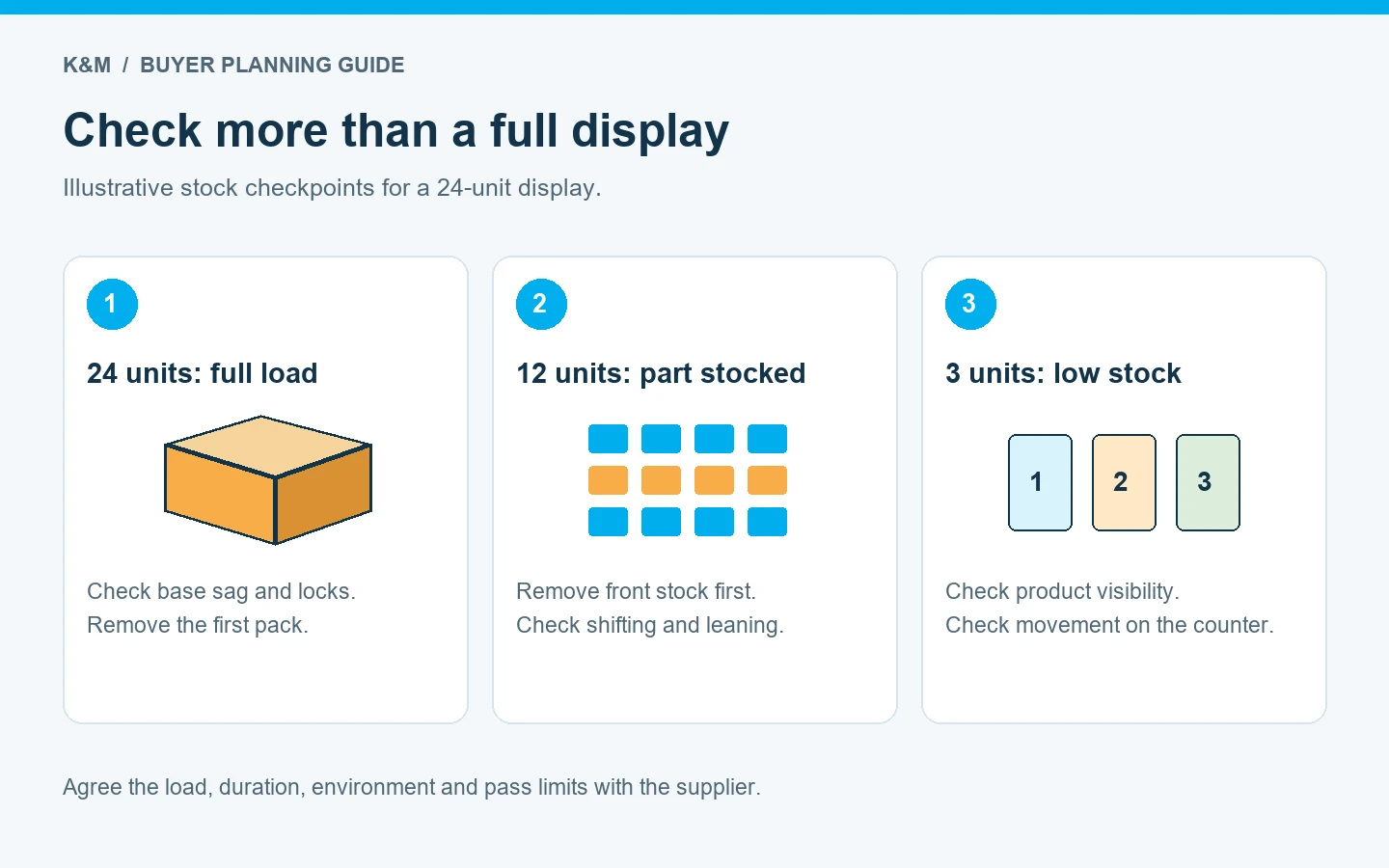
- 24 units: Measure base sag and check whether the first pack comes out without catching.
- 12 units: Remove the front stock first. Record fallen packs, shifted dividers, and movement between sections.
- 3 units: Check visibility and whether taking a product pulls the display across the counter.
Specify the board type, thickness, and paper grades rather than “heavy-duty cardboard.” The same paper grammage does not establish the load capacity of different box structures. A wider base or a different locking fold needs its own check.
Example acceptance clause: Load 24 specified products, totaling 1.8 kg. Hold at ___°C and ___% relative humidity for ___ days. Maximum base sag: ___ mm. No locking tabs may release, no base seams may split, and no products may fall out.
For a planned 30-day display period, agree on inspection dates during that period. If staff will carry the display fully loaded or refill it repeatedly, specify the handling method and number of operations to test.
Assembly and Shipping
State who folds the boxes, installs the dividers, and loads the toys. Specify whether tape or tools are allowed, the number of displays per shipping carton, carton dimensions, and gross weight. For tear-open designs, inspect the torn edges, printed panels, and sidewalls after opening.
Assembly time can change the cost comparison. For 1,000 displays, 30 seconds each equals about 8.3 hours; 90 seconds each equals 25 hours. At an illustrative labor rate of CNY 30 per hour, the difference is CNY 500, or CNY 0.50 per display.
Have three people unfamiliar with the design assemble one sample each. Record the time from flat pack to ready for loading, repeated steps, and extra tools. Use the trial to identify assembly problems, not to establish a production-wide average.
For prefilled shipments, test the complete shipping pack, including its outer carton and inserts. Choose the procedure for the actual route: ISTA distinguishes early screening tests from simulation procedures for specific shipment types.[1] Afterward, inspect the toys, retail packs, display structure, and barcode readability.
Artwork, Barcodes, and Labels
Approve the final artwork by version number and date. Use a signed physical color sample with its paper stock and finish identified. If you need three language versions at 1,000 units each, request separate unit prices, setup charges, and minimum quantities for each version.
Keep barcodes away from folds, joins, and curved surfaces. Check them on a finished, assembled, loaded sample using the intended store scanner. If the retailer requires a barcode verification grade, obtain the specified report as well.
Identify each code as an individual-item code, full-display code, or shipping-carton code. Confirm the retailer’s requirements before printing a full-display sales barcode where it could be scanned during an individual sale.
Market-Specific Information
Provide the destination country, intended age group, and whether the display stays in the store or goes home with the customer. If toys are sold individually, check the required information on each sale unit rather than relying on labels on the shared display.
For US children’s products, tracking information must appear on the product and its packaging to the extent practicable. It must allow identification of details including the responsible manufacturer or private labeler, production location and date, and batch or run.[2]
If the box doubles as a play scene or the header becomes a game map, include that use in the safety assessment. Packaging materials may also fall within specific requirements; CPSC’s toy safety guidance includes provisions for certain plastic packaging films.[3]
For EU sales, confirm the toy’s conformity assessment and CE marking requirements before approving the print files. The CE mark declares the toy’s conformity; it is not a general certification for an ordinary display box.[4]
Match test reports to the actual product and material versions. If an ink, coating, adhesive, or other assessed material changes, have the compliance reviewer confirm whether the existing evidence still applies.
Price, Approval, and Delivery
| Cost Item | Example Amount |
|---|---|
| 1,000 displays at CNY 4 each | CNY 4,000 |
| Cutting die and samples | CNY 600 |
| Shipping packaging | CNY 300 |
| Freight | CNY 500 |
| Total | CNY 5,400, or CNY 5.40 each if all 1,000 displays pass inspection. |
List taxes, inserts, filling, and testing separately if they are extra. Agree on quantity tolerances, repeat-order prices, die ownership, replacement deadlines, and who pays freight for replacement goods.
Define what starts a quoted “15-day production lead time”: deposit receipt, artwork approval, or sample approval. Specify working or calendar days and list the production completion date separately from the expected arrival date.
Before production, retain an approved sample and record any differences between it and the planned production materials or process. The inspection sheet should cover dimensions, loading results, barcodes, quantities, and agreed photo limits for scratches, exposed white edges, and excess glue. Any later material, dimension, or artwork change needs written approval and a revised document reference.