
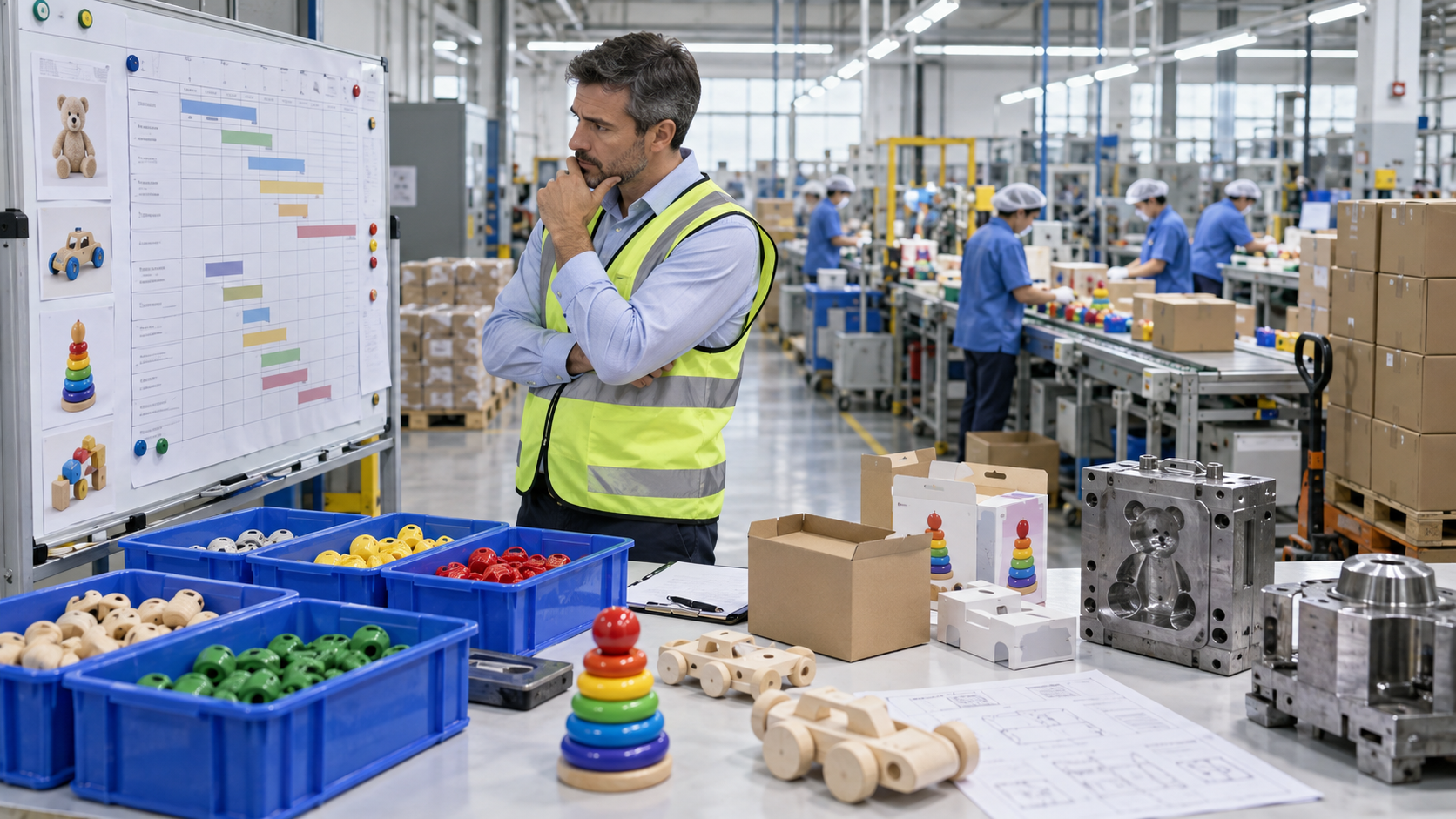
Toy production delays usually come down to one thing: something important is not ready when the next process needs it. A mold still needs work. A PCB is late. The box artwork is not approved. QC finds a defect after thousands of units are packed. Any one of these can move the shipping date.
A factory can tell you an order is 90% finished and still be nowhere near ready to ship. If the missing 10% includes a critical part, the rest of the percentage does not help much. Ask what is blocking the next step, who owns that problem, and what date is actually confirmed.
In a custom educational toy project, tooling, materials, packaging, testing, and production often overlap. Some jobs can move together. Others have to wait.
Find the Real Bottleneck
A typical custom toy moves through something like this:
Design → DFM → tooling → sample → approval → purchasing → molding → decoration → assembly → testing → packing → inspection → shipment
Standard screws can be ordered while a mold is being made. Artwork can move forward while samples are being checked if the product size and required text are already stable.
But assembly cannot finish without the PCB. Packing cannot finish without the box, manual, or insert. If the main housing mold still needs a steel change, full production should not start.
Treat a task as critical if:
- another process must wait for it;
- there is no approved substitute;
- a failure means another sample, mold trial, or test;
- it affects a fixed inspection or loading date;
- there is almost no schedule buffer left.
| Milestone | Planned Date | Expected Date | Risk |
|---|---|---|---|
| T1 mold trial | May 5 | May 5 | Low |
| T1 approval | May 8 | May 11 | Medium |
| PCB arrival | May 15 | May 22 | Critical |
| Box delivery | May 23 | May 23 | Low |
| Assembly start | May 18 | May 23 | Critical |
| Final inspection | May 28 | June 2 | Critical |
| Shipment | May 31 | June 5 | Critical |
Here the PCB is the real problem. The box is on time, but that does not save the order because assembly is waiting on the PCB.
Leave Some Room Around Risky Steps
A schedule with no space between key steps looks tidy on paper and can fall apart fast in real production.
Useful buffer usually sits between:
- T1 and final mold approval;
- critical component arrival and assembly;
- formal testing and production release;
- final inspection and container loading.
Say production finishes May 30, inspection is also May 30, and container loading is May 31. That gives the factory almost no room to fix a wrong manual, damaged box, failed function check, or carton-mark problem.
Even two extra days can help with a small sorting or repacking job. A mold or compliance problem is a different story and may need much longer.
Different Toys Get Stuck in Different Places
Plastic toys often lose time in tooling, molding, color matching, painting, pad printing, or assembly fit.
Electronic toys bring in more purchased parts: PCBs, switches, speakers, LEDs, battery contacts, firmware, and test fixtures. The assembly line can be fast while the final function test becomes the slowest step.
Wooden toys can run into moisture, warpage, sanding, paint, coating, and drying problems. If a painted part is packed too early, it can stick to the insert or pick up marks.
Fabric toys have another set of problems: fabric availability, dye-lot differences, printing, embroidery, sewing capacity, filling, and attachment quality.
STEM kits are usually more about part count. A science kit may include experiment materials, plastic parts, cards, labels, tools, bags, instructions, and retail packaging. One missing item can stop the whole pack-out.
The same thing happens with a dinosaur dig kit. The block may be finished, but if the tools, guidebook, insert, or retail box are missing, you still do not have a complete sellable unit.
Tooling Delays
A supplier may quote:
Tooling: 25 days.
That number only works if the design is frozen. Mold size, number of cavities, sliders or lifters, surface finish, material, and the number of correction rounds all change the schedule.
Small Design Changes Can Spread Fast
Take a battery compartment that needs to become 5 mm wider.
That may touch:
- the outer housing;
- internal ribs;
- screw bosses;
- battery contacts;
- the battery door;
- PCB position;
- wiring;
- wall thickness;
- packaging size.
If the mold is already being cut, the factory may have to modify the steel and run another sample. A 5 mm change sounds small. The work behind it may not be.
Check DFM Before Steel Is Cut
Before tooling starts, check the things that commonly cause molding trouble:
- walls that are too thick or too thin;
- not enough draft;
- deep ribs;
- weak snap fits;
- difficult undercuts;
- poor gate positions;
- difficult ejection;
- unnecessarily tight tolerances;
- large flat surfaces that can distort.
A thick plastic section can cool more slowly than the area around it. Sink marks or distortion may show up during T1.
Instead of:
T1 → approval
you get:
T1 → problem found → mold change → another trial → another approval
For a moderate correction, a buyer might leave 3–7 working days in the plan before the next trial. That is just a planning range. A machine-setting change may be much faster. Welding and re-machining can take longer.
Not Every Mold Change Is Quick
Removing a small amount of steel may be straightforward. Adding steel back is usually more work. The toolmaker may need welding, re-machining, EDM, polishing, texture repair, and another trial.
If the factory says “small mold modification,” ask:
- what section is changing;
- whether steel is being added or removed;
- whether welding is needed;
- whether texture or polish will be touched;
- whether another trial is needed;
- when the next sample will be ready.
T1 Can Still Have Problems
Common T1 problems include:
- flash;
- short shots;
- warpage;
- sink marks;
- gate marks;
- poor surface finish;
- loose or tight assembly;
- uneven gaps;
- misaligned holes;
- weak clips;
- wrong dimensions.
Flash caused by setup may be fixed at the machine. A wrong snap-fit dimension may need steel work. Those are very different delays.
One Toy May Need Several Molds
A toy can use separate molds for the front housing, rear housing, buttons, wheels, battery door, and accessories.
If five of six molds have passed the final trial:
5 ÷ 6 = about 83%.
| Example Mold | Status |
|---|---|
| Front housing | Approved |
| Rear housing | Approved |
| Buttons | Approved |
| Wheels | Approved |
| Battery door | Correction required |
| Accessory | Approved |
That 83% sounds good until you notice the battery door is used on every toy. Final assembly is still blocked.
Freeze One Approved Specification
Before tooling and purchasing start, keep one approved version for materials, dimensions, colors, components, assembly, packaging, and quality limits.
A toy product specification sheet helps keep the buyer, factory, QC team, and subcontractors on the same revision.
Before tooling starts, confirm:
- 3D files are final;
- materials are selected;
- critical dimensions are marked;
- cosmetic surfaces are identified;
- assembly method is fixed;
- mating components are confirmed;
- DFM comments are closed.
Component Delays
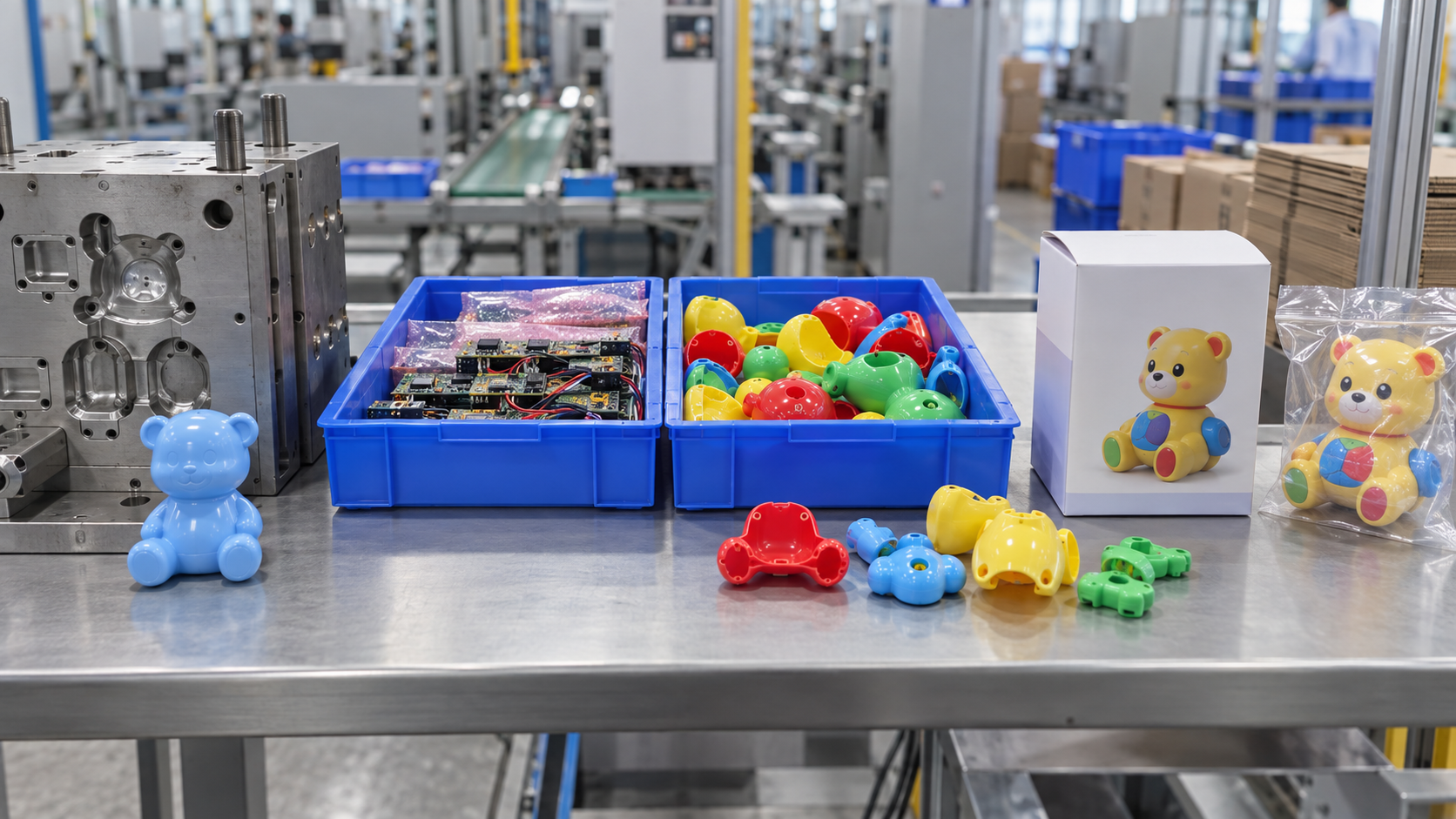
A toy factory may mold the housing and assemble the product, but many parts still come from outside suppliers.
A learning toy can include:
- plastic parts;
- screws;
- springs;
- magnets;
- PCBs;
- speakers;
- LEDs;
- wires;
- battery contacts;
- switches;
- labels;
- printed cards;
- fabric;
- adhesive;
- packaging inserts.
Track Long-Lead Parts One by One
| Component | Custom? | Example Lead Time | Status | Risk |
|---|---|---|---|---|
| Screws | No | 3 days | Ordered | Low |
| Speaker | Yes | 12 days | Ordered | Medium |
| PCB | Yes | 20 days | Ordered | High |
| Printed cards | Yes | 8 days | Not ordered | Medium |
The numbers above are planning examples. The important part is the logic. A $0.02 contact or spring can stop a much more expensive toy if every unit needs it.
Check How Many Complete Units Can Be Built
“99% of materials have arrived” sounds better than it may really be.
Say the order is 20,000 pieces and the factory has every part except enough battery contacts. Only 5,000 approved contacts are in stock.
5,000 ÷ 20,000 = 25%.
So the factory can finish only 25% of the order, even if almost every other material has arrived.
The same issue shows up in the BOM. If 23 of 25 BOM lines are ready:
23 ÷ 25 = 92%.
That 92% does not help much if one missing line is the PCB used in every unit.
Ask one simple question:
“How many complete units can you assemble today?”
“Ordered” Is Not a Useful Final Status
For critical parts, track:
- PO issued
- supplier confirmed
- raw material available
- production started
- production completed
- goods shipped
- goods received
- incoming QC passed
Treat the part as ready only after it arrives and passes incoming QC.
Incoming Parts Can Still Fail
Common incoming problems include:
- wrong dimensions;
- wrong color;
- weak spring force;
- poor plating;
- bad solder joints;
- wrong connector;
- low battery capacity;
- wrong magnet specification;
- scratched surfaces;
- mixed models.
If 20,000 switches arrive on time but fail the incoming requirement, the factory may have to sort, return, or replace them. The truck was on time. Production still lost time.
Check Substitute Parts Before Use
A replacement part can change fit, durability, electrical performance, material composition, or safety performance.
For U.S. children’s products, third-party testing requirements depend on the product, age group, use, and material composition.[1]
Compare any substitute with the approved specification first. A full retest is not needed for every change, but the effect of the change has to be checked.
Packaging Delays
A finished toy still cannot ship if the box, tray, artwork, manual, barcode, warning, or master carton is not ready.
A retail pack may need:
- dieline;
- artwork;
- barcode;
- warnings;
- age information;
- instructions;
- product images;
- company information;
- insert or tray;
- master-carton marks.
Small Product Changes Can Change Carton Math
If the toy grows from 198 mm to 205 mm after a mold correction, the old tray may not fit.
A size change can affect the retail box, units per carton, master-carton size, gross weight, and freight volume.
Take a simple box example:
200 × 150 × 100 mm = 3.0 liters
After a small size increase:
210 × 155 × 105 mm ≈ 3.42 liters
The increase is:
(3.42 − 3.0) ÷ 3.0 ≈ 14%.
None of the three dimensions changed very much, but the box volume went up by about 14%.
Carton Count Can Jump Too
For a 12,000-piece order packed 24 units per carton:
12,000 ÷ 24 = 500 cartons.
If the new retail box allows only 20 units per carton:
12,000 ÷ 20 = 600 cartons.
That is 100 more cartons, a 20% increase. More cartons mean more handling, more carton material, and usually more freight volume.
Split Packaging Approval Into Three Checks
Structural sample: size, fit, protection, tray position, pack-out.
Printed proof: artwork, text, barcode, color, product image, warnings, model number, language.
Production packaging: the actual mass-produced box, insert, label, manual, and finished toy together.
Keep Artwork Versions Simple
A file called:
toy-box-final-new2-revised.pdf
is asking for trouble.
A cleaner name is:
SKU123_Box_Artwork_V07_Approved_2026-09-09.pdf
Only one approved file should be active for production.
Printing Still Takes Time
After artwork approval, the packaging supplier may still need:
- prepress checks;
- proof approval;
- paper procurement;
- printing;
- lamination or coating;
- die cutting;
- window application;
- gluing;
- tray production;
- delivery.
Foil, embossing, spot UV, molded inserts, and blister trays add more steps.
Packaging and Compliance Can Hold Shipment
For U.S. children’s products, tracking information generally needs to be permanently marked on the product and its packaging, to the extent practicable, so details such as the manufacturer or private labeler, production location and date, and batch or run can be identified.[2]
Certification is separate from packaging text. Toys intended for children 12 and under are subject to third-party testing and Children’s Product Certificate requirements for the applicable U.S. children’s product safety rules.[3]
The domestic manufacturer or importer is generally responsible for issuing the CPC. The lab does not issue the CPC for the company.[4]
Since July 8, 2026, importers of most regulated consumer products covered by CPSC certificate rules must electronically file certificate data through the CPSC eFiling process.[5]
For U.S. and EU orders, the toy safety compliance workflow should be set before packaging and mass production are locked.
Plan for EU Rule Changes
Regulation (EU) 2025/2509 is the new EU Toy Safety Regulation. It applies from August 1, 2030, while some provisions apply earlier. Toys placed on the EU market in line with Directive 2009/48/EC before August 1, 2030 are covered by the transition rules.[6]
If a product will keep selling for several years, check the rules again before reusing old packaging and compliance files.
QC Delays
If QC finds a basic problem after thousands of units are packed, the correction can take much longer than the original defect took to create.
Make Inspection Rules Clear
“No obvious scratches” is too loose.
Use measurable limits, photos, or an approved sample for:
- critical dimensions;
- color;
- printing position;
- assembly gap;
- button function;
- sound or light function;
- accessory count;
- packaging condition.
Keep One Golden Sample
If the buyer has Sample 4, production uses Sample 3, and QC checks against Sample 2, people are judging three different products.
The approved sample should show:
- SKU;
- revision;
- approval date;
- sample number;
- approval reference.
Check the First Production Pieces
Say a logo is printed 4 mm too low.
If a 30-piece first-piece check catches it, the factory may only need to adjust the setup.
If the printing line makes 3,000 parts in one shift and nobody checks until the end, as many as 3,000 parts may need sorting.
Check the Line While It Is Running
For an electronic educational toy, useful checks may include:
- PCB version;
- speaker output;
- LED function;
- button response;
- battery polarity;
- wire routing;
- firmware version;
- housing gap;
- label position.
Book Final Inspection Before the Last Day
The inspector can be ready while the goods are not.
For example:
- 60% finished;
- 30% packed;
- cartons still open;
- the rest still on the line.
That may force the inspection to move or be repeated later.
AQL Is Not a Safety Pass
Final inspection may use a sampling plan with critical, major, and minor defects.
The sampling rules and acceptance limits should be written into the order specification.
A safety or regulatory problem still needs its own decision. A low defect percentage does not make a real safety issue acceptable.
Fix the Cause Before Reworking the Goods
Use:
Defect → containment → root cause → correction → verification
A logo printed too low might come from the fixture, plate, operator setup, part position, or the wrong reference sample.
If the cause stays on the line, workers can spend all day fixing yesterday’s defects while making new ones today.
Rework Eats Time
Suppose 8,000 finished toys contain the wrong manual.
The cartons and retail boxes have to be opened, the manual replaced, the packs closed again, the cartons rebuilt, and the goods checked again.
At 45 seconds per unit:
8,000 × 45 seconds = 360,000 seconds = 100 direct labor hours.
With 10 workers moving at the same speed:
100 labor hours ÷ 10 workers = about 10 direct working hours.
Real time will be longer once you add carton movement, damaged-pack replacement, supervision, recounting, and reinspection.
Testing Delays
ASTM F963-23 is the mandatory toy safety standard version incorporated by CPSC for relevant children’s toys manufactured on or after April 20, 2024.[3]
Set the test plan during development.
The scope can depend on:
- age grading;
- small parts;
- magnets;
- batteries;
- electronics;
- projectiles;
- sound;
- materials;
- coatings;
- cords;
- accessible points and edges.
Use the Production Version for Testing
The tested sample should match the product the factory will actually make.
Watch for changes in:
- plastic grade;
- paint or coating;
- magnet;
- PCB;
- battery;
- adhesive;
- mechanical connection.
CPSC requires applicable children’s product testing to be done by a CPSC-accepted third-party laboratory, and the tests vary with the product and its materials.[1]
A Failed Test Can Send the Product Back to Engineering
A failed test can turn into:
failure → engineering review → product change → mold or component correction → new samples → internal check → laboratory retest
| Step | Example Time |
|---|---|
| Failure review | 1 working day |
| Engineering correction | 2 working days |
| New sample build | 2 working days |
| Internal verification | 1 working day |
| Laboratory retest | 3 working days |
| Total | 9 working days |
Nine days is only a simple project example. A small fix may be quicker. A mold change or difficult lab issue can take much longer.
Buyer Approvals Can Burn Through the Schedule
Common approvals include:
- DFM;
- mold design;
- T1 or T2 samples;
- color;
- electronics;
- packaging;
- manuals;
- cartons;
- production samples.
If five approvals happen one after another and each waits three working days:
5 × 3 = 15 working days.
Some approvals can run together, so the final delay may be less. But slow buyer feedback can still eat a large part of the schedule.
Use deadlines that connect to production:
“V6 artwork sent September 8. Approval required by September 10 to keep the September 16 printing slot.”
Once something is approved, do not reopen it casually.
Factory Capacity Can Look Better Than It Is
A supplier saying “we make 300,000 toys per month” does not tell you where your order will get stuck.
For a 50,000-piece order:
| Process | Daily Output | Days Needed |
|---|---|---|
| Molding | 20,000 | 2.5 |
| Painting | 8,000 | 6.3 |
| Assembly | 6,000 | 8.3 |
| Functional test | 5,000 | 10 |
| Packing | 7,000 | 7.1 |
Testing takes 10 days here, so another molding machine does not solve the main delay.
When sourcing educational toys from China, ask for output by molding, painting, assembly, testing, and packing instead of relying on one monthly factory-capacity number.
Ask What Capacity Is Actually Assigned to Your Order
A factory can own four assembly lines and give your order only one.
Ask:
- how many lines are assigned to your order;
- how many test fixtures are available;
- daily output at the slowest process;
- whether painting or printing is subcontracted;
- whether other orders use the same equipment.
Watch the WIP Pile
If molding makes 5,000 sets per day and assembly finishes only 2,000:
5,000 − 2,000 = 3,000 extra WIP sets per day.
After five working days:
3,000 × 5 = 15,000 unfinished sets.
That pile tells you assembly is not keeping up.
Late Changes Get Expensive Fast
Before tooling, a button change may only need a drawing update.
After tooling, the mold may need work.
After material purchasing, stock may become unusable.
After mass production, parts may need sorting or rework.
After compliance testing, the changed product may need another compliance review.
| Example Change | Stock Impact | Tool Impact | Test Impact | Packaging Impact | Example Delay |
|---|---|---|---|---|---|
| New button shape | None | Yes | Possible | No | 7 days |
| Darker housing color | Existing resin affected | No | Review | Photo may change | 4 days |
| New magnet | Existing stock may be unusable | No | High | No | To confirm |
The 7-day and 4-day figures are sample project values, not fixed industry lead times.
Holiday Risk Starts Outside the Main Factory
The assembly factory may reopen while the carton supplier is still closed. The PCB supplier may be clearing a backlog. A printer or coating subcontractor may be working at half speed.
For major holiday periods, confirm:
- last practical purchasing date;
- last production date;
- last shipping date;
- restart date;
- normal-capacity date.
A multi-factory toy sourcing plan should track every critical supplier against the same shipment date.
Early Signs That the Order Is Slipping
- T1 corrections have no completion date.
- The BOM is still changing after sample approval.
- A critical component ETA changes more than once.
- A critical component has no confirmed delivery date.
- Packaging artwork keeps changing near the printing date.
- The factory cannot show reliable daily output.
- WIP grows while finished-goods output stays low.
- Rework quantity keeps increasing.
- Final inspection moves closer to loading day.
- A subcontractor’s status is unclear.
- The supplier keeps saying “should be okay” without giving dates or quantities.
Ask for Dates and Quantities
When something slips, ask:
- What exact item is late?
- Why is it late?
- What was the original date?
- What date is now confirmed?
- Which process is waiting for it?
- Can another process keep moving?
- How many finished units are ready?
- How many units are at each production stage?
- Does this move testing or inspection?
- What is the new shipment date?
Keep three dates separate:
- planned date — the original schedule;
- confirmed date — the current supplier commitment;
- actual date — when the job really finished.
“PCB expected around May 20” is still an estimate.
“PCB supplier confirmed May 20 dispatch” is better.
“PCB received May 22 and incoming QC passed May 23” means the factory can actually use it.
Ask for Proof on Critical Milestones
Useful proof can include:
- mold trial and measurement reports;
- open tooling corrections;
- component supplier confirmation;
- incoming QC result;
- approved artwork revision;
- daily production quantity;
- WIP and rework quantity;
- inspection report;
- corrective-action result.
A close-up photo of finished toys does not tell you whether 500 units or 50,000 units are ready.
Look Past the Direct Cause
A PCB supplier may deliver late. But if the toy factory placed the order two weeks late, the purchasing process is the bigger problem.
A buyer may approve artwork late. If the factory never said that missing Friday’s deadline would lose the print slot, planning was weak too.
Recover Time Where the Delay Actually Is
- Run independent work in parallel: finish safe subassemblies, printing, or packaging work that will not need to be opened again later.
- Finish ready SKUs first: one late model does not always need to hold the others.
- Add labor: helpful only when assembly or packing labor is the problem.
- Add test fixtures: useful when function-test capacity is the bottleneck.
- Expedite transport: useful when the part already exists. Air freight cannot speed up a part that has not been made.
- Split shipment: useful only when the ready goods are complete, acceptable, and useful on their own.
Do not save time by skipping required testing, safety checks, inspection, curing, or verification.
One Delay Example
Take a 20,000-piece electronic learning toy order:
| Stage | Original Plan |
|---|---|
| T1 mold trial | Day 15 |
| Sample approval | Day 18 |
| PCB arrival | Day 30 |
| Packaging arrival | Day 32 |
| Assembly | Day 33–38 |
| Final inspection | Day 40 |
T1 finds that the button is too tight. The mold needs four more days.
At the same time, PCB production starts late and the PCB moves five days.
You cannot simply say the order is nine days late. Artwork, standard-component purchasing, and other jobs may keep moving while the mold is being fixed. The final delay depends on which late item blocks assembly.
Do Not Start Full Production Yet If
- the main product structure is still changing;
- a safety-critical part is not confirmed;
- production material is still being selected;
- the approved sample does not match the planned production version;
- important mold corrections are still open;
- the compliance plan is still unclear.
Do Not Release Shipment Yet If
- a critical defect is still open;
- rework has not been checked;
- required compliance documents are not ready;
- the final product differs from the approved or tested version;
- the agreed final inspection has not been completed.
Conclusion
Toy delays are easier to manage when the buyer tracks a few hard numbers instead of one overall percentage. Five of six molds may look like 83% complete, yet one missing battery-door mold can still stop every finished unit. A 20,000-piece order with only 5,000 approved critical parts is only 25% buildable. If molding makes 5,000 sets a day and assembly finishes 2,000, WIP grows by 3,000 sets a day and reaches 15,000 in five days. Keep an eye on the current bottleneck, the quantity actually ready, the owner of the problem, and the next confirmed date.