
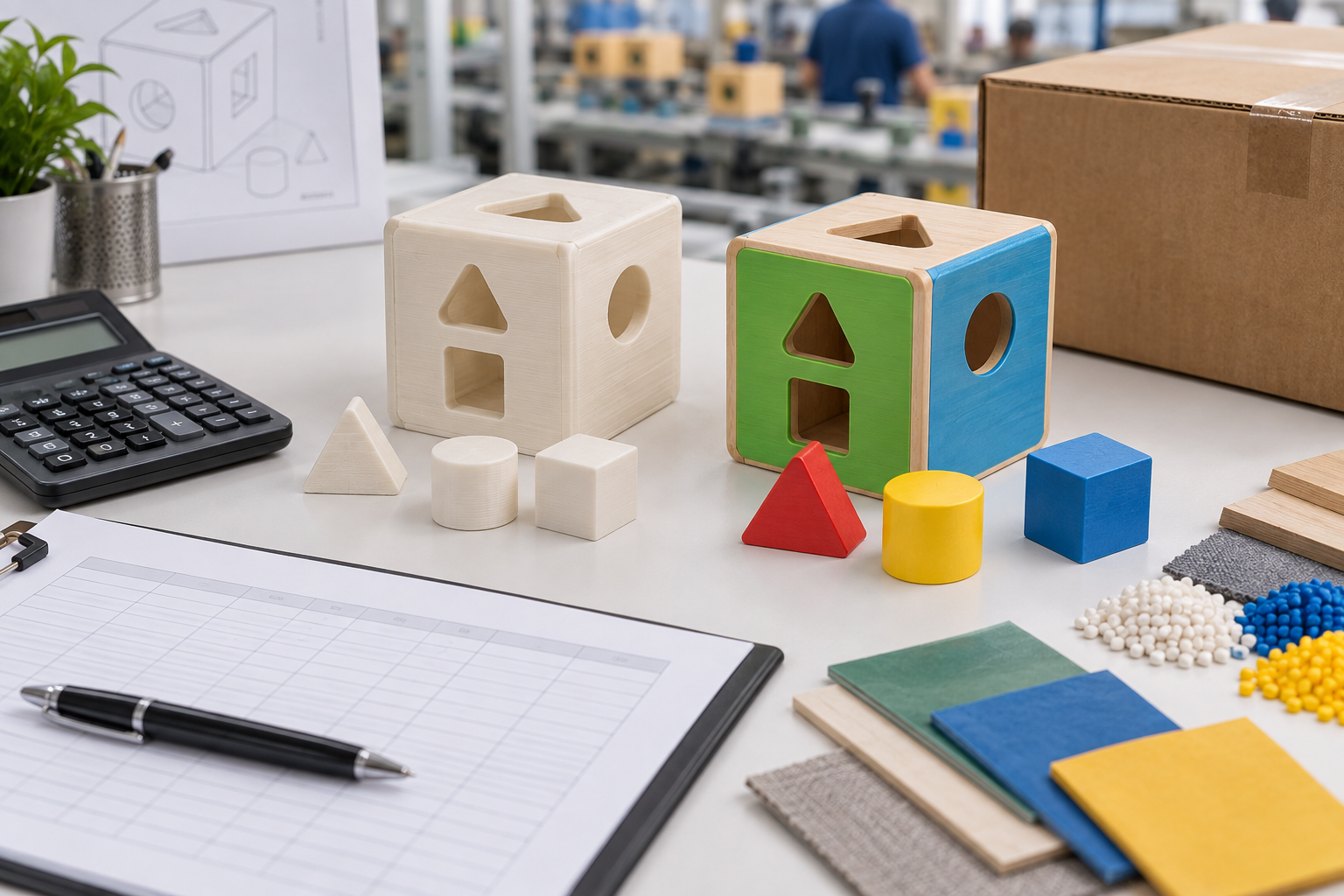
A toy that leaves the factory at $4.20 does not really cost your brand $4.20.
You may still have to pay for samples, tooling, testing, packaging setup, inspection, freight and import costs. On a first order, those extra costs can be bigger than expected.
Here is a simple example. You order 3,000 units at $4.20 each. Production costs $12,600. Then you add $8,000 for tooling, $1,500 for samples, $2,000 for testing, $700 for packaging setup, $400 for inspection and $3,500 for freight and import costs.
Your first run now costs $28,700, or $9.57 per ordered unit.
All dollar figures below are budgeting examples. They are not universal factory prices, testing fees or industry averages.
Three Toy Cost Numbers You Need
Factory price is the supplier’s price under the quoted Incoterm.
Landed cost adds the cost of getting the goods to the agreed destination. Depending on the shipment, that can include freight, insurance, duty, customs-related charges and local transport.
Fully loaded first-run cost goes one step further. It also includes one-time costs such as development, samples, tooling, initial testing and packaging setup.
For a new toy, use this calculation:
Fully loaded first-run cost = development + samples + tooling + production + packaging setup + testing + inspection + freight + import costs
Cost per sellable unit = fully loaded first-run cost ÷ sellable units
| Cost | Main Driver |
|---|---|
| Development | CAD, mechanics, electronics, custom parts |
| Samples | Prototype method and number of revisions |
| Tooling | Part size, cavity count, geometry, mold structure |
| Production | Materials, components, labor, decoration |
| Packaging | Structure, printing, inserts, dimensions |
| Testing | Sales market, age grade, materials, functions |
| Inspection | Product complexity and inspection scope |
| Freight | Weight, volume, route, transport mode |
| Import costs | Destination and tariff classification |
How Much Should You Budget?
A product already made by the factory is usually cheaper to launch than a completely new one. You avoid some design work, tooling and trial-and-error.
| Illustrative Project | Quantity | Production | Other First-Run Costs | Total | Cost Per Unit |
|---|---|---|---|---|---|
| Existing product + branding | 1,000 | $2,800 | $3,550 | $6,350 | $6.35 |
| Custom molded educational toy | 3,000 | $12,600 | $16,100 | $28,700 | $9.57 |
| Custom electronic toy | 2,000 | $19,000 | $28,800 | $47,800 | $23.90 |
Pick the manufacturing route before you ask for final pricing. Private label, ODM and custom OEM toy manufacturing have different engineering, tooling and MOQ requirements.
Need a first-order cost breakdown?
Send your product type, quantity, sales market and packaging requirement. K&M can separate product cost, customization, tooling and MOQ-related charges before you choose a production route.
1. Product Design and Engineering
A factory needs more than a sketch. It needs dimensions, materials, colors, components, assembly details and tolerances.
If you use an existing product, you may only need new artwork and packaging. A custom electronic toy is different. It may need CAD files, mechanical design, PCB work, firmware, component selection and production drawings.
Part count matters too. A toy with two plastic shells is easier to manage than one with 12 molded parts, switches, wires, a speaker and a PCB.
Set the custom educational toy development process before tooling starts. Changing the structure after the mold is made gets expensive quickly.
Development Cost Per Unit
Suppose development costs $4,000.
| Lifetime Volume | Development Cost Per Unit |
|---|---|
| 1,000 | $4.00 |
| 5,000 | $0.80 |
| 20,000 | $0.20 |
The development bill stays the same. You are simply spreading it over more units.
2. Samples and Prototypes
The first sample often finds problems that were hard to see on a screen: parts do not fit, a mechanism feels weak, the color looks wrong, assembly takes too long or the box does not protect the product well.
If one sample round costs an illustrative $400, three rounds cost $1,200.
That extra sample round can still be cheap compared with fixing a mold or opening finished cartons to rework thousands of units.
3. Tooling and Mold Costs
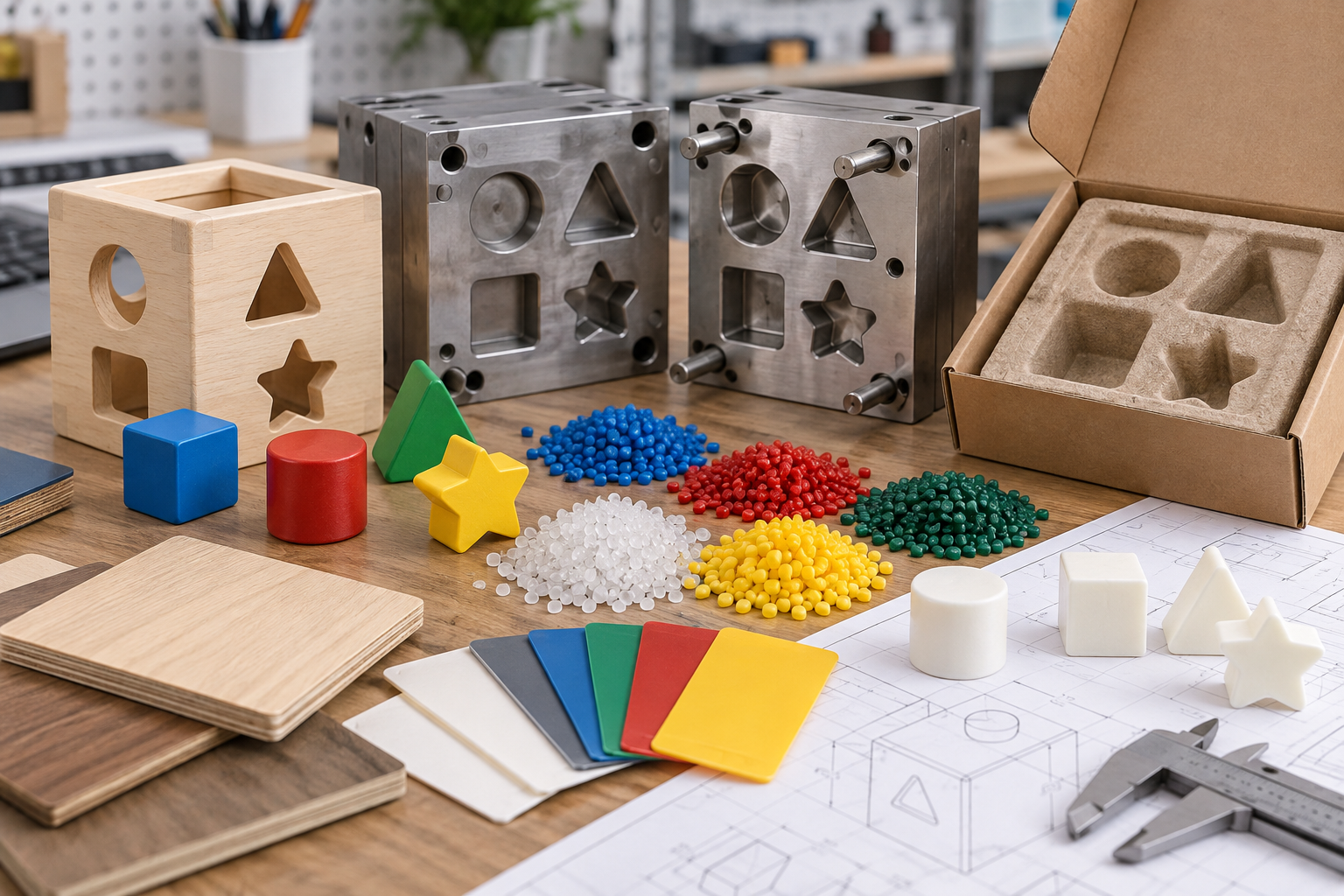
Injection-molded toys may need new molds before mass production can start.
Tooling cost changes with part size, cavity count, shape, undercuts, sliders, surface finish, tolerances and expected mold life.
One toy part does not always mean one mold. Several parts may share the same tool. Ask the supplier which parts need new tooling and which can use existing molds.
How Fixed Costs Change With Quantity
Assume development, tooling, testing and setup total $12,000. Manufacturing stays at $4.80 per unit.
| Quantity | Fixed Cost Per Unit | Manufacturing | Combined Cost Before Freight |
|---|---|---|---|
| 500 | $24.00 | $4.80 | $28.80 |
| 1,000 | $12.00 | $4.80 | $16.80 |
| 3,000 | $4.00 | $4.80 | $8.80 |
| 5,000 | $2.40 | $4.80 | $7.20 |
| 10,000 | $1.20 | $4.80 | $6.00 |
Put Tooling Terms in Writing
- Which molds or tools are included?
- Who owns them?
- Where are they stored?
- What is the expected production life?
- Who pays for maintenance?
- Can the tooling be moved to another factory?
- How are engineering changes charged?
4. Materials and Components
A toy BOM can include plastic, wood, fabric, stuffing, screws, magnets, motors, switches, LEDs, speakers, batteries, PCBs, coatings and adhesives.
Do not judge cost by weight alone. A 200 g electronic toy with 25 parts may cost more to source and assemble than a 500 g toy made from two molded pieces.
Small Changes Add Up Fast
If a better component adds $0.18 per unit, the extra spend becomes:
| Quantity | Added Cost |
|---|---|
| 1,000 | $180 |
| 5,000 | $900 |
| 10,000 | $1,800 |
| 50,000 | $9,000 |
Put approved materials and components in the BOM. A supplier swapping a component without approval can change the price, appearance, performance or compliance of the finished toy.
5. Manufacturing and Assembly
Making the toy can involve molding, cutting, sewing, printing, painting, soldering, fastening, gluing, electronics assembly and functional testing.
Even a small manual step becomes noticeable at volume. Add 20 seconds of work to each unit and you add about:
- 16.7 production hours at 3,000 units;
- 55.6 production hours at 10,000 units.
Decoration works the same way. One more paint color may need another mask, another setup, another application, drying time and another inspection point.
Before cutting material quality, look for work the product simply does not need.
6. Packaging Cost
Packaging cost is not just the box. It can include printing, inserts, instructions, labels and the amount of space the finished package takes during shipping.
Lock the package before printing starts. A late artwork or structure change can leave you with boxes you cannot use. The private-label toy packaging process covers the main approval points.
Box Size Example
A 24 × 18 × 8 cm retail box has a volume of 3,456 cm³. Across 3,000 units, that is a theoretical individual-box volume of 10.37 m³.
Reduce the depth from 8 cm to 7 cm and the total falls to 9.07 m³.
That is a 12.5% reduction. Real freight savings depend on master-carton packing, pallet use and container utilization, but one centimeter can matter when you multiply it by thousands of boxes.
7. Safety Testing and Compliance
Decide where the toy will be sold and who it is for before you lock materials and tooling.
Children’s toys subject to applicable U.S. children’s product safety rules generally require third-party testing by a CPSC-accepted laboratory and certification through a Children’s Product Certificate.[1]
For children’s products made outside the United States, the U.S. importer generally issues the CPC using passing test results. The laboratory provides the results; it does not issue the certificate.[2]
A laboratory is not automatically accepted for every toy test. CPSC acceptance is tied to specific testing scopes, so check the lab against the tests your product actually needs.[3]
Your compliance budget may include lab fees, samples, shipping, engineering changes and retesting.
For most imported regulated consumer products subject to certification, mandatory CPSC certificate eFiling began on July 8, 2026.[4]
For the EU market, manufacturers must complete the applicable safety assessment and conformity assessment, prepare technical documentation and apply CE marking before putting toys on the market.[5]
Regulation (EU) 2025/2509 entered into force on January 1, 2026. Most of its substantive requirements apply from August 1, 2030, subject to transitional provisions.[6]
If the factory changes a material, coating, component or construction detail, check whether the existing compliance evidence still covers the new version.
8. Quality Control
A passed lab test does not tell you whether every production unit was assembled correctly.
Production inspection can check dimensions, appearance, function, accessories, labels, barcodes, packaging and cartons. The educational toy QC checklist links those checks back to the approved BOM, drawings and sample.
Defects Change Your Real Unit Cost
Using the $28,700 first-run example:
| Sellable Units | Fully Loaded Cost Per Sellable Unit |
|---|---|
| 3,000 | $9.57 |
| 2,940 | $9.76 |
| 2,850 | $10.07 |
The implied 2% and 5% losses are only calculation examples. They are not acceptable defect standards.
For a large order, confirm the real manufacturing site, production capability, material controls and traceability. An educational toy factory audit is one way to check those points before money and inventory risk get bigger.
9. MOQ and Inventory Risk
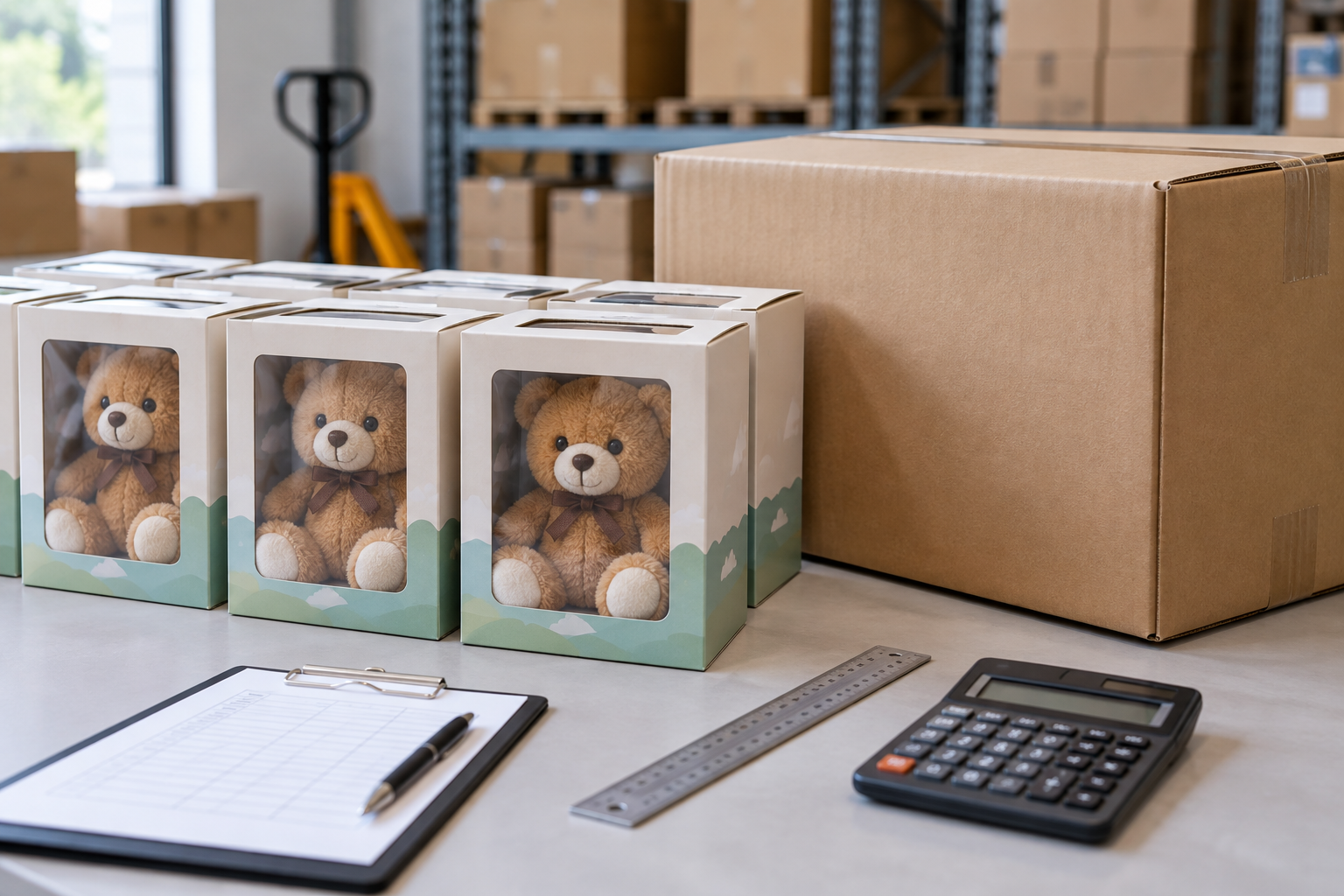
The factory may not be the real reason behind a high MOQ.
The limit can come from printed boxes, fabric, plastic color batches, electronics or another purchased component.
Ask one direct question: “Which component or process sets this MOQ?”
If the answer is packaging or a custom part, you may be able to lower the MOQ by using an existing mold, standard material, shared component or simpler package. The MOQ guide for custom educational toys explains the common constraints.
Turn MOQ Into Months of Inventory
If you expect to sell 300 units per month:
| Order Quantity | Inventory Coverage |
|---|---|
| 1,500 | 5 months |
| 3,000 | 10 months |
| 5,000 | 16.7 months |
Now say the factory drops the price by $0.30 when you move from 3,000 to 5,000 units, and the new unit price is $5.00.
Those extra 2,000 units need another $10,000 in inventory cash.
Saving a few cents is not much of a win if the extra stock sits in a warehouse for a year.
MOQ higher than your launch forecast?
Send the product, target quantity and customization requirements. K&M can identify whether tooling, packaging, materials or purchased components are setting the minimum.
10. Work Backward From Retail Price
Do not wait for the factory quote to decide what you can afford.
Set a maximum landed product cost first.
At a $24.99 retail price:
| Illustrative Gross Margin | Maximum Landed Product Cost |
|---|---|
| 55% | $11.25 |
| 60% | $10.00 |
| 65% | $8.75 |
Maximum landed product cost = selling price × (1 − target gross margin)
At a 60% example margin:
$24.99 × 40% = about $10.00
That $10.00 is not profit. Advertising, marketplace fees, payment processing, fulfillment, returns, storage and overhead still have to come out somewhere else.
The percentages above are examples, not recommended margins.
11. Private Label vs. ODM vs. Custom OEM
| Model | Typical Changes | Cost Effect |
|---|---|---|
| Private label / existing product | Logo, packaging, selected colors | Lower development and tooling exposure |
| ODM | Existing platform with material, accessory or feature changes | Moderate development cost |
| Custom OEM | New structure, mechanisms or electronics | Higher engineering, sampling and tooling cost |
Custom tooling makes sense when the custom feature changes what the customer sees or uses. If an internal part already works and meets the specification, redesigning it just to make it “custom” can burn money for no real gain.
12. Cost Drivers by Toy Type
| Toy Type | Main Cost Drivers |
|---|---|
| Plush | Fabric, sewing, embroidery, stuffing |
| Plastic | Molds, molded parts, decoration, assembly |
| Wooden | Material, machining, sanding, coating |
| Electronic | PCB, firmware, components, molds |
| Collectible figure | Sculpting, molds, painting |
| Science kit | Part count, consumables, tools, instructions |
| Craft kit | Consumables, containers, accessories |
A custom science kit is a good example. The individual pieces may be cheap, but every activity can add another tool, consumable, instruction sheet or sourced component.
13. Two Easy Ways to Keep Cost Under Control
Share Parts Across Products
If several SKUs can use the same approved fastener, switch, wheel, battery cover or electronic module, reuse it.
Five products using five different switches means five component lines to buy and manage. Five products using one approved switch means one shared component.
Launch Fewer Variants
Five colors × three language versions × two accessory options creates up to 30 combinations.
That means more artwork, more packaging versions and more inventory to forecast. Start smaller. Add variants after real sales show which ones people actually buy.
14. What to Send for an Accurate Quote
If two factories receive different information, their quotations are not really comparable.
Send each supplier the same:
- product dimensions;
- drawings or reference files;
- target materials;
- colors;
- target age;
- sales markets;
- functions and electronics;
- accessories;
- printing or decoration;
- retail packaging;
- order quantity;
- known compliance requirements;
- required delivery timing.
Ask the supplier to separate:
- unit price;
- MOQ;
- sample charges;
- tooling;
- packaging setup;
- testing responsibility;
- production lead time;
- retail-box dimensions;
- master-carton dimensions and weight;
- Incoterm.
Carton size, testing responsibility, inspection timing and Incoterm should be agreed early in the educational toy sourcing process.
Already have a sketch, sample or product specification?
Send the files with your target quantity, market and packaging requirements. K&M can identify existing parts, new tooling and missing specifications before preparing the quote.
15. Compare Supplier Quotes by Total Cost
Say two factories quote the same 3,000-unit product:
| Supplier A | Supplier B | |
|---|---|---|
| Unit price | $4.60 | $5.40 |
| Tooling | $8,000 | $4,000 |
| 3,000-unit production | $13,800 | $16,200 |
| First run + tooling | $21,800 | $20,200 |
Supplier A is $0.80 cheaper per unit.
But Supplier B is $1,600 cheaper on the first 3,000-unit run.
Now look at the next 3,000 units. If neither supplier charges for tooling again, Supplier A costs $13,800 and Supplier B costs $16,200 in production.
So neither supplier is automatically cheaper. It depends on how many units you expect to buy over the life of the product.
Then check the less obvious details: material specification, tooling ownership, testing responsibility, packaging and delivery terms.
16. Before Paying a Deposit
Get these points in writing before production starts:
- Which drawings, BOM, artwork and approved sample control production?
- Who owns the tooling?
- What happens if the tooling needs correction?
- Can materials or components be changed without written approval?
- Who pays for corrective work if production does not match the approved specification?
- Who arranges required compliance testing?
- When can pre-shipment inspection happen?
- What happens if the shipment fails the agreed inspection criteria?
- How much payment is still due before shipment?
- How are missing, damaged or nonconforming units handled?
FAQ
How much does it cost to manufacture a toy?
There is no single price. Materials, tooling, part count, electronics, packaging, quantity, testing and logistics all change the cost. Calculate factory price, landed cost and fully loaded first-run cost separately.
Why is the first toy order more expensive?
The first order may include development, prototypes, tooling, packaging setup and initial testing. Some of those costs may not repeat at the same level on later orders.
What is usually the largest upfront toy manufacturing cost?
For injection-molded products, tooling can be a major upfront cost. Electronic toys may also need PCB work, firmware, component development and extra engineering before production.
Does a higher MOQ always reduce cost?
It can lower some fixed costs per unit, but it also locks more cash into inventory. Compare the unit saving with how long it will take to sell the extra stock.
What is the difference between factory price and landed cost?
Factory price is the supplier’s price under the agreed Incoterm. Landed cost adds the shipping and import expenses needed to get the goods to the destination.
How should a brand budget its first toy order?
Add development, samples, tooling, production, testing, inspection and logistics. Divide the total by expected sellable units. Then compare that number with the maximum product cost your selling price can support.
The Bottom Line
Before paying a deposit, work out three numbers:
- Total cash needed for the first order.
- Fully loaded cost per sellable unit.
- How many months of inventory the MOQ creates.
If one of those numbers does not work, fix it before production. Change the specification, tooling plan, packaging or order quantity while those changes are still cheap to make.