
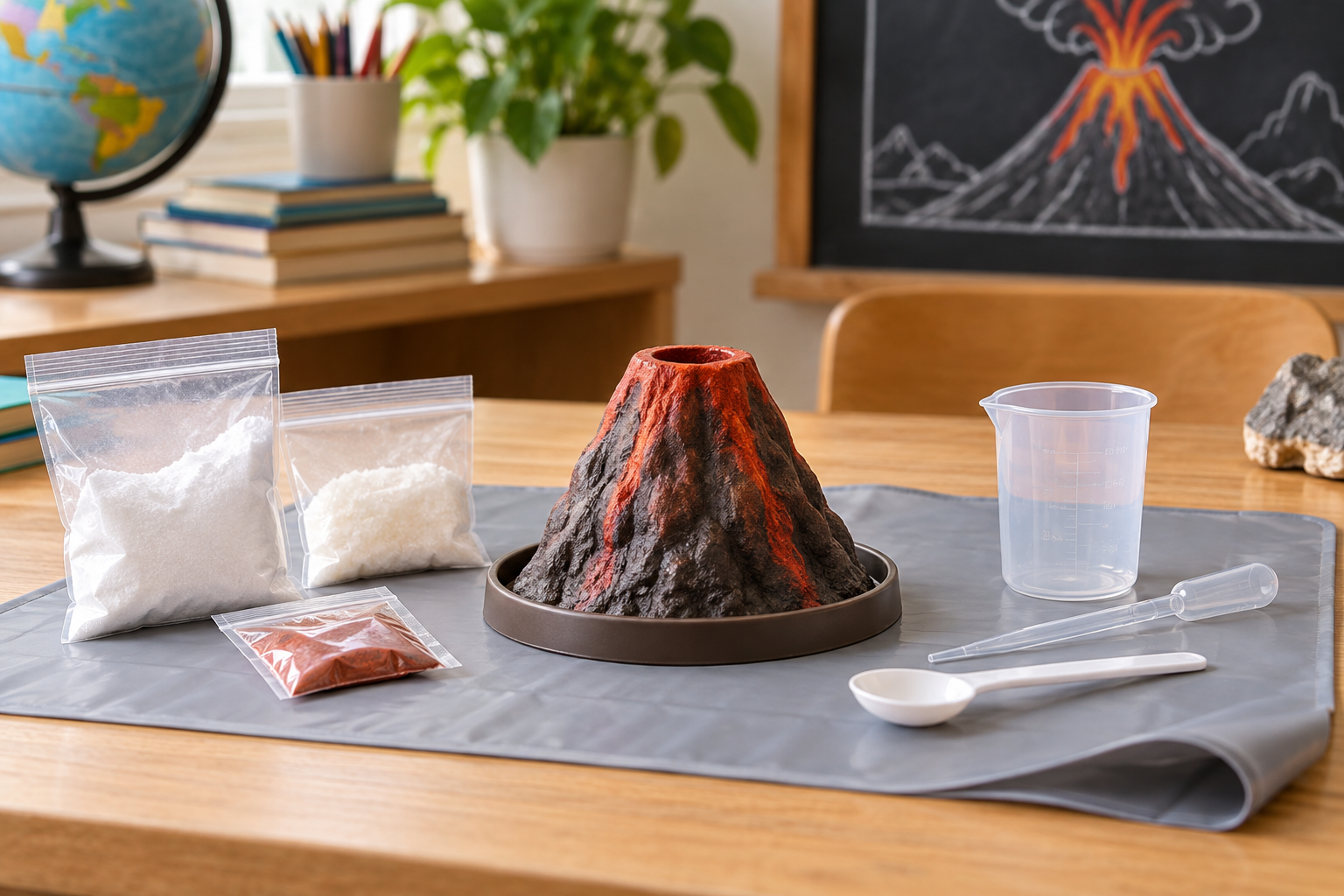
A good volcano kit should let a child do the experiment without hunting around for half the missing pieces. You need a usable volcano or the materials to build one, the right measuring tools, clear instructions, safety information, and either the experiment materials or a clear list of what to get at home.
Before buying, check the age grade, what is actually in the box, what you still need to supply, whether the main parts can be reused, and whether the instructions explain the science. A big box and a long parts list do not tell you much on their own.
What Should Be in a Complete Volcano Kit?
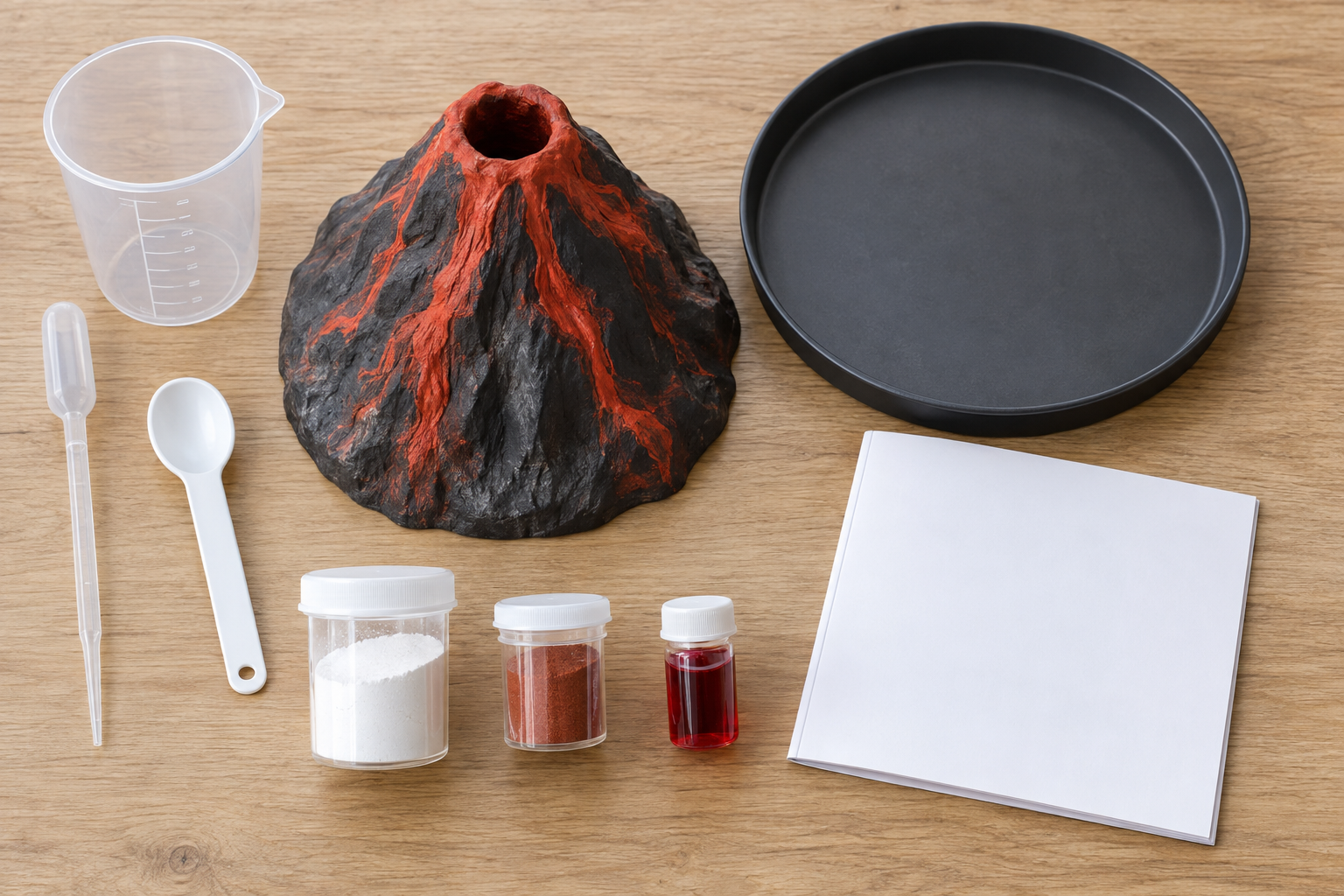
“Complete” does not mean the box has to contain every drop of liquid. Water, vinegar, baking soda, and other common household materials may be left out. That is fine as long as the product page tells you before you buy.
When comparing a kids’ science kit, look at the parts the child will actually use to build, measure, test, and repeat the activity. Stickers and decorative pieces may look nice in the box, but they do not make the experiment better.
| Component | What to Check | Why It Matters |
|---|---|---|
| Volcano model | Stable base, easy-to-reach reaction chamber, washable surface | Less chance of tipping and easier to use again |
| Measuring tools | Spoons, cups, droppers, or marked containers used in the instructions | Keeps the amount of each material more consistent |
| Experiment materials | Included consumables plus a clear list of anything needed from home | You know whether the child can start the activity right away |
| Instructions | Steps, quantities, warnings, supervision, and cleanup | Makes the experiment easier to repeat correctly |
| Science explanation | Explains the reaction and what the model does not represent | Stops the child from learning the wrong idea about real volcanoes |
The useful parts are usually the boring-looking ones: the measuring cup, dropper, instructions, and washable model. Those parts are what make a second experiment possible.
Start With the Manufacturer’s Age Grade
The U.S. Consumer Product Safety Commission looks at intended use, product presentation, how consumers recognize the product, and its Age Determination Guidelines when deciding whether a product is intended for children.[1]
CPSC guidance also looks at the physical skills, thinking ability, interests, and play behavior expected at different ages.[2]
That matters with volcano kits. A child may understand that two materials react and make gas, but still struggle to read measurement marks, control a dropper, pour into a small opening, or follow several steps in the right order.
Do not look at the experiment alone. Plastics, paints, coatings, small parts, and other educational toy materials are all part of the finished kit.
Check What You Need to Supply at Home
The product page should make two lists easy to find: what is in the box and what you need from home.
Depending on the experiment, that second list may include:
- water;
- baking soda;
- vinegar;
- dish soap;
- food coloring;
- paper towels;
- a washable tray or protected work surface.
This sounds basic, but it matters. A child opening a “complete” science kit and finding out that one essential ingredient is missing is not a great start, especially when the kit was bought as a gift.
Measuring Tools Turn It Into a Real Experiment
If the child simply mixes two things and watches foam come out, that is a demonstration. To compare one trial with another, the amounts or conditions need some control.
Useful tools may include measuring spoons, graduated cups, droppers, or marked containers. Fancy-looking lab accessories are not useful if the instructions never ask the child to use them.
The instructions should also give real quantities. “Add some powder” may be enough to make bubbles, but it is not much help if the child wants to compare two results.
A simple experiment can follow this pattern:
- run the original procedure;
- write down what happens;
- change one permitted variable;
- keep the other conditions the same;
- compare the new result with the first one.
Whether the packaging says science kit or STEM kit matters less than what the child actually does. Measuring, changing, recording, and comparing are more useful clues.
Check Whether the Kit Is Really Reusable
A plastic volcano can be washable and still be a one-time kit. If the reaction materials cannot be replaced, the model may end up sitting on a shelf after the first session.
Check these points:
- Can the volcano and tools be rinsed without damage?
- Can you reach the reaction chamber well enough to clean it?
- Does the manual tell you what can be used as refill material?
- Can you repeat the same procedure with defined quantities?
Reusable tools also give the child another chance to practice prediction, measurement, observation, and comparison after the original supplies are gone.
Planning a volcano kit for retail or private label?
Send the target age, destination market, experiment procedure, required components, packaging format, and expected order quantity.
Ready-Made or Build-Your-Own Volcano?
| Format | Main Activity | Check Before Buying |
|---|---|---|
| Ready-made model | Measure, mix, observe, and repeat | Stability, washable chamber, measuring tools, refill instructions |
| Build-your-own model | Build the volcano first, then run the experiment | Molding material, tools, paint, drying requirements, eruption materials |
A build-and-erupt geology kit has two jobs to do. The child has to build the model, then run the eruption experiment. Both stages need the right materials and instructions.
What Does a Baking Soda Volcano Actually Show?
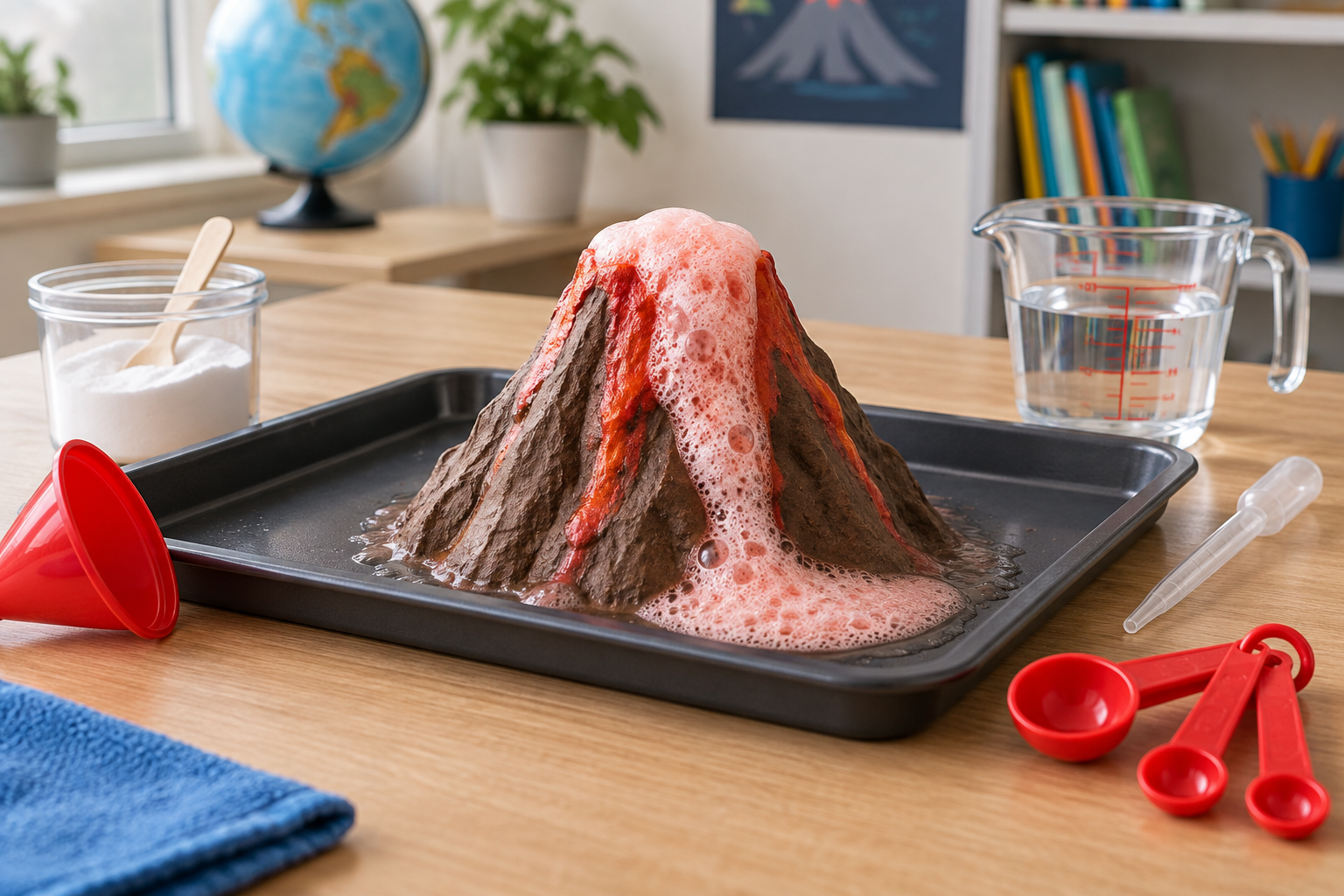
Many children’s volcano activities use sodium bicarbonate and vinegar. When they react, they produce carbon dioxide gas. The gas forms bubbles, and those bubbles can carry liquid or foam up and out of the volcano.
The National Park Service uses baking soda and vinegar in an educational volcano activity and explains that the reaction rapidly produces carbon dioxide bubbles.[3]
That part is real chemistry. The volcano itself is still only a model.
The National Park Service points out that the classroom reaction is different from a real eruption. In the baking-soda-and-vinegar activity, the reaction creates the carbon dioxide. In a volcanic system, gases are associated with magma.[3]
USGS explains that volcanic gases are dissolved in magma and separate as the magma rises and pressure drops. Water vapor, carbon dioxide, and sulfur dioxide are among the major volcanic gases.[4]
| The Kit Can Demonstrate | It Does Not Reproduce |
|---|---|
| Gas produced by a chemical reaction | Magma formation |
| Bubble formation | Volcanic temperatures |
| Material moving through an opening | Real geological pressure conditions |
| Changing and comparing experiment variables | The chemistry and scale of a real volcanic eruption |
If the instructions only call the effect an “explosion,” they miss the useful part. The child should understand that gas produced by the reaction is what pushes the foamy mixture out.
Do Not Trust the Experiment Count on the Box
A kit may advertise a long list of experiments, but the number means little if most of them repeat the same reaction.
Changing the foam from red to blue is a visual change. It is not automatically a new scientific investigation. Changing a defined variable and comparing the result gives the child something to test.
Look at what actually changes:
- Does the child measure a different variable?
- Is a different science idea introduced?
- Does the child record or compare a result?
- Does the activity use a different method?
- Does it answer a different question?
If the answer is no across the board, several “experiments” may just be different versions of the same activity.
Check Safety Information Before You Buy
The listing should show the intended age, supervision requirements, warnings, handling instructions, and any protective equipment required by the activity.
CPSC states that when a science kit is designed and primarily intended for children 12 years of age or younger, the items supplied in the kit are considered children’s products and must comply with applicable children’s product requirements.[5]
Children’s products covered by applicable federal children’s product safety rules generally require testing by a CPSC-accepted third-party laboratory and certification in a Children’s Product Certificate, subject to the requirements and exceptions that apply to the product.[6]
If a listing gives you no age grade, no clear manufacturer information, no warnings, and no useful description of the experiment materials, that is a reason to look more closely before buying.
Check Eye, Splash, and Pressure Risks
Use the protective equipment called for in the kit instructions.
The American Chemical Society’s elementary science safety guidance recommends properly fitting splash-proof goggles when students work with chemicals or watch others work with chemicals.[7]
Do not cap or seal a gas-producing volcano unless the activity is specifically designed and instructed as a pressure experiment. Gas building up inside a closed container can raise the pressure.
Think About Cleanup Before the Eruption Starts
A deep, narrow reaction chamber can be awkward to fill and annoying to rinse. A wider opening is easier to reach. Small grooves and decorative cavities around the base can hold wet residue after the experiment.
A tray or rimmed washable base helps catch runoff before it reaches the table. Separate tools are also easier to rinse than pieces fixed around the reaction area.
The National Park Service recommends doing its soda-bottle volcano activity outdoors or protecting an uncarpeted indoor area because it can get messy.[3]
If you are doing the experiment indoors, move books, electronics, and absorbent fabrics out of the splash area first. That takes less effort than trying to clean colored foam out of them later.
What Should Teachers Check?
For classroom science kits, plan around working groups rather than the total number of students.
If several groups have to wait for the same dropper, volcano model, or measuring cup, a short experiment can turn into a long queue.
Before ordering, check:
- how many groups will work at the same time;
- which tools each group needs;
- how much consumable material each procedure uses;
- how those materials will be refilled;
- how the parts will be cleaned between classes;
- whether the teacher needs separate preparation notes or instructions.
Specifying a volcano kit for classroom use?
Provide the working-group count, experiment procedure, consumables per group, target age, and destination market to work out tools, refills, teacher materials, and packaging.
Can It Be Used for a Science Project?
Making a volcano erupt shows that the procedure works. A science project needs a question that can be tested.
The student can change one permitted variable, keep the other conditions as consistent as possible, record the result, and repeat the procedure according to the teacher’s or competition’s rules.
Red Flags on a Volcano Kit Product Page
No age grade or safety information
You cannot tell whether the tools, small parts, warnings, or activity suit the intended child.
No complete contents or extra-material list
You may open the box and find that the experiment still cannot start.
“Reusable” but no refill information
A washable model is not much use after the first session if the experiment materials cannot be replaced.
A large experiment count with no activity details
The number tells you very little if the activities simply repeat the same reaction with different colors or decorations.
Buying Checklist
- Confirm the manufacturer’s age grade.
- Read the full contents list.
- Check which materials need to come from home.
- See whether the volcano and tools can be washed and reused.
- Find out how the consumables are replaced.
- Look for defined quantities in the instructions.
- If you want a real experiment, check that one variable can be changed and compared.
- Make sure the guide explains why the reaction happens.
- Make sure it does not present the model as the way a real volcano works.
- Read the supervision, warning, protective-equipment, and cleanup instructions.
For Retail and Private-Label Buyers
A parent is mainly asking a simple question: will this kit suit the child and work properly when the box is opened?
A retail or private-label buyer has more to pin down. The bill of materials, target age, destination market, packaging, instructions, warning placement, consumables, and repeat-order requirements all affect the final product.
A science kit manufacturer has to make the experiment, materials, production, packaging, and instructions work together. When comparing wholesale science kits, compare what is actually in the BOM and how the kit is built—not just the unit price.
Need a volcano experiment set built for your market?
Send the target age, destination market, experiment procedure, required components, packaging format, and order quantity.
Frequently Asked Questions
What should a complete volcano kit include?
It should include the volcano or building materials, the tools used in the experiment, clear instructions, age and safety information, and either the consumables or a clear list of materials to provide at home. If the kit is reusable, it should also explain how to replace the consumables.
Does a volcano kit need to include vinegar and baking soda?
No. Common household materials can be supplied separately as long as the product page and instructions say exactly what is needed.
Why are measuring tools important?
They make the quantities easier to repeat, so the child can compare one trial with another.
Is a baking soda volcano scientifically accurate?
The reaction is real, but it shows gas production rather than the way a real volcano erupts. NPS and USGS describe real volcanic systems in terms of magma, dissolved gases, pressure changes, and other geological processes.[3][4]
Can a volcano kit be used for a science fair?
Yes. The student needs to turn the demonstration into a testable question, control the other conditions, record the result, and repeat the procedure according to the teacher’s or competition’s rules.
Are volcano science kits children’s products in the United States?
If a science kit is designed and primarily intended for children 12 or younger, CPSC states that the supplied elements are children’s products and are subject to applicable children’s product requirements.[5]