

Short answer: Before you approve an educational toy factory in China, check five things: who will actually make the toy, how much capacity is really free for your order, how the factory controls materials and production, whether mass production still matches the tested sample, and whether a bad batch can be traced quickly.
Do not spend the whole audit in a meeting room looking at samples and certificates. Walk the line. Pick your own records. Open material boxes. Trace one finished carton back to production. Compare the BOM with the parts workers are actually using. That tells you far more about the factory than a polished presentation.
If you are still at the supplier-selection stage, these checks also fit naturally into the wider process of sourcing educational toys from China.
The capacity, yield, scoring and audit-sampling numbers used below are examples for planning. They are not legal limits or fixed industry benchmarks.
Audit, Test or Inspection?
| Check | Main Question | What It Covers |
|---|---|---|
| Factory audit | Can this factory control production? | Capacity, materials, processes, staff, records and traceability |
| Product testing | Does the tested toy meet the rules that apply? | Mechanical, chemical, electrical and other safety tests |
| Pre-shipment inspection | Is this batch ready to ship? | Quantity, workmanship, function, labels and packaging |
Testing checks the sample sent to the lab. A factory audit checks how the supplier works. A shipment inspection checks one production lot. You may need all three.
Start With the Toy
Do not audit a factory in the abstract. Audit it against the toy you plan to buy.
Before the visit, write down the target age, sales market, materials, dimensions, functions, packaging, key parts and current product version. Much of this should already be clear during custom educational toy development.
| Feature | Main Risk | What to Check |
|---|---|---|
| Small parts | Part comes loose | Part size, attachment and assembly method |
| Magnets | Magnet comes out | Magnet size, cavity size, retention and batch traceability |
| Paint or ink | Wrong material is used | Material code, supplier and batch |
| Plastic housing | Cracks, flash or poor fit | Resin grade, molding settings and dimensions |
| Wooden parts | Splinters, cracks or warping | Wood, moisture, sanding and coating |
| Battery | Unsafe access or bad assembly | Battery model, cover, screws, wiring and charging parts |
| Electronics | Wrong part or function failure | PCB version, wiring, firmware and function test |
Mark the safety-critical parts separately. A toy may have 12 controlled components but only 3 that can create a serious safety problem. Those 3 deserve closer checks when you review materials, assembly and supplier changes.
Also compare the age grade on the specification, packaging, test report and sales material. If the toy was assessed for older children but is later marketed to a younger age group, review the safety requirements again.
Verify the Factory
Write down the Chinese company name, Unified Social Credit Code, factory address, contract company and payment company.
China’s National Enterprise Credit Information Publicity System lets users search companies by name, Unified Social Credit Code or registration number.[1]
Different company names are not always suspicious. A factory may use a separate export company. Still, the supplier should be able to tell you who takes the order, who receives payment, who owns the factory and which site will make your goods.
Ask one direct question: Will the factory I am standing in actually make my order?
Check Outsourcing
Walk through the process and compare it with what the supplier claims to do in-house.
If painting is listed as an internal process but there is no spray area or drying area, ask where the parts go. Do the same for molding, printing, PCB assembly, sewing and special packing.
| Process | Where Is It Done? | Approved? | Incoming Check? | Change Notice? |
|---|---|---|---|---|
| Molding | Record location | Yes / No | Yes / No | Yes / No |
| Painting | Record location | Yes / No | Yes / No | Yes / No |
| Printing | Record location | Yes / No | Yes / No | Yes / No |
| PCB assembly | Record location | Yes / No | Yes / No | Yes / No |
When several factories make parts for the same order, use one specification, one traceability rule and one change process across all sites. That is especially important when sourcing toys from multiple Chinese factories.
Prove Capacity
Ask the production manager to show the math behind the monthly capacity figure.
Say one line makes 550 sets in an eight-hour shift. The factory has three suitable lines and works 25 days a month.
550 × 3 × 25 = 41,250 sets per month
If the factory plans around 80% operating efficiency:
41,250 × 80% = 33,000 sets per month
Now check how much of that capacity is already booked. If existing customers use 21,000 sets:
33,000 − 21,000 = 12,000 sets left for new orders
A sales brochure may say “33,000 per month.” Your order can only use what is still available.
Check Good Output
Now look at first-pass yield.
If a line makes 2,000 toys a day and 92% pass the first inspection:
2,000 × 92% = 1,840 good pieces
That leaves 160 pieces for rework, sorting or scrap.
Over 25 working days:
160 × 25 = 4,000 pieces needing extra handling
If 4,000 pieces need extra work in one month, ask who repairs them, who checks them again and whether the shipment date can still hold.
Find the Bottleneck
Use the slowest process to estimate real output.
A molding shop may make 10,000 housings a day while assembly can finish only 2,000 toys. In another factory, assembly may reach 5,000 units a day while functional testing handles only 3,200.
That leaves:
5,000 − 3,200 = 1,800 units waiting for testing each day
After five days, the backlog could reach 9,000 units.
Check molding, printing, painting, drying, assembly, testing, final inspection and packing. One slow step can hold the whole order up.
Test the Order Plan
Ask the production manager to schedule this:
“We need 80,000 sets ready in 45 days.”
That works out to roughly:
80,000 ÷ 45 ≈ 1,778 finished sets per calendar day
If only 30 actual production days are available:
80,000 ÷ 30 ≈ 2,667 finished sets per production day
Add time for late materials, rework and final inspection.
Check whether the plan shows:
- material lead time;
- available lines;
- daily good output;
- shifts;
- workers;
- subcontractors;
- test capacity;
- packing capacity;
- inspection time;
- shipping buffer.
“No problem” is not a schedule.
Ask for the largest similar order completed in the past year. If the factory normally handles 8,000-piece orders and you need 80,000 pieces, that is a 10× jump in volume.
Walk the Line
Follow one product from incoming material to finished carton.
At each station ask:
- Which drawing or instruction is the worker using?
- What usually goes wrong here?
- How is it checked?
- What happens if it fails?
Spend the audit on the line, in the warehouse and with original records. Keep the presentation short.
Check Materials
Pick materials yourself from the warehouse and production line.
For resin, check supplier, grade, batch and inspection status. For paint, ink and adhesive, also check expiry date and storage. For magnets and electronic parts, compare the actual part with the approved specification.
Check opened containers too. An unmarked bottle beside the line is a bigger warning than a tidy sample shelf in the meeting room.
Randomly choose 3–5 incoming material lots. A mixed sample could include resin, coating, magnets, electronic parts and packaging.
For each lot, check:
- supplier;
- batch number;
- specification;
- inspection result;
- release status.
Check Incoming Inspection
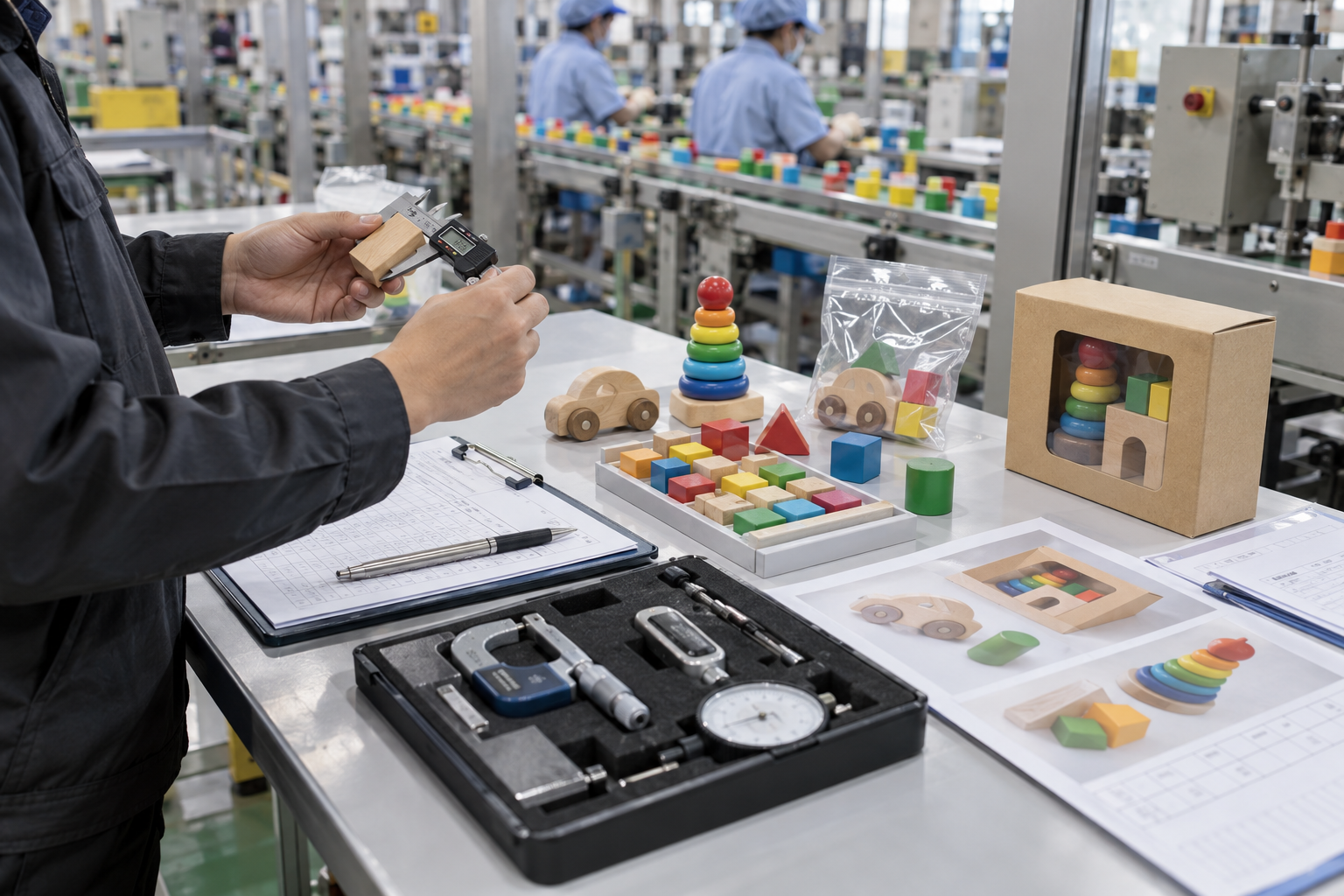
The incoming inspection sheet should tell the inspector what to check, how many pieces to check, which tool to use and what counts as a pass.
Counting a box of magnets is not enough if magnet dimensions affect retention.
Ask whether production can use material before inspection is finished. If the answer is yes, the factory should be able to show who approved the release and which orders used that material.
Test Traceability
Do not ask, “Do you have traceability?” Pick something and trace it.
Start with one finished carton and one raw-material lot.
From the carton, ask for:
- production date;
- work order;
- line;
- inspection record;
- important material lots.
Then pick a batch of paint, resin or magnets and ask which finished lots used it.
Check both directions:
Finished toy → production record → material batch
Material batch → affected finished lots
If one coating batch went into four production orders, the factory should find all four.
If it takes hours and several departments to trace one batch, recall control is weak.
Lock the Product
Production should follow one approved BOM, one drawing set and one packaging version.
The BOM should name parts precisely enough to stop casual substitutions. It should match the toy product specification sheet.
| Part | Specification | Approved Supplier | Revision |
|---|---|---|---|
| Plastic housing | Approved resin grade | Supplier A | R03 |
| Magnet | Approved size and grade | Supplier B | R02 |
| Adhesive | Approved material code | Supplier C | R01 |
A BOM that only says “plastic,” “magnet,” or “glue” does not control the exact material.
Use a golden sample for appearance, color and assembly. Use the BOM and drawings for technical details.
Once the product is approved, do not change the BOM, materials, packaging, key suppliers or firmware without approval.
Control Changes
Ask what happens if the approved paint, resin, magnet, battery or PCB is suddenly unavailable.
If the answer is “we use something similar,” keep digging.
A change record should show:
- old item;
- new item;
- reason for the change;
- technical review;
- retesting or validation if needed;
- buyer approval where required;
- first affected batch.
Ask for one completed change record, not just the blank form.
Check Work Instructions
Check the instructions at the workstation, not only in the quality office.
“Apply glue properly” is too vague. The worker needs the adhesive code, application point, amount or range, curing time and pass criteria.
For screws, “tighten firmly” is also too vague when retention matters.
Check the control plan:
Process → risk → item checked → method → frequency → record → action after failure
If magnet retention is a major risk but there is no incoming, assembly or verification check for it, something is missing.
Check First Pieces
After a mold change, repair, material change or new setup, inspect the first pieces before running the full batch.
Check dimensions, fit, color, printing, assembly and function where they matter.
Select 3 recent production runs and match each one to its first-piece record.
Then check in-process records from the same day. Hidden features such as magnets, internal wires, adhesive curing and battery fasteners are easier to check before the toy is fully closed and packed.
Check Safety Defects
Treat a loose magnet, sharp point or failed battery cover differently from a print defect.
If 199 pieces out of 200 look fine but one has a serious safety defect, do not hide that failure inside a 99.5% pass rate.
When a safety defect appears, check that the factory:
- stops the affected process;
- separates the affected goods;
- finds the last batch that passed;
- works out how many pieces may be affected;
- finds the cause;
- fixes the process;
- checks new output before restarting.
For small parts, look at parts that can come loose during use, not only parts already supplied loose.
For magnets, check the approved magnet, cavity size, retention method and assembly process. A final pull test should not be the only control.
For battery toys, inspect the compartment, screws, terminals and wiring. Rechargeable products also need control of the battery model, charging circuit, connector and PCB version.
For wooden toys, check the wood, moisture where needed, cracks, splinters, sanding, dimensions and coating.
For science and activity kits, check weighing, mixing, filling and component counts. A multi-component science kit can fail because one small item is missing even when every part looks fine on its own.
Verify Testing
Go to the test area and look at the equipment used for your product.
Match each tool to its calibration record. Make sure the gauge is precise enough for the drawing tolerance.
Ask a regular QC worker to run one test. Watch how the sample is prepared, how the tool is used, what the pass limit is and how the result is written down.
Then open the full external test report and compare:
- model number;
- product photos;
- age grade;
- materials;
- components;
- factory;
- test date;
- standard version.
Compare the tested sample with the current BOM. If the resin, magnet, battery or another key part changed, the old report may no longer cover what the factory is making now.
U.S. Compliance
For U.S. children’s toys, 16 CFR Part 1250 incorporates ASTM F963. CPSC states that ASTM F963-23 applies to toys manufactured after April 20, 2024.[2]
Do not accept “we have ASTM” as the answer. Check which ASTM F963 sections and other CPSC rules apply to the toy. CPSC’s ASTM F963 chart shows that not every provision has the same third-party testing requirement.[3]
For products made outside the United States, the importer is responsible for issuing the Children’s Product Certificate under the applicable CPSC rules.[4]
| Requirement | Applicable? | Evidence |
|---|---|---|
| ASTM F963 sections | Yes / No / Review | Test and compliance records |
| Lead requirements | Yes / No / Review | Material or laboratory evidence |
| Phthalate requirements | Yes / No / Review | Material or laboratory evidence |
| Tracking information | Yes / No / Review | Product and packaging marking |
Before mass production, make sure the final SKU, age grade and market match the documents used for U.S. and EU toy safety compliance.
EU Compliance
For toys sold in the EU in 2026, check the rules that apply under Directive 2009/48/EC. Manufacturers must carry out a safety assessment, prepare technical documentation, follow the required conformity assessment and apply CE marking to compliant toys.[5]
Make sure these documents all describe the same toy:
Specification → safety assessment → standards → test reports → technical file → declaration → labels → production version
The EU has also adopted Regulation (EU) 2025/2509. It generally applies from August 1, 2030 and introduces a digital product passport for toys.[6]
In 2026, buyers should make sure suppliers are preparing for the 2030 change. The full 2030 system does not yet apply to every toy currently sold in the EU.
China Compliance
China’s updated mandatory GB 6675.1-2025, GB 6675.2-2025, GB 6675.3-2025 and GB 6675.4-2025 toy-safety standards were published on October 5, 2025 and take effect on November 1, 2026.[7]
Ask what the factory has changed for the new GB 6675 requirements: specifications, tests, materials or production checks.
If the toy will also be sold in China, check whether it falls under CCC and whether the current factory and model are covered.
CNCA published the revised toy CCC implementation rule CNCA-C22-02:2026. The transition allows old or new rules through October 31, 2026, while certification activities use the new rule from November 1, 2026.[8]
Handle Defects
Rejected materials and products should be separated from good stock.
Pick one rejected item and ask:
- Why did it fail?
- What happens to it now?
- Can it be reworked?
- Who checks it again?
Review 2 recent corrective-action records.
Weak answers often say “worker careless” or “QC missed it.” Those are not root causes.
The record should show:
Problem → evidence → root cause → correction → corrective action → owner → deadline → effectiveness check
Review complaints from the last 6–12 months too. Focus on repeated defects, not just the total complaint count.
Check Tooling
Inspect molds, dies, fixtures and test jigs.
Check identification, storage and maintenance records.
If a mold is repaired, inspect the first pieces again. A repair can change dimensions, fit, flash or part retention.
For buyer-funded tooling, confirm who owns it, where it is stored, who maintains it and whether the factory can move or use it without permission.
Ask for the backup plan if the only molding machine, test fixture or approved supplier becomes unavailable.
Check the Warehouse
Look for clear separation between:
- good and rejected materials;
- old and new revisions;
- different colors or SKUs;
- expired and usable materials.
Check storage for wood, chemicals, adhesives and other materials that can be affected by moisture, temperature or shelf life.
If the order has three packaging languages, pull one carton from each version. Compare warning text, barcode, artwork revision and product code.
Check Final Inspection
The final inspection sheet should list real checks, not just “appearance and function.”
- quantity;
- dimensions;
- assembly;
- function;
- accessories;
- printing;
- labels;
- barcode;
- packaging.
AQL is a sampling method. It does not prove product safety.
A shipment may pass a normal workmanship sampling plan and still have a serious safety defect. Treat that safety failure separately; do not hide it inside the overall defect rate.
Talk to Workers
Ask the incoming inspector what happens when material fails. Ask an operator how they know which component revision to use. Ask warehouse staff how they identify rejected stock.
Ask the same question to different departments. If their answers conflict, the written procedure is not being followed consistently.
Check training for new workers, inspectors and anyone using special test equipment or handling safety-critical work.
ISO 9001 covers the quality management system. It does not prove that a specific toy meets toy-safety rules.[9]
Sample the Evidence
For one day, sample:
- 3 recent production orders;
- 3–5 incoming material lots;
- 2 rejected lots;
- 2 customer complaints;
- 2 corrective actions;
- 1 engineering or material change;
- 1 finished carton for backward traceability;
- 1 raw-material lot for forward traceability.
Cross-check the claims.
Capacity: sales claim × production records × line output
Materials: BOM × warehouse stock × material on the line × test report
Factory identity: registration × certificates × actual site × contract company
Traceability: carton code × production record × material lot
Score the Factory
| Area | Example Weight |
|---|---|
| Product safety and compliance | 25% |
| Process quality control | 20% |
| Traceability and change control | 15% |
| Capacity and planning | 15% |
| Material and supplier control | 10% |
| Testing and calibration | 10% |
| Staff and management | 5% |
The weights total 100%.
Even an 88/100 factory should fail if it falsifies reports, hides the real production site or cannot trace a safety-critical batch.
Do not let a high total score cancel a critical failure.
One-Day Audit
| Time | Main Work |
|---|---|
| 09:00–09:30 | Company identity and product scope |
| 09:30–11:30 | Production floor and process checks |
| 11:30–12:00 | Warehouse |
| 13:00–14:00 | Quality records and corrective actions |
| 14:00–15:00 | Compliance files and test reports |
| 15:00–15:45 | Capacity and order plan |
| 15:45–16:30 | Traceability test |
| 16:30–17:00 | Findings and next actions |
Keep the opening meeting short. Use the day to inspect production, materials and original records.
Red Flags
- Sales says a process is in-house, but workers say it is outsourced.
- The test report names another factory and nobody can explain why.
- Monthly capacity does not match real line output.
- The BOM lists one material but workers are using another.
- A random carton cannot be traced.
- Calibration records do not match the equipment IDs.
- Months of QC records show perfect results with no normal variation.
- The supplier says changes need approval but cannot show one completed change record.
If the license, BOM, test report and production records keep telling different stories, verify the supplier before placing the order.
Approve or Reject
Approved: no major unresolved risk.
Conditional: fixes are needed before full production.
Trial order: the factory looks capable, but volume or consistency is not yet proven.
Reject: serious safety, traceability, compliance or integrity problems remain.
On repeat orders, compare the current BOM, materials, suppliers and factory site with the approved version. This is one of the basic controls behind a long-term relationship with a Chinese toy manufacturer.
When to Re-Audit
- production moves to another site;
- a sister factory starts making the product;
- critical materials or suppliers change;
- important subcontractors change;
- batteries or electronics change;
- serious complaints keep coming back;
- major regulations change.
Going from an 8,000-piece order to an 80,000-piece order is a 10× increase. Even with the same toy, the factory may need more workers, warehouse space, subcontractors and inspectors.
Conclusion
If one line makes 550 sets per shift, do the math before you accept the factory’s capacity claim. Check how many lines are really free and how much production is already booked. If 2,000 toys a day produce 160 rework pieces, that becomes 4,000 pieces in 25 days. Trace one carton backward and one material lot forward. Compare the BOM with parts on the line and with the test report. For magnets, batteries and coatings, look at the process, not just the final test. When company records, production data and the factory floor keep disagreeing, stop and verify the supplier before placing a large order.
FAQ
Should the factory know that an audit is coming?
Schedule the visit so the right managers and records are available, but choose some samples and records yourself.
Should I audit before or after final sample approval?
Audit before placing a large order. Once the design, BOM and main materials are mostly fixed, the auditor can check the real process more accurately.
What if the factory will not identify an important subcontractor?
Ask where the process is done and who controls it. If a safety-critical process is hidden and cannot be checked, treat it as a serious risk.
Can one audit cover every toy made by the factory?
No. The general quality system may be the same, but the product risks change. Plastic toys, magnetic toys, electronic products and science kits need different checks.
Should I audit a new site if production moves?
Yes. A new site can have different machines, workers, subcontractors and inspection controls even when the finished toy looks the same.