
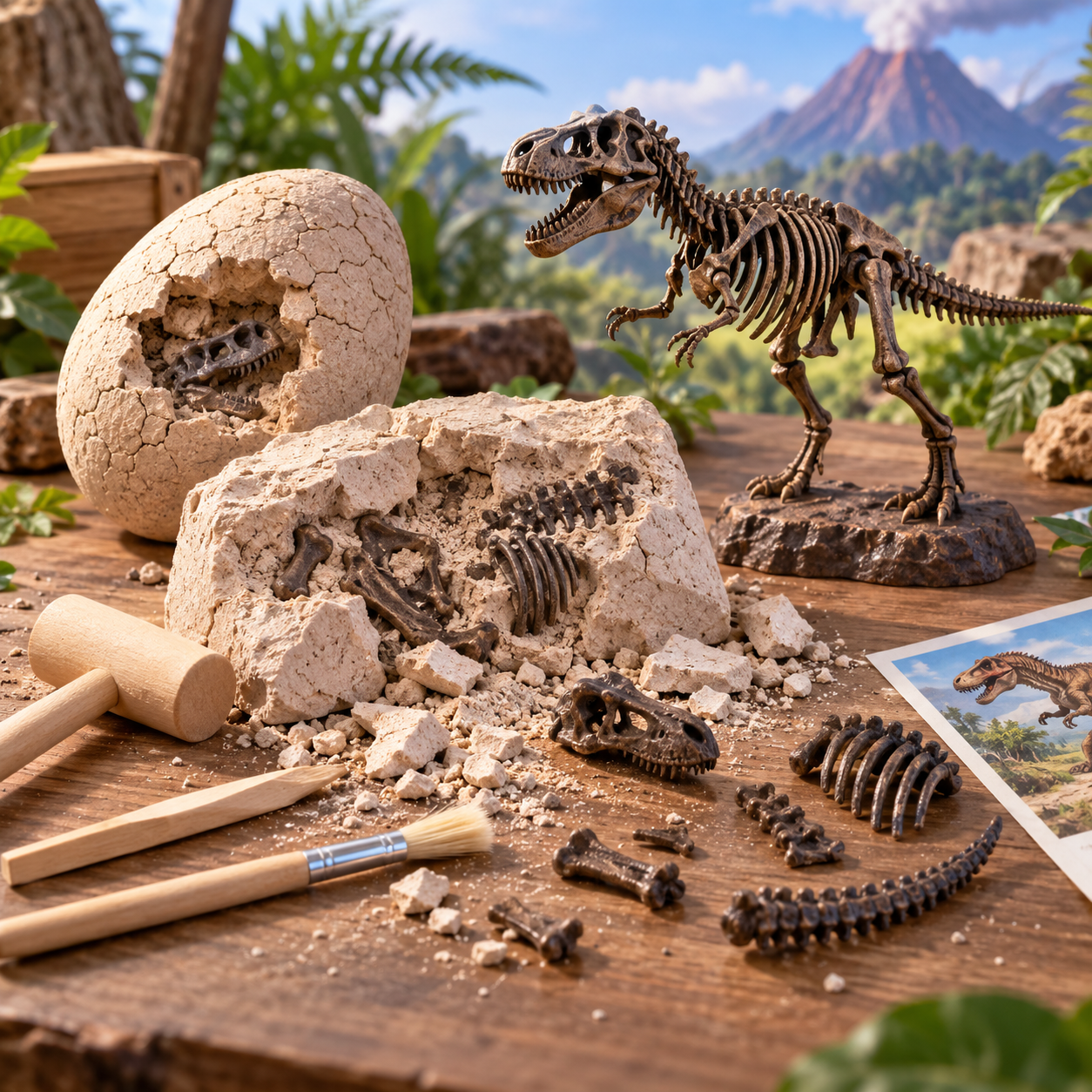
Factory price is only part of the picture. In the cost example below, a $2.70 dig kit ends up at $3.60 after packaging, inspection, freight, and local handling. A 15-piece activity set can also take more work to pack and inspect than a simple dinosaur figure. That is where many wholesale comparisons start to look very different.
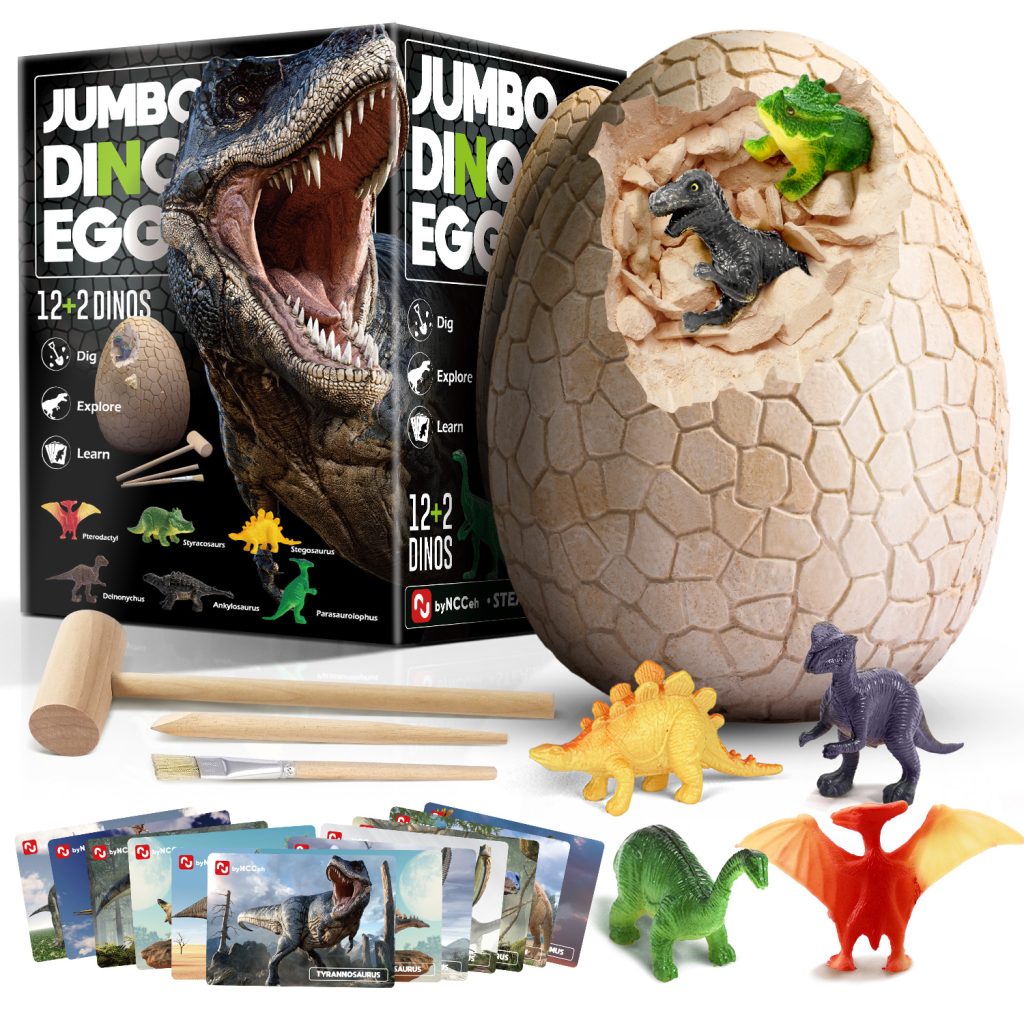
Dinosaur excavation products sit directly inside K&M’s Dig & Explore manufacturing range. A buyer can change more than the box artwork: dig-block format, dinosaur or fossil selection, tool combinations, difficulty, guide content, labels, warnings and packaging can all affect cost, play experience and the checks needed before production.
Dig Kits, Models, and Activity Sets Compared
| Buying factor | Dig kits | Dinosaur models | Activity sets |
|---|---|---|---|
| Main play value | Excavation and discovery | Imaginative play and collecting | Several activities in one box |
| Repeat-play potential | Low to medium | High | Medium |
| Component complexity | Medium | Low to medium | High |
| Packaging need | Medium | Low to medium | Medium to high |
| Best range role | Activity product | Core product | Gift/premium product |
| Main sourcing risk | Block consistency and hidden pieces | Molding, paint, balance, and durability | Missing or wrong components |
Dinosaur Models Work Well as Core Products
Models are simple to build into a full range. One supplier can offer the same basic idea in different species, sizes, colors, pack sizes, or levels of detail.
A small opening range might include Tyrannosaurus rex, Triceratops, Stegosaurus, Brachiosaurus, Velociraptor, and Spinosaurus. Add a few multi-packs and you already have enough choice for customers without filling the shelf with near-identical products.
Price gaps should also make sense:
| Product position | Example retail price |
|---|---|
| Small figure | $5.99–$7.99 |
| Standard figure | $9.99–$12.99 |
| Small multi-pack | $14.99–$19.99 |
| Larger set | $24.99–$29.99 |
| Premium playset | $39.99+ |
If four similar dinosaurs sell at $13.99, $14.49, $14.99, and $15.49, the difference is hard to see. A higher price works better when the customer can spot the upgrade right away: a larger figure, more detail, moving joints, more pieces, or better accessories.
Check Model Quality in Real Samples
Photos can make almost any dinosaur look good. They do not tell you if it stands properly, if the jaw gets loose, or if the eyes are painted differently from one piece to the next.
A ten-piece sample check might look like this:
| Check | Example result |
|---|---|
| Stands correctly on a flat surface | 9/10 |
| Main paint areas acceptable | 8/10 |
| Moving joints work correctly | 10/10 |
| No obvious molding flash | 8/10 |
If the same defect appears on 2 of 10 samples, do not brush it off as bad luck. Check whether it comes from one mold cavity, one assembly step, or the finishing process before you place a much larger order.
Thin and moving areas deserve a closer look too. Check tails, horns, claws, legs, jaw hinges, and detachable parts for looseness, sharp flash, or easy breakage.
Dig Kits Need a Good Excavation Experience
A basic dinosaur dig kit may contain:
- one excavation block;
- one brush;
- one or two digging tools;
- 6–12 skeleton or fossil pieces;
- an assembly guide;
- a dinosaur information card.
The number on the box can be misleading. A 12-piece skeleton is not always better than an 8-piece one. Twelve tiny parts can be fiddly and easy to lose. Eight larger pieces may build into a cleaner, more stable 20 cm model that looks better when the child is finished.
Measure Dig Time and Block Consistency
For a custom K&M dig-kit project, sample approval should lock the details that change the experience: block weight and hardness, hidden-item count and placement, tool type, assembly fit, instructions and retail packaging. If production changes one of those items later, the new version should be checked against the approved sample rather than treated as automatically equivalent.
Before ordering, dig through several samples yourself. It sounds basic, but this is where you notice problems that product photos never show.
| Sample | Example excavation time |
|---|---|
| 1 | 23 minutes |
| 2 | 26 minutes |
| 3 | 24 minutes |
| 4 | 39 minutes |
| 5 | 25 minutes |
Four samples sit in a fairly tight 23–26 minute range. One takes 39 minutes. That is enough to justify another look at block weight, density, moisture, or where the hidden pieces were placed.
If the approved block is around 500 g, record the sample weights as well:
| Sample | Weight |
|---|---|
| A | 492 g |
| B | 504 g |
| C | 497 g |
| D | 501 g |
Weight by itself does not tell the whole story, but it gives you something concrete to compare with dig time. If the heavier blocks keep taking longer to finish, the factory has a process issue worth checking.
Check Dust, Tools, and Cleanup
Try the kit on a normal table, not in a factory sample room. Then look at the mess it leaves behind.
- How far does the loose material spread?
- Does a tray keep most of it in one place?
- Can the hidden pieces be cleaned easily?
- Does the brush still work halfway through the activity?
- Do the tools bend or break?
- Do the instructions tell parents how to prepare the work area?
A small tray may cost very little per unit, but that small number grows over a large order. If the tray adds $0.08 per kit, 10,000 units add:
10,000 × $0.08 = $800
Now the decision is easier. You are not arguing over eight cents. You are deciding whether an $800 packaging change makes the activity cleaner and easier to use.
Activity Sets Need Better Packing Control
Activity sets look attractive because there is more to see in the box. The downside is obvious once you think like a packer: every extra item is another thing that can go missing.
| Component | Quantity |
|---|---|
| Dinosaur figures | 4 |
| Dig block | 1 |
| Dig tools | 2 |
| Coloring sheets | 3 |
| Markers | 3 |
| Sticker sheet | 1 |
| Activity guide | 1 |
| Total | 15 pieces |
At a 0.5% packing-error rate on 10,000 sets:
10,000 × 0.5% = 50 incomplete sets
That is why the packing method matters. Trays, packing cards, weight checks, or a fixed packing sequence can catch missing parts before the box is sealed.
Do Not Judge Value by Piece Count
| Set A | Set B | |
|---|---|---|
| Total pieces | 24 | 14 |
| Main dinosaur items | 4 | 6 |
| Distinct activities | 2 | 4 |
| Minor filler accessories | 15 | 2 |
| Example retail price | $24.99 | $27.99 |
Set B has fewer pieces, but more of them matter. The child gets more main dinosaur items and more actual activities. Set A looks bigger on paper, yet much of the piece count comes from filler accessories.
Those little extras are not free either. Someone has to buy them, pack them, inspect them, ship them, and replace them if they are missing.
Match the Product to the Retail Channel
K&M’s current dinosaur-dig-kit program supports retail, e-commerce, education, gifting, party-favor and museum-store formats. That is why the same dinosaur theme can require very different pack sizes, guide content and price architecture depending on where the product will actually be sold.
| Channel | Products worth testing | Reason |
|---|---|---|
| Traditional toy store | Models + activity sets | Repeat play plus gifting |
| Museum or science shop | Dig kits + skeleton sets | Discovery and educational theme |
| Online marketplace | Compact models + differentiated kits | Parcel size and reviews matter |
| Gift retailer | Larger activity sets | Stronger gift presentation |
| Value retailer | Basic models + compact kits | Lower price points |
A museum shop may care more about species names, skeleton shape, and the quality of the information card. An online seller has different headaches: parcel size, breakage, and whether the product photos clearly show what the buyer will receive.
Build a Mixed Range Without Too Many SKUs
MOQ should be checked by development route rather than assumed from the examples below. K&M currently publishes working ranges of 200–500 units/SKU for existing designs with logo customization, 500–1,000 units/SKU for private-label custom-box projects, and 1,000–5,000 units/SKU for full ODM or new tooling. Final quantities depend on the actual dinosaur format, packaging and customization. See K&M’s MOQ planning guide.
You do not need 40 dinosaur toys just to make the category look full. A smaller range can still cover the main buying needs.
| Category | Example SKUs | Purpose |
|---|---|---|
| Individual models | 6 | Entry and repeat purchases |
| Multi-model packs | 3 | Core higher-value products |
| Dig kits | 5 | Hands-on discovery |
| Skeleton/build sets | 2 | Construction and educational play |
| Multi-activity sets | 3 | Gift positions |
| Large premium product | 1 | Top price point |
| Total | 20 |
If the opening order is 500 pieces per SKU:
20 × 500 = 10,000 units
A 30-SKU launch at the same quantity becomes:
30 × 500 = 15,000 units
That is another 5,000 units sitting in stock before you know which products actually move.
Calculate Landed Cost
Take a $2.70 dig kit:
| Cost item | Example per unit |
|---|---|
| Factory product | $2.70 |
| Custom retail packaging | $0.22 |
| Inspection allocation | $0.06 |
| International freight allocation | $0.34 |
| Import/local logistics | $0.28 |
| Landed cost | $3.60 |
$3.60 − $2.70 = $0.90 extra per unit
$0.90 ÷ $2.70 × 100 ≈ 33.3%
For 5,000 kits:
5,000 × $0.90 = $4,500
Now compare that with a supplier who is only $0.03 cheaper at the factory:
5,000 × $0.03 = $150
A $150 saving is not much if the cheaper option needs more freight, weaker packaging, or extra sorting after arrival.
Check Packaging Before Printing
Large gift boxes can look impressive in photos and still waste a surprising amount of shipping space.
Suppose Product A packs 12 units per master carton and Product B packs 8.
For 2,400 units:
Product A: 2,400 ÷ 12 = 200 cartons
Product B: 2,400 ÷ 8 = 300 cartons
Before you approve the retail box, ask for:
- retail-box dimensions;
- gross weight per unit;
- units per master carton;
- master-carton dimensions;
- master-carton gross and net weight;
- inner-carton configuration.
Check Cost per Saleable Unit
A low unit price is less impressive when part of the shipment cannot be sold.
If 5,000 sets land at $4.00 each:
5,000 × $4.00 = $20,000
If 100 units arrive damaged or incomplete:
5,000 − 100 = 4,900 saleable units
The effective cost becomes:
$20,000 ÷ 4,900 ≈ $4.08 per saleable unit
And that still does not include sorting, replacement freight, returns, or disposal.
Safety Requirements for U.S. Buyers
A large dinosaur figure and a skeleton kit full of small connectors do not create the same safety questions.
In the United States, toys designed or intended primarily for children 12 years old or younger are subject to applicable children’s-product requirements. CPSC states that ASTM F963-23 became the mandatory toy standard for covered toys manufactured on or after April 20, 2024.[1]
CPSC also states that toys and other articles intended for children under three may not contain prohibited small parts, including after applicable use-and-abuse testing.[2]
For dig kits, look at the pieces that come out of the block, not just the size of the block itself. Skeleton sets can contain small feet, claws, vertebrae, pegs, and connectors.
CPSC states that accessible component parts of children’s products generally may not contain more than 100 ppm total lead. Paint and similar surface coatings are subject to a 90 ppm lead limit.[3]
Covered children’s toys and child-care articles may not contain more than 0.1% (1,000 ppm) of regulated phthalates in applicable accessible component parts.[4]
Some activity sets also include paint, markers, crayons, or clay. CPSC states that consumer art materials are subject to requirements under the Labeling of Hazardous Art Materials Act and related rules, including toxicological review and applicable ASTM D-4236 labeling requirements.[5]
An old test report for one PVC dinosaur may be useful background, but it does not cover a new box made with ABS figures, markers, stickers, and a dig block. The paperwork needs to match the product you are actually buying.
EU Buyers: Current Rules and the 2030 Change
The European Commission states that Toy Safety Directive 2009/48/EC sets safety requirements for toys placed on the EU market.[6]
Regulation (EU) 2025/2509 entered into force in 2026, while its main new toy-safety regime applies from August 1, 2030. The regulation includes transition provisions for toys placed on the market under the existing framework before that date.[7]
What to Check Before Ordering
| Product type | Check first |
|---|---|
| Dinosaur models | Material, finished weight, paint, balance, joints, molding quality |
| Dig kits | Block weight, dig time, hardness, hidden pieces, tools, dust, assembly |
| Activity sets | Component count, packing controls, art materials, instructions, inner trays |
If a model comes from a multi-cavity mold, check parts from different cavities. One cavity can produce a problem the others do not.
For dig kits, record block condition, piece count, tool condition, assembly fit, and instruction accuracy. “Appearance OK” is not enough.
For a multi-piece activity set, compare the packed box with the component list before shipment.
Compare Quotations on the Same Product
Supplier A quotes $3.20. Supplier B quotes $3.35.
At 10,000 units:
($3.35 − $3.20) × 10,000 = $1,500
Before you call Supplier A cheaper, compare:
- figure dimensions;
- finished weight;
- material;
- paint operations;
- component count;
- retail packaging;
- master-carton configuration;
- inspection scope;
- testing and documentation;
- packing method.
A 180 g dinosaur and a 260 g dinosaur with more paint and stronger packaging are not the same product, even if the photos look similar.
Planning a dinosaur dig-kit line? Share the target market, age group, kit structure, quantity and packaging direction with K&M so the team can suggest an existing format, private-label route or ODM development plan.
FAQ
Which dinosaur toys are best for wholesale?
Models are usually the easiest core products because they support repeat play, different species, and several price points. Dig kits add a hands-on activity. Activity sets work well for gift positions and larger boxes.
Are dinosaur dig kits good wholesale products?
They can work well in toy, museum, science, education, and gift channels. Check several samples for dig time, block weight, dust, tool strength, hidden pieces, assembly, and packaging before you order.
How many dinosaur toy SKUs should a new buyer start with?
Start with your MOQ and stock budget. At 500 pieces per SKU, 20 SKUs mean 10,000 units of opening inventory. A 30-SKU range means 15,000 units.
Should I choose the supplier with the lowest price?
Only if both suppliers are quoting the same product. Compare material, size, weight, paint, components, packaging, cartons, inspection, paperwork, and landed cost.
What is the main sourcing risk with activity sets?
More parts mean more chances for packing mistakes. Check how the factory counts and verifies each component before the box is closed.
Finally
Models are the safer choice for a repeat-play core range. Dig kits add the discovery element, and activity sets make more sense when you want a larger gift product. Before you order more, look at the numbers that actually change the deal: landed cost, carton size, missing parts, QC work, and safety requirements. In the example above, a $2.70 dig kit reaches $3.60 landed cost. That is a 33.3% jump before the product reaches the shelf.