
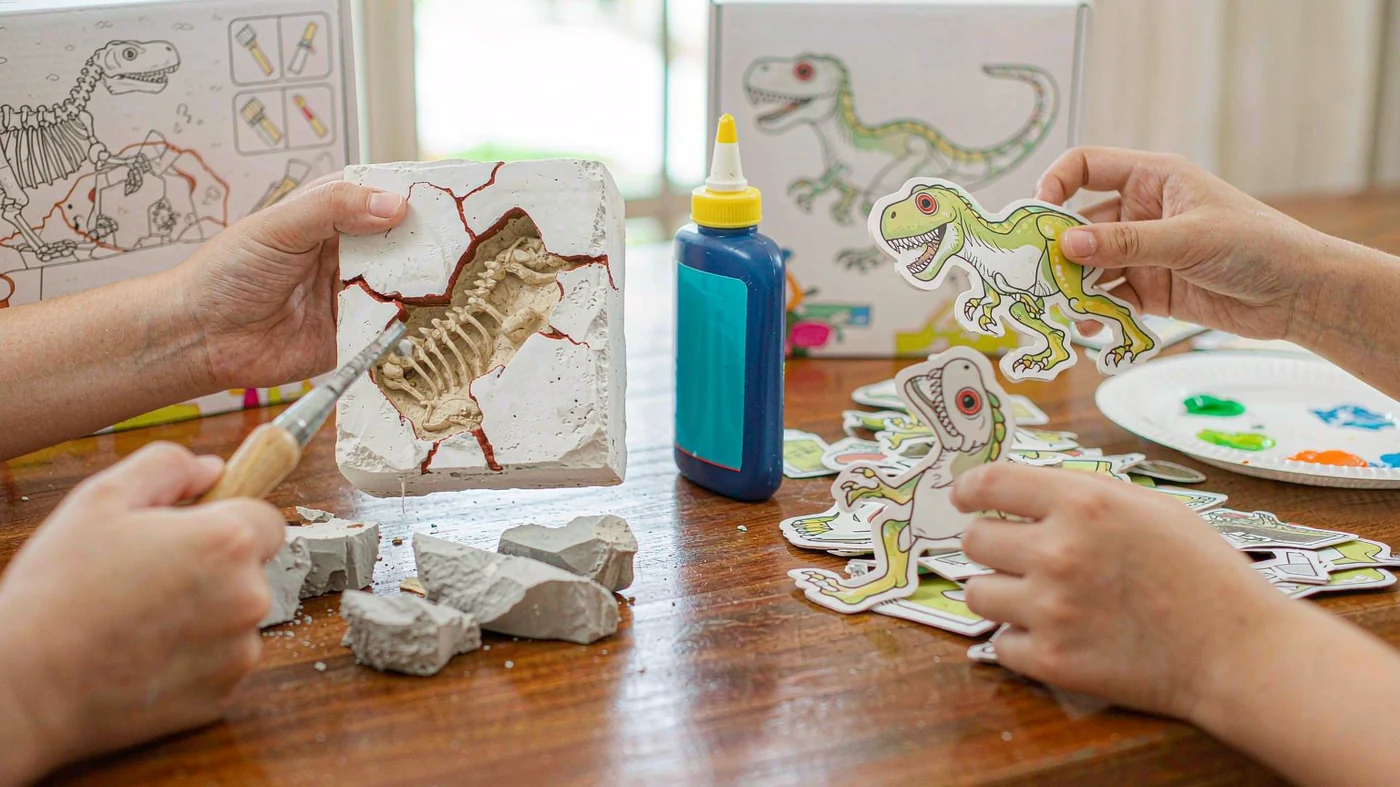
Dinosaur dig kits focus on uncovering a hidden object; dinosaur crafts focus on making or decorating one. Choose a dig kit for a child who enjoys searching, brushing, and revealing pieces. Choose a craft for a child who prefers choosing colors, shaping materials, or designing a scene. Both can leave a keepsake. The practical differences are the activity itself, the type of mess, any assembly or drying steps, and whether the materials can be used again.
Neither category has a reliable universal completion time or age recommendation. A small sticker scene and a multi-coat painted model are very different projects, just as a single-figure excavation differs from a skeleton that needs assembly. Compare the contents and instructions of the actual kits rather than relying on the dinosaur theme.
Dinosaur Dig Kits vs. Dinosaur Crafts at a Glance
| Buying question | Dinosaur dig kits | Dinosaur crafts |
|---|---|---|
| What does the child do? | The child excavates a block, brushes off finds, and may assemble a model. | The child paints, shapes, sticks, builds, or decorates dinosaur-themed materials. |
| Where is the surprise? | The reveal happens during excavation, even when the box identifies the hidden model. | The interest comes from creative choices, although a project may also include a reveal. |
| What remains afterward? | The recovered figure or assembled skeleton may be kept for display or suitable play. | The result may be a painted figure, picture, mask, scene, or model. |
| What affects the schedule? | Block size and hardness, the child’s pace, cleaning, and any assembly affect completion. | The number of steps, coats, glue stages, and required drying affect completion. |
| What needs cleaning? | Excavation can leave powder and crumbs on the tray and surrounding surface. | Paint and glue may leave marks; stickers and paper crafts produce a different cleanup task. |
| Can the main activity be repeated? | The original excavation cannot be repeated with the same broken block. | Consumable crafts finish once; reusable modeling compounds may support another session if stored as directed. |
| What should the buyer confirm? | Check the buried pieces, tools, assembly guide, age grade, and warnings. | Check the supplied materials, extra supplies, drying instructions, age grade, and warnings. |
The Activity and the Finished Result
Dinosaur Dig Kits
A dig kit places figures or model pieces inside a block for the child to uncover. Formats include eggs containing figures, blocks containing skeleton parts, and individual excavation packs for groups. K&M’s dinosaur dig kit range provides examples of these product formats.
Excavation and assembly are separate tasks. A child who wants the reveal may not want to build a skeleton afterward, so check whether the find is already complete. For a closer look at that distinction, the egg-versus-skeleton kit comparison addresses two excavation formats.
Confirm exactly what is buried and what comes loose in the box. A total piece count does not, by itself, tell you how many discoveries or complete activity sets the package contains.
Dinosaur Crafts
Dinosaur crafts include paint-your-own figures, paper scenes, stickers, mosaics, masks, and modeling projects. Some provide a fixed shape to decorate; others leave the child more freedom to design the result. K&M’s arts and crafts kit range is a starting point for comparing materials and project types.
Check whether a modeling compound stays reusable or hardens, and whether a painted project requires glue, extra coats, or a separate drying area. Not every craft needs drying, and not every finished piece is intended as a durable play toy.
The categories can overlap. A kit that combines excavation with painting offers both activities, but it also adds materials, steps, and cleanup. Judge the combined contents rather than treating the product name as a complete description.
Discovery, Creative Choice, and Learning Opportunities
Digging gives a child a reason to look closely, uncover pieces carefully, and sort finds. A skeleton model can add a task involving matching parts to a diagram. Crafting offers choices about color, placement, shape, and composition. These are opportunities within the activities, not promises that one kit will produce a measurable learning gain.
A dinosaur theme alone does not make either product a science lesson. For a learning-focused purchase, inspect the guide: does it explain the model, name relevant features, or invite questions? A craft can support the same discussion if an adult connects the making activity to the dinosaur represented.
Recent play can help narrow the choice. Consider whether your child prefers searching for hidden objects, following a construction diagram, or making their own design. If the answer is unclear, introduce a small age-appropriate project before buying a large group pack.
Time, Workspace, and Cleanup
Plan the whole session, not just the digging or painting. Setup, help with difficult steps, assembly, cleanup, and drying can all affect when the table becomes available again. Without product-specific information, a category-wide minute range would be misleading.
| Stage | Assumed allowance | Planning condition |
|---|---|---|
| Excavation | 30 minutes | This is a chosen allowance, not a prediction of when the block will be finished. |
| Cleaning | 10 minutes | The example reserves time for the finds and work area. |
| Assembly | 15 minutes | The example assumes a model that requires assembly. |
| Total | 55 minutes | The calculation is 30 + 10 + 15; setup is additional, and actual completion may take longer. |
For a paint craft, use the instructions for that paint and project to plan drying and handling. Do not transfer a drying estimate from another kit or assume a piece can be packed as soon as painting ends. A sticker scene has no paint-drying stage, so it needs a different schedule.
A raised-edge tray gives excavation debris a defined work area, but it does not guarantee dust-free play or quick cleanup. Protect the surface, keep the activity away from food, and follow the instructions for handling powder and cleaning. Add water or rinse finds only when the product instructions permit it.
For crafts, cover the work surface and arrange any required drying space before opening the materials. When minimal cleanup matters most, compare a paper or sticker project with the actual dig kit rather than assuming every craft is messier than digging.
Practical Scenarios for Choosing a Kit
These scenarios show how to apply the comparison to a purchase; they are not reports of timed product tests.
A Party With a Fixed Pickup Time
Suppose every child needs something to take home before pickup. Individual dig packs can work if each pack includes suitable tools and a complete find. For a painting activity, confirm the handling and drying instructions before promising a take-home piece. A sticker scene avoids that particular drying constraint.
Before buying a group pack, count complete child-sized activity sets rather than total components. The party activity kit formats can help frame questions about individual versus shared contents. Shared brushes, incomplete tool sets, or one assembly guide may affect how you run the table.
A Child Who Enjoys the Reveal but Not Assembly
Compare a complete hidden figure with a skeleton kit that requires construction. The first matches an interest in uncovering an object without adding a separate building task. If decorating is the stronger interest, a ready-made figure to paint may be a closer fit than either excavation format.
A Table Needed for Another Activity
Check where an unfinished project can go. A dig needs a way to contain the block, tools, and loose finds between sessions. A wet craft needs a suitable drying location. When neither space is available, choose a project that can be packed away according to its instructions instead of relying on a generic completion estimate.
Age Grades, Small Parts, and Materials
Neither dinosaur dig kits nor dinosaur crafts share one universal minimum age. Read the particular product’s age grade, warnings, and instructions, and consider the child’s ability to use the tools as directed. Adult supervision does not override an age restriction.
In the United States, toys and articles intended for children under 3 that present choking, aspiration, or ingestion hazards because of small parts are banned hazardous substances. The small-parts test considers whether an article or relevant component fits completely inside the specified cylinder without compression. That rule does not mean every product labeled for older children is suitable for every child. [1]
For the actual kit, check the following details before purchase:
- The contents list should identify the tools, small connectors, figures, and other loose pieces.
- The instructions should explain any permitted wetting, rinsing, ventilation, handwashing, and cleanup steps.
- Paints, glues, coatings, and modeling compounds need product-specific information; a dinosaur theme says nothing about their composition.
- The adult should be able to keep loose parts and materials away from younger siblings.
If dust or odors are a concern, do not assume a softer block is low-dust or that a particular craft material is suitable. Consider an age-appropriate paper or sticker project that avoids excavation, then check its materials and warnings. Stop the activity if the child becomes uncomfortable.
Cost, Reuse, and Value per Child
Neither category is automatically cheaper. Compare the price of a complete activity for each child, including any extra tools, glue, protective covering, or replacement materials. A multipack offers little convenience if participants must wait for one essential tool.
A dig block provides one original excavation, while the recovered object may remain useful for display or suitable pretend play. Painted crafts also offer a finished object to keep. Reusable modeling material can support another making session only if its formulation and storage instructions allow it.
For a fair value comparison, separate three things: the initial activity, the finished object, and any genuinely reusable materials. This avoids treating a dig as disposable simply because the block breaks, or treating every craft as endlessly reusable.
Product Documents for Schools and Wholesale Buyers
Buyers sourcing a range should request documents tied to the actual model, materials, age grade, and intended market. K&M’s STEM toy OEM support and ordering FAQs provide routes for product-specific questions; a category page is not proof that a particular SKU complies.
CPSC explains that ASTM F963 is a mandatory U.S. toy safety standard and that firms must determine which sections apply to their specific products. A report should therefore identify the tested product and applicable requirements, not merely name a standard. [2]
The European Commission describes CE marking on toys as the manufacturer’s declaration that essential safety requirements are met. It should not be presented as a blanket third-party approval of a supplier’s entire range. [3]
Ask which standard editions and legal requirements the documents address for the intended market and sale date. Confirm that the product identifiers and material details match the proposed order. Claims about a particular kit’s certification, minimum order quantity, or delivery schedule require a specific supplier response.
Planning a dinosaur dig kit or craft range? Send K&M your target market, intended age group, and pack format to discuss contents, samples, and product-specific documents.
Frequently Asked Questions
Are Dinosaur Dig Kits Less Messy Than Crafts?
Dinosaur dig kits are not necessarily less messy than crafts. Excavation can leave powder and crumbs, while painting or gluing can leave marks and require drying space. A sticker activity may involve less cleanup than either. Compare the specific materials and cleanup instructions rather than the category alone.
Can a Dinosaur Craft Replace a Dig Kit at a Party?
A craft can replace a dig kit if making or decorating suits the group. Check that each child has the necessary supplies and that any wet project can be handled or transported by pickup time. A craft does not reproduce the excavation experience, so choose based on the activity you want to offer.
Are the Buried Pieces Real Fossils?
Do not assume they are. A dinosaur figure or skeleton model is not evidence of a genuine fossil. Check the contents description and ask the supplier to clarify ambiguous wording before buying.
Can Children Dig and Craft on the Same Day?
Children can do both in one day provided the products are age-appropriate and their instructions allow the planned activities. Keep excavation debris separate from wet paint or glue, clean the work area between tasks, and leave enough time for the required steps. Painting a recovered object is appropriate only if the product information supports it.
The Best Choice for Your Child
Choose a dinosaur dig kit for the search and reveal; choose a dinosaur craft for making and decorating. Both can produce something worth keeping. Let the actual contents, the child’s preferences, the available workspace, and the product instructions decide the purchase—not an unsupported promise of a faster, cleaner, or more educational afternoon.