
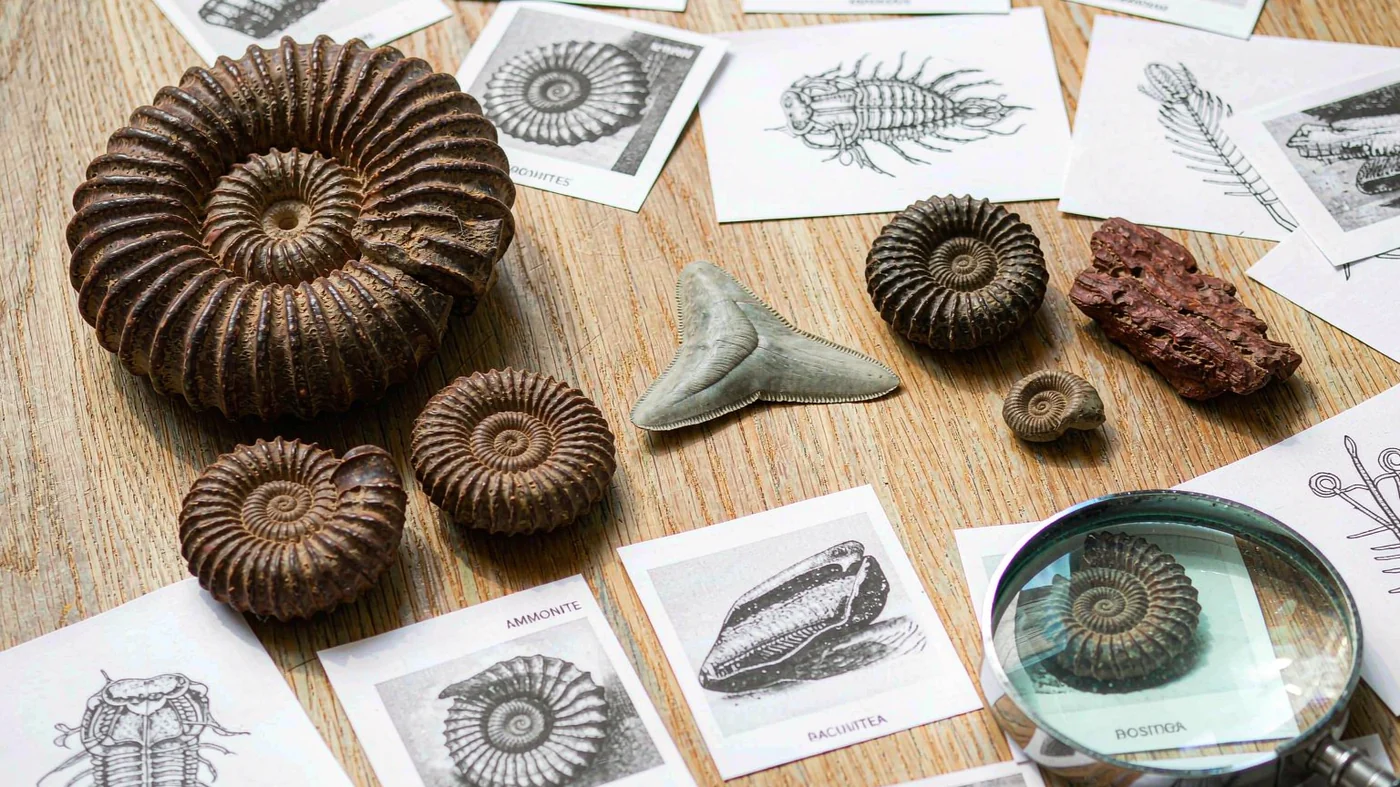
A fossil identification card should give the find’s common name, say what kind of organism it came from, and explain where and roughly when that organism lived, if known. It should point out two or three features the reader can see, give a size or scale reference, and say plainly whether the piece is a genuine fossil, a replica, or a teaching model.
What belongs on a fossil identification card?
Use the same common name on the card, box, and contents list. Add a scientific name only when the identification supports it. For a model that represents a broad group, a familiar group name is more useful than a species name the piece cannot support.
| Card field | Example wording |
|---|---|
| Common name | Fossil footprint |
| Organism group | This is a copy of a track left by an animal. The trackmaker was not identified. |
| Habitat | The animal’s habitat is not known from this track alone. |
| Broad time | The age of the original footprint is not documented. |
| Recognition and scale | Look for three toe impressions and a wider base. This model is 40 mm long. |
| Specimen status | This piece is a replica, not a genuine fossil. |
The wording and 40 mm measurement are illustrative. On a two-sided card, put the name, matching clues, and specimen status on the front so a learner can use them with the piece in hand. Use the back for habitat, age, and any note about what is unknown. On a one-sided card, use the same reading order rather than shrinking the matching clues to make room for a longer description.
Clues and scale readers can check
A useful clue tells the reader where to look and what to compare. “Look for grooves” could describe several pieces. For the footprint example, try “Turn the piece so the toe impressions point away from you. Look for three impressions that spread out from a wider base.” If the reverse looks different, label the pictured view so readers know which face to compare. Keep only features they can actually see on the supplied piece.
Say what the measurement refers to. In the footprint example, “Replica length: 40 mm from heel to longest toe” tells the reader what to measure; it does not give the original track’s size. If the proof shows that same 40 mm replica as an 80 mm drawing, write “Drawing enlarged 2× from the replica” or include a scale bar that resizes with the drawing. Check the final printed proof before calling any image actual size.
Habitat, age, and provenance
Habitat describes where the organism lived. Find locality tells the reader where a particular specimen was collected. If the only record is a quarry name, put it under “Original fossil found at” and write “Habitat: not established.” That keeps a reader from mistaking the collection site for the animal’s living environment. A country of manufacture belongs in neither field.
Use a period, era, or age range that the identification supports, and make clear that it describes the fossil represented, not the manufacturing date of the replica. Geologists use some fossils that lived during limited intervals to help establish the relative age of the rocks in which they are preserved. [1] Depth in a manufactured dig block does not date a find. If geology and earth science kits include a separate rock-layer activity, keep its evidence distinct from the layout of the play block.
When the documentation supports only a period, print the period name rather than a precise age in years. If there is no age record for the original footprint, keep “The age of the original footprint is not documented.” That wording tells the reader which answer is missing without suggesting they can work it out from the shape of the toes.
Genuine fossils, replicas, and teaching models
Put the status on each card, not just on the box. A genuine fossil is the specimen itself. A replica copies a specimen; a teaching model may reconstruct features or represent a type rather than reproduce a particular specimen. On cards for dinosaur dig kits, distinguish a reconstruction of a whole skeleton from a copy of an individual bone. In a mixed kit, ask the supplier to document which pieces are genuine and what the manufactured pieces are made of. An unknown status is not a basis for a “genuine fossil” label.
For example, if the supplier documents a resin cast of a specific fossil, “This is a resin copy of a fossil, not the fossil itself” tells the learner both what they are holding and what it represents. If the piece was designed to show a typical shape without copying a specific specimen, use “This is a teaching model. It is not a copy of a specific fossil.” When the paperwork does not match the supplied piece, hold the card for review rather than guessing from the piece’s weight or color.
A sample check before printing
Imagine that a fossil kit contains two ribbed finds and both cards say “look for ridges.” For a supervised trial with the intended age group, put both pieces beside the cards and ask one reader to point out the feature that rules out the other match. If the reader can identify the right card only after an adult points to it, replace the shared clue with a feature visible on the supplied piece, such as a coiled rather than fan-shaped outline.
Swap the reader and handler roles before testing the next pair. Use these three checks to decide what to revise:
- Match: Ask the reader to choose a card and point to a feature that fits. A correct guess without a visible reason is a cue to check the clue again.
- Status: Ask whether the piece is the fossil itself and which words tell them. If the reader calls a cast genuine, move the status next to the name or replace unclear wording.
- Size: Ask what the stated length measures. If the reader points to the drawing instead of the piece, label the replica and drawing separately.
Try the revised card with someone who has not seen the answer. For custom STEM toy projects, record the sample item number and card revision together. If a replacement footprint has a different length or fewer visible toe impressions, recheck the measurement, picture, and matching clue before reusing the artwork.
| Check | Starting assumption |
|---|---|
| Coverage | For six different finds intended for one-to-one matching, provide six cards. Cross-check names and clues against the pieces in the sample. |
| Preview time | At one guided minute per card, six cards take about six minutes before questions or handovers. Time the preview with the intended readers and adjust. |
| Group copies | For 30 learners in pairs, plan 15 complete sets, plus a teacher set and any spares. Recalculate if groups share sets. |
Safety information and the limits of the card
Keep the card’s handling advice consistent with the kit’s age grade and instructions. Check excavated pieces for broken or sharp edges before handing them to children. An identification activity cannot establish whether a kit meets applicable safety requirements.
- In the United States, covered products intended for children under three must not contain small parts or release them during applicable testing. The determination uses the prescribed small-parts cylinder; a ruler check does not replace it. [2]
- The U.S. total lead limit for accessible components of children’s products is generally 100 ppm, subject to applicable exclusions or exemptions. [3] The limit for lead in covered paints and similar surface coatings is 90 ppm. [4]
- Under the CPSIA, applicable provisions of ASTM F963-23 are mandatory for covered U.S. toys under 16 CFR part 1250. The CPSC distinguishes the standard’s toy scope from U.S. children’s-product testing and certification requirements for products primarily intended for children 12 or younger. [5]
- For EU toys, check the warnings and CE marking requirements under Directive 2009/48/EC. [6] The European Commission identifies August 1, 2030, as the general application date of the successor Toy Safety Regulation (EU) 2025/2509. [7]
Confirm the applicable standard parts and editions for the exact kit, age grade, materials, coatings, and destination market. Do not infer an EN 71 or ISO 8124 edition, test result, or certification from the wording on a card.
Planning cards for a fossil dig kit? Share the find list and intended age group so the card wording can be reviewed against the pieces.