
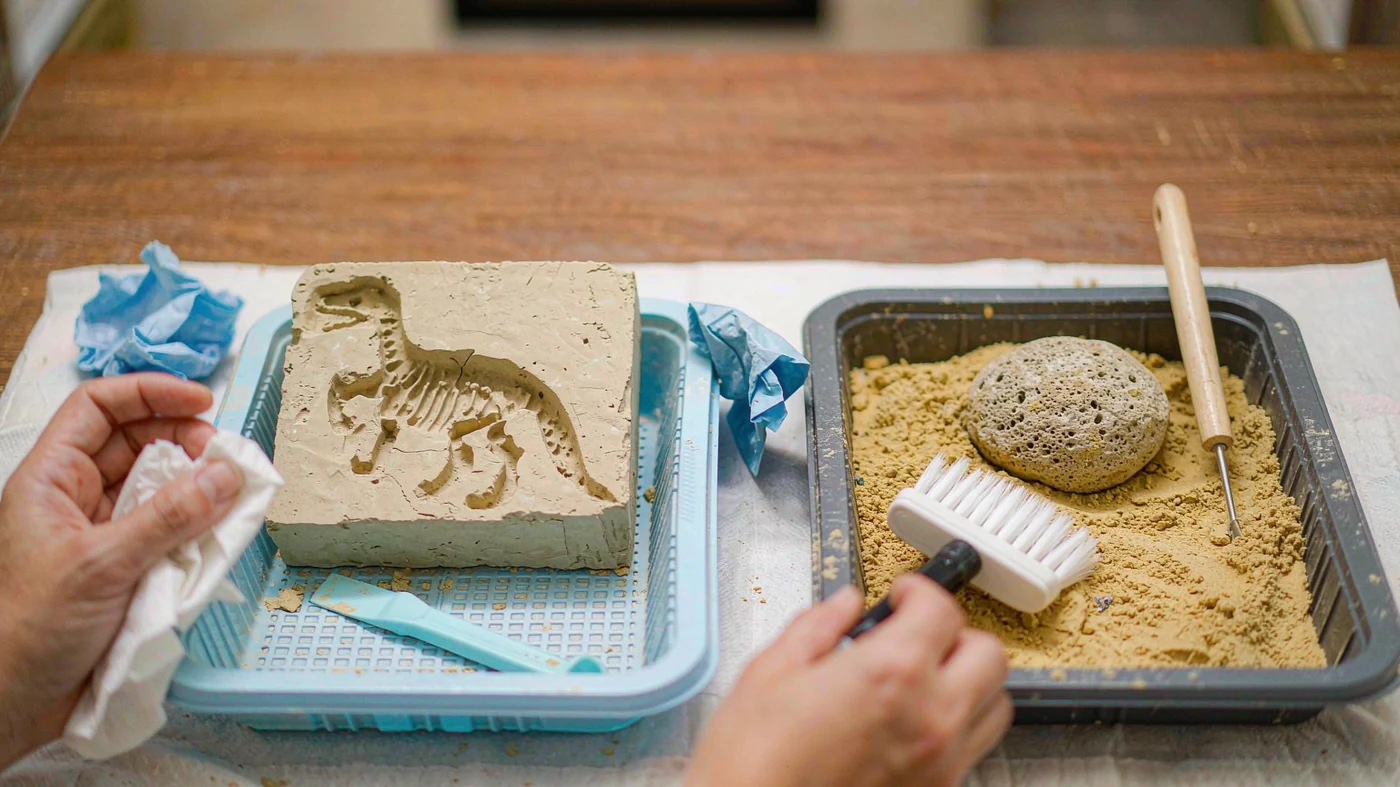
Short answer: choose a fossil dig kit with accurately described finds, a supported age grade, manageable digging and cleanup, a guide that identifies each fossil, and safety documentation for your destination market.
For retail, classroom, or wholesale buying, start by confirming whether the finds are genuine fossils or manufactured replicas. Review a sample against the promised contents, then time the activity using the supplied tools and instructions. The safety references below are starting points for a product-specific assessment, not a complete compliance checklist.
| Check | Reference point |
|---|---|
| Small parts | Under the US small-parts rule, a small part fits completely into the specified test cylinder. Covered products intended for children under 3 must not contain or release small parts during applicable testing; a ruler check is not a substitute.[1] |
| US lead limits | 100 parts per million limit for total lead in accessible components of children’s products, subject to exclusions and exemptions.[2] Paint and similar surface coatings have a 90 parts per million limit.[3] |
| US age scope | A children’s product is defined as a consumer product designed or intended primarily for children 12 years of age or younger.[4] A toy is defined as a plaything for children under 14 years of age, with listed exclusions.[5] Age grading considers product characteristics, skills, play behavior, and interests.[6] |
| Toy safety framework | ASTM F963-23 is a US toy safety specification; confirm the mandatory edition and applicable provisions with CPSC guidance and your laboratory.[7] In the EU, Directive 2009/48/EC covers products designed or intended for play by children under 14 years, subject to its scope and exclusions.[8] Check the current Official Journal references for applicable EN 71 parts and amendments. The European Commission lists Regulation (EU) 2025/2509 as applicable from 1 August 2030.[9] ISO 8124-1:2022 addresses mechanical and physical properties; its catalogue also lists Amendment 1:2025. An ISO reference alone does not establish compliance in a destination market.[10] |
A tidy sample and a supplier’s general certificate do not establish product compliance. Have the applicable assessment, testing, and documentation confirmed for the exact configuration you intend to sell.
Real or Replica
Do not infer authenticity from the fossil name or a product photograph. Ask whether each find is a genuine fossil, a manufactured replica, or another type of model. A mixed kit should identify which pieces belong to each category.
- The contents list gives names such as trilobite replica or ammonite specimen, rather than only a total fossil count.
- Sellers describe manufactured pieces as replicas or models, never as real fossils.
- Review the finds for breakage and sharp edges after excavation, not only while they are protected by the block.
- Choose the mix to suit the activity: varied finds for open-ended discovery, or a focused selection for a science kit lesson or geology and space science range.
Ask the supplier to confirm in writing what is natural and what is manufactured. Keep that wording identical on the page, box, and guide.
Kit Contents
Check the exact set before you pay: dig block, buried finds, tools, printed guide, tray or mat if specified, retail packaging.
| Component | What to check |
|---|---|
| Dig block | Intact block, no major cracks, no loose powder leaking out. |
| Buried finds | Names and quantities match the contents list; no broken finds or connectors after excavation. |
| Tools | Tool count matches the participant plan; flag sharp points, cracks, or breakage for assessment rather than assuming visual inspection proves safety. |
| Guide | Digging steps, cleaning steps, warnings, fossil identification section. |
| Packaging | Transit protection; consistent age information and market-appropriate warnings, instructions, and required product identification. |
Photograph the unopened pack, the supplied contents, and the recovered finds against the packing list. Record the sample code, arrival condition, missing items, and any damage. The dinosaur excavation sample checklist provides a related framework for organising those observations.
Age and Supervision
When you shortlist a kit, check the printed age grade on the exact product, not the fossil theme. Product design, skills needed, foreseeable use, and play behavior set it.[6]
- Small fossil pieces, small connectors, or detachable tool parts do not suit children under 3 under the small-parts rule cited above.[1]
- Within the supported age range, check grip, tool control, and instruction reading level. Larger pieces or rounded tools alone do not establish suitability for a younger child.
- Plan the adult help stated in the instructions. Supervision is not a substitute for an appropriate age grade or required testing.
- If the box grade and the listing grade differ, hold the offer and ask for a correction on the exact product.
Review age, piece size, and session length together, as discussed in the dinosaur dig kit age and activity guide, but make the final decision from the exact product’s assessment and instructions.
Digging Experience
Start with an adult sample review using the supplied tools and instructed method. Record every point where you need extra force, another tool, or unclear instructions resolved. Do not improvise with hammers or soaking unless the instructions permit it. An adult’s completion time does not establish how long a child will take.
- Log setup, first find, excavation completion, identification, and cleanup separately. Note the reviewer and any assistance or deviations.
- Use the same review surface and recording method across suppliers, but follow each kit’s own instructions, including whether wetting is allowed.
- Record powder escaping the work area, fragment scattering, tool damage, and damaged finds. Follow the cleaning instructions; easy cleanup does not prove dust is safe to inhale.
When a find appears, pause and follow the guide’s method for clearing around it. Record whether it can be recovered intact without striking it directly.
For a classroom purchase, map that log to the actual lesson: handing out materials, digging, identifying finds, and clearing tables. If excavation uses the whole session, select a different configuration or plan separate lessons. For retail, check that the guide explains when an unfinished activity can be paused. Use the same categories when comparing dig kits, models, and activity sets.
These are proposed review steps, not reported test results. One sample can reveal questions to investigate; it cannot establish batch consistency, age suitability, or compliance.
Learning Value
Check whether a child can connect each recovered find to its name and visible features, rather than simply finish the block.
- Cards or a booklet with the name, picture, and one or two observable traits for each fossil.
- Plain, age-appropriate wording; replicas stay separate from real specimens.
- Simple flow: dig, clean, identify, optionally assemble or display.
- For a classroom educational toy brief, specify an observable task, such as matching a find to its card and describing a visible feature.
When you approve an offer, skip guides that name fossils missing from the box, use only decorative pictures, or make scientific claims the activity cannot back up.
Safety References
Turn the reference table into a document request for the exact kit, not a request for a generic “toy safety certificate.” Ask your laboratory to determine the applicable requirements from the age grade, destination, materials, coatings, and intended use.
- Match report identifiers, photographs, materials, colours, and tested components to the offered SKU. Ask the laboratory to explain any differences or reliance on component testing.
- Check the listed standard editions, amendments, test dates, results, and laboratory details. Do not treat ASTM F963, EN 71, and ISO 8124 as interchangeable approvals.
- Request material and coating specifications for the block, finds, tools, and printed components. A “non-toxic” label or a clean-looking sample is not enough to settle chemical or dust-related questions.
- For the US, covered children’s products generally require certification based on testing by a CPSC-accepted third-party laboratory, subject to applicable exceptions. The domestic manufacturer or importer issues the Children’s Product Certificate; it is not a CPSC-issued approval. Confirm current certificate-data filing requirements for imports as well.[11]
For a private-label STEM toy project, document changes to the block, finds, tools, coatings, and packaging before approval. A dinosaur dig kit manufacturer brief or custom excavation kit specification should identify who reviews those changes and whether further assessment or testing is needed.
Value and Supplier Fit
Compare identical sets across suppliers: block size and weight, buried contents, tool count, guide quality, packaging, order quantity, delivery terms.
| Use case | What to confirm |
|---|---|
| Individual play | One tool set and guide per block where promised. |
| Parties or classrooms | Blocks and tools per child, plus trays, table protection, and cleanup spares. |
| Retail | Shelf-ready pack with barcode and warning placement; crack and powder-leak resistance in transit. |
| Wholesale and private label | Approved sample code, bill of materials, artwork version, change approval, and agreed pre-shipment checks. |
Send every supplier the same brief: age range, destination markets, kit contents, packaging, quantity, and required arrival date. Get the minimum order, sample charges, production timing, delivery terms, and replacement policy in writing; no universal order quantity or lead time applies to this checklist. When reviewing K&M’s supplier capabilities, use the project FAQs to identify questions that still need a quote-specific answer.
Frequently Asked Questions
Are the fossils in children’s dig kits real?
They may be genuine fossils, manufactured replicas, or a mixture. Ask for a contents list identifying each type. If the wording is unclear, do not describe the finds as real fossils until the supplier provides supporting information.
What age are fossil dig kits for?
There is no single age range for all fossil dig kits. Use the supported age grade and instructions for the exact set. Theme, piece count, and adult supervision alone do not determine age suitability; product characteristics and the skills needed matter.[6]
How long should a fossil dig take?
There is no universal completion time. Record setup, excavation, identification, and cleanup for the exact sample, including who used it and what help was needed. Allow for the intended users rather than presenting an adult review time as a child’s expected result.
What should wholesale buyers confirm before reordering?
Confirm that the production specification, materials, contents, tools, guide, labels, and packaging still match the approved version. Review changes with the responsible compliance team or laboratory, and agree inspection, documentation, and delivery requirements before placing the repeat order.
Bottom line: choose a kit you can describe accurately, assess for its intended age group, fit into the planned activity, and support with relevant documents. Resolve unclear claims, sample problems, and mismatched reports before committing to an order.
Need a fossil or excavation set matched to your market?
Send your age range, kit contents, and destination markets for a product and packaging review.
References
- CPSC Small Parts for Toys and Children’s Products. https://www.cpsc.gov/Business–Manufacturing/Business-Education/Business-Guidance/Small-Parts-for-Toys-and-Childrens-Products
- CPSC Total Lead Content. https://www.cpsc.gov/Business–Manufacturing/Business-Education/Lead/Total-Lead-Content
- CPSC Lead in Paint. https://www.cpsc.gov/Business–Manufacturing/Business-Education/Lead/Lead-in-Paint
- CPSC Children’s Products. https://www.cpsc.gov/Business–Manufacturing/Business-Education/Childrens-Products
- CPSC Toy Safety Business Guidance. https://www.cpsc.gov/Business–Manufacturing/Business-Education/Toy-Safety
- CPSC Age Determination Guidelines, January 2020. https://www.cpsc.gov/s3fs-public/Age-Determination-Guidelines-Relating-Consumer-Product-to-Characteristics-Skills-Play-Behavior-Intersts-to-Children-January-2020.pdf
- ASTM F963-23 Standard Consumer Safety Specification for Toy Safety. https://store.astm.org/f0963-23.html
- EUR-Lex Directive 2009/48/EC on the safety of toys. https://eur-lex.europa.eu/eli/dir/2009/48/oj/eng
- European Commission Toy safety harmonised standards. https://single-market-economy.ec.europa.eu/single-market/goods/european-standards/harmonised-standards/toy-safety_en
- ISO ISO 8124-1:2022 Safety of toys Part 1. https://www.iso.org/standard/80767.html
- CPSC Children’s Product Certificate. https://www.cpsc.gov/Business–Manufacturing/Testing-Certification/Childrens-Product-Certificate