
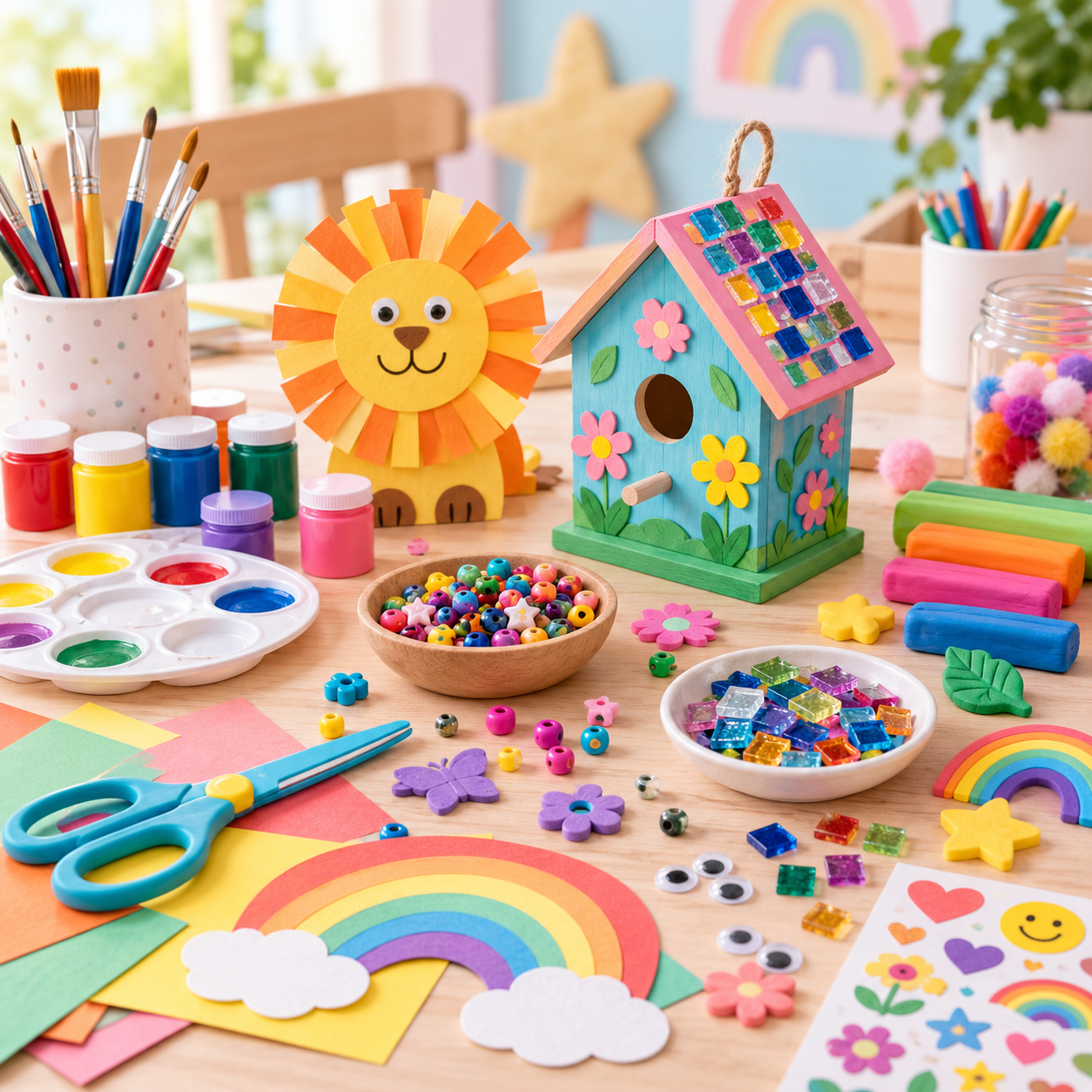
A catalog can have 24 products and still feel narrow. If 16 are painting kits for ages 6–8 and most sit in the same price band, retailers have plenty of item numbers but not much real choice. A useful new SKU should fill a gap in age, activity, price, project time, finished result or buying occasion.
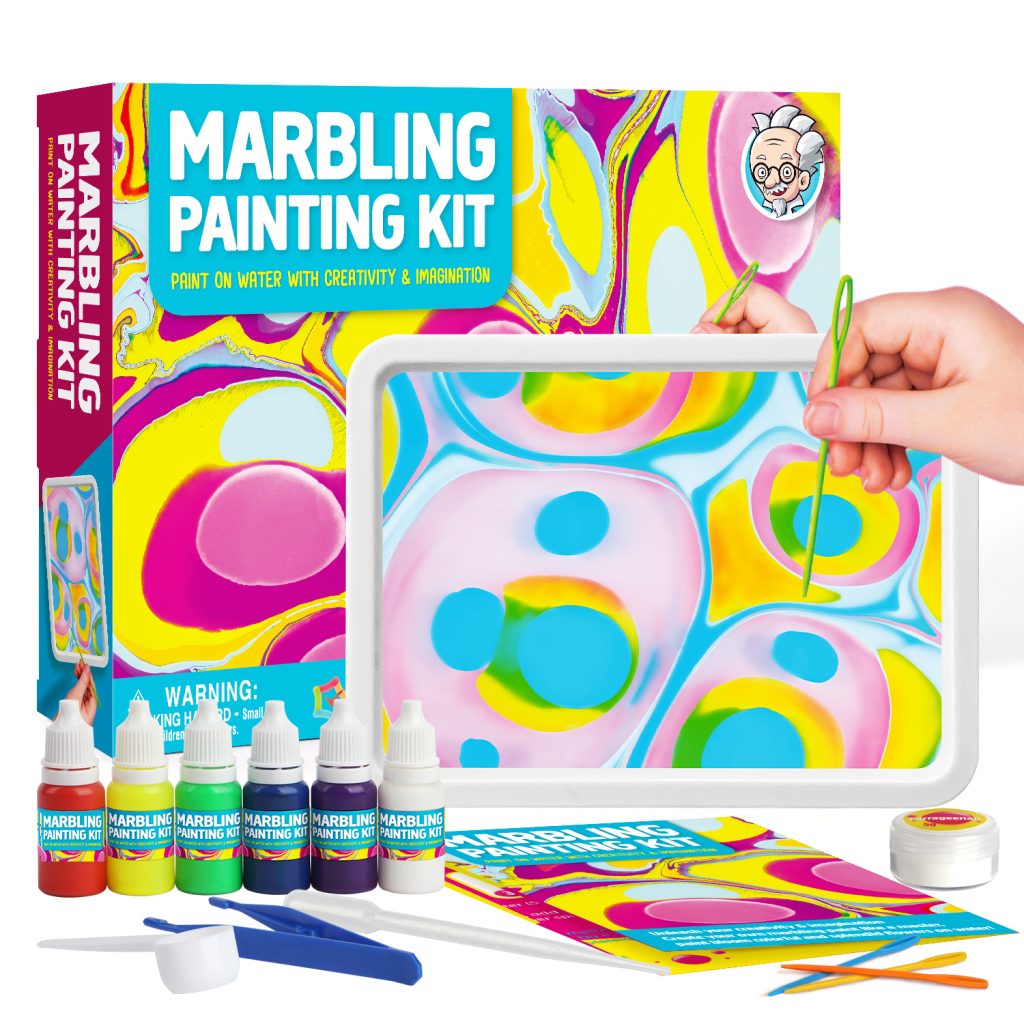
K&M lists Arts & Crafts as one of its core educational-toy categories, including jewelry making, painting, modeling and creative-assembly formats. Assortment planning works better when it starts with the buyer’s channel and the child’s activity experience, then works backward to SKU count, packaging, MOQ and target price.
Start With Why People Buy
Parents usually shop by need, not by craft technique. One parent may want a small birthday gift. Another wants a 20-minute activity for a rainy afternoon. Someone else just wants something a child can get on with without asking for help every five minutes.
| Buying need | Example SKU count |
|---|---|
| Quick activities | 5 |
| Everyday creative play | 8 |
| Giftable projects | 5 |
| Longer skill-based projects | 3 |
| Seasonal activities | 3 |
| Total | 24 |
A discount retailer may want more quick, lower-cost activities. A gift shop may lean toward sewing, jewelry, model-building or decorate-your-own kits. There is no reason those two buyers should receive the same mix.
Cover More Than One Age Group
Age changes the whole feel of a kit. It affects piece size, the number of steps, how much patience the project needs and how often an adult has to step in.
| Intended user group | Example SKUs | Share |
|---|---|---|
| Ages 3–5 | 5 | 20.8% |
| Ages 6–8 | 9 | 37.5% |
| Ages 9–12 | 7 | 29.2% |
| Mixed-age / family | 3 | 12.5% |
| Total | 24 | 100% |
Adjust the mix to what retailers actually sell. If ages 6–8 bring the most repeat orders, give that group more space. The issue is not having a large age segment. The issue is ending up with one by accident.
For ages 3–5, larger pieces, fewer steps and picture-led instructions usually make more sense. Kits for ages 9–12 can include longer projects such as sewing, jewelry and model building.
For the U.S. market, toys and other articles intended for children under three are subject to small-parts requirements. Prohibited small components can create a choking hazard.[1]
Mix Short and Long Activities
A 15-minute sticker kit and a two-hour sewing project are not really competing for the same moment. The first works well for travel or quick play. The second can make sense as a bigger gift or weekend project.
| Approximate project time | Example SKUs |
|---|---|
| 10–20 minutes | 4 |
| 20–45 minutes | 8 |
| 45–90 minutes | 8 |
| 90+ minutes / multi-session | 4 |
Short kits might include stickers, scratch art and collage. Medium-length kits can cover painting, threading and simple decorating. Longer projects may include sewing, detailed modeling, larger jewelry sets or multi-stage craft boxes.
Keep the time claim believable. If a “30-minute activity” regularly takes 90 minutes, either the wording or the project needs work.
Avoid Too Much of One Craft Type
Suppose a 24-SKU range contains:
- 5 dinosaur painting kits
- 4 unicorn painting kits
- 4 vehicle painting kits
- 3 ocean painting kits
16 ÷ 24 × 100 = 66.7%
The artwork changes, but two-thirds of the range is still painting.
A broader mix could look like this:
| Craft family | Example SKUs |
|---|---|
| Painting and coloring | 4 |
| Mosaic, sticker and paper crafts | 4 |
| Jewelry and threading | 3 |
| Sewing and textile crafts | 3 |
| Build-and-decorate projects | 3 |
| Clay and modeling | 2 |
| Wooden crafts | 2 |
| Seasonal mixed crafts | 3 |
| Total | 24 |
If painting demand slows, only four SKUs are directly exposed instead of 16. The shelf also looks more useful: painting, sewing, modeling and jewelry instead of row after row of similar paint kits.
Create Clear Price Levels
If nearly every kit lands around $14–$17 at retail, buyers have very few low-price or premium choices.
| Tier | Illustrative retail position | Example SKUs |
|---|---|---|
| Entry | $5–$9 | 5 |
| Core | $10–$17 | 10 |
| Gift | $18–$29 | 7 |
| Premium | $30+ | 2 |
Here, 10 of 24 products, or 41.7%, sit in the core price tier. Entry kits can suit impulse buys and small gifts. The $18–$29 tier can offer more projects, stronger packaging or a more substantial finished item. Keep the highest-price SKUs limited until demand is clear.
Compare Value by Finished Projects
Big component counts can look impressive on a box, but they do not always tell buyers much about actual value.
| Kit A | Kit B | |
|---|---|---|
| Wholesale cost | $5.40 | $7.20 |
| Finished projects | 2 | 6 |
| Storage included | No | Yes |
| Tools included | Basic | Full set |
Kit A costs:
$5.40 ÷ 2 = $2.70 per finished project
Kit B costs:
$7.20 ÷ 6 = $1.20 per finished project
Kit B is $1.80 more per box, but each finished project costs less than half as much. It also includes storage and more tools.
Only count projects a child can realistically finish. Calling 400 loose beads “20 projects” makes little sense if the materials and instructions only support four complete items.
Balance Ease of Use
Some parents want a kit a child can do alone. Others are happy to sit down and work on it together.
| Use type | Example products |
|---|---|
| Mostly independent | Scratch art, stickers, simple mosaics |
| Light adult help | Painting, threading, basic jewelry |
| Shared project | Sewing, detailed building, multi-step decorating |
Do not call a kit “independent” if an adult has to do the cutting, knotting or key assembly work.
Mess matters too. Paint, glue, clay and glitter will not suit every home or every occasion. Keep some low-setup options such as scratch art, stickers, foam crafts, threading or self-adhesive mosaics.
And “low mess” should mean what it says. A kit may contain no paint but still scatter 500 loose beads across the floor when the tray tips over.
Vary the Finished Result
| Finished result | Example SKUs |
|---|---|
| Artwork or picture | 6 |
| Wearable item | 4 |
| Model or figure | 4 |
| Room decoration | 3 |
| Functional item | 3 |
| Cards or gifts | 2 |
| Open-ended creations | 2 |
Only 6 of 24 products, or 25%, finish as flat artwork in this example.
A child may spend 45 minutes decorating a pencil case and then use it for months. Another kit might end as a bracelet, model, room decoration or gift. That gives retailers more ways to sell the category without simply changing the picture on the box.
Keep Evergreen Products at the Core
| Product role | SKUs | Share |
|---|---|---|
| Evergreen core | 8 | 33.3% |
| Theme / trend-led | 6 | 25% |
| Higher-value projects | 4 | 16.7% |
| Seasonal | 4 | 16.7% |
| Test concepts | 2 | 8.3% |
Core SKUs can include painting, mosaics, jewelry, sewing and decorate-your-own kits. Rotate themed items more often. If a dinosaur, space or ocean design keeps getting repeat orders, move it into the core range. If it stalls, replace it.
Buy Seasonal Stock Against the Sales Window
Suppose an evergreen animal painting kit sells 80 units per month.
Three months of stock equals:
80 × 3 = 240 units
If a few are left over, they can still sell later in the year.
Now take a Halloween kit expected to sell 240 units during its main sales window. Ordering 480 units means buying:
480 ÷ 240 × 100 = 200% of expected demand
If the forecast is right, 240 units are still sitting there after the main season.
A 10% lower factory price may not make up for 50% leftover stock that needs markdowns or another year of storage. Seasonal products should be bought against the real sales window, not annual demand.
Calculate MOQ Before Adding More Designs
K&M’s current project guidance gives a useful reality check before using one MOQ across an entire range: existing designs with logo customization are generally planned around 200–500 units/SKU, private-label products with a custom box around 500–1,000 units/SKU, and full ODM or new-tooling projects around 1,000–5,000 units/SKU. The exact number changes with materials, packaging, print setup, components and customization. Use the figures below as inventory-planning examples rather than a universal factory rule, and see K&M’s MOQ guide for more context.
Assume the MOQ is 500 units per SKU and the average factory price is $4.20 per kit.
Launching 30 designs requires:
30 × 500 = 15,000 kits
15,000 × $4.20 = $63,000
Launching 20 designs requires:
20 × 500 = 10,000 kits
10,000 × $4.20 = $42,000
The extra 10 designs tie up another:
$63,000 − $42,000 = $21,000
That still leaves out inspection, freight, duty, warehousing and local delivery.
Extra designs make sense when they bring in new sales. If they mostly steal sales from products already in the range, stock grows faster than revenue.
New concepts are worth testing on a smaller scale. If a new sewing line has a 600-unit MOQ per design, two designs require 1,200 units. Eight designs require 4,800. At $5 each, the difference is:
(4,800 − 1,200) × $5 = $18,000
Test two first. If they sell through and reorders come in, add more colors or themes on the next run.
Compare MOQ With Unit Savings
A cheaper unit price can still leave the buyer in a worse position.
| Option A | Option B | |
|---|---|---|
| Unit price | $4.00 | $3.80 |
| MOQ | 300 | 1,200 |
| Factory commitment | $1,200 | $4,560 |
Option B saves $0.20 per unit but requires another:
$4,560 − $1,200 = $3,360
If sales average 100 units per month, 1,200 pieces are roughly a year of demand before slower months or changing themes are considered. Saving $0.20 a unit does not look nearly as attractive when another 900 pieces sit in storage for most of that year.
Track Sell-Through and Margin Together
| Kit A | Kit B | Kit C | |
|---|---|---|---|
| Units received | 1,200 | 600 | 800 |
| Units sold | 840 | 510 | 520 |
| Units left | 360 | 90 | 280 |
| Sell-through | 70% | 85% | 65% |
Kit A sold more units. Kit B had better sell-through.
Now assume gross profit per sold unit is:
- Kit A: $2.40
- Kit B: $3.10
- Kit C: $4.20
Kit A: 840 × $2.40 = $2,016
Kit B: 510 × $3.10 = $1,581
Kit C: 520 × $4.20 = $2,184
Kit C has the weakest sell-through but the highest gross profit in this example. Kit B has the strongest sell-through but lower gross profit than A and C.
Look at sales, sell-through, margin, stock, returns and reorders together. One number rarely tells the whole story.
Set Reorder Points From Lead Time
Suppose a core kit sells 25 units per week and production plus shipping takes eight weeks.
Expected demand during lead time:
25 × 8 = 200 units
Add four weeks of extra stock:
25 × 4 = 100 units
A simple planning reorder point becomes:
200 + 100 = 300 units
If the buyer waits until only 50 units are left, an eight-week lead time is likely to create a stockout unless demand drops or production can be rushed.
Do not use the same buffer for every SKU. A product with steady monthly sales can carry more safety stock than something launched three weeks ago.
Check Package Volume
Craft kits are often light but bulky. A few extra centimeters on the box can quickly turn into more cartons, more storage and more freight.
A package measuring:
30 × 20 × 5 cm = 3,000 cm³
If every dimension grows by 10%:
33 × 22 × 5.5 cm = 3,993 cm³
Cubic volume rises by:
(3,993 − 3,000) ÷ 3,000 × 100 ≈ 33.1%
If the smaller box fits 24 units per master carton and the larger one fits 18, a 2,400-unit order changes from:
2,400 ÷ 24 = 100 cartons
to:
2,400 ÷ 18 ≈ 134 cartons
That is about 34 extra cartons for exactly the same number of kits.
Remove Duplicate SKUs
Before adding another product, compare it with the range you already have:
- Age
- Craft technique
- Retail price
- Project time
- Finished result
- Theme
- Adult help
- Buying occasion
If a new kit matches an existing one on seven of those eight points and only changes dinosaur artwork to an ocean theme, treat it as a variant when judging range diversity.
If 7 of 24 SKUs serve almost the same need:
7 ÷ 24 × 100 ≈ 29.2%
Nearly 30% of the catalog is then chasing the same customer need.
Replace three with a sewing kit, a mosaic project and a build-and-decorate model. The catalog still has 24 SKUs, but the choice is much wider.
Check Safety Before Ordering
Paper, paint, jewelry and clay kits can need different compliance checks.
The U.S. Consumer Product Safety Commission states that art materials and art or craft kits sized, decorated and marketed to children 12 years of age or younger are considered children’s products.[2]
Children’s products subject to applicable CPSC safety rules generally require a Children’s Product Certificate based on applicable testing, including testing by a CPSC-accepted third-party laboratory where required. Exceptions and special provisions can apply.[3]
Testing depends on the product, age grade, materials and the rules that apply to them. A supplier saying the whole catalog is “CPSC compliant” does not show which SKU was tested or what was actually checked.
Check Art Materials and Toy Rules
Under the U.S. Labeling of Hazardous Art Materials Act, consumer art materials require toxicological review for chronic hazards. CPSC states that the review must be repeated at least every five years. Applicable hazard labeling requirements also need to be followed.[4]
A change in formulation can also require reevaluation. That can include a change in a component supplier if the formulation no longer matches the material that was previously reviewed.[5]
Some children’s craft kits may also qualify as toys depending on their design, intended use and marketing.
For children’s toys manufactured on or after April 20, 2024, the U.S. mandatory toy standard incorporates ASTM F963-23 through 16 CFR Part 1250. The sections that apply depend on the product’s features and hazards.[6]
Do not use one generic test list for every product sold under a “kids’ crafts” label.
Match Documents to the Production SKU
This matches K&M’s published production workflow: the approved sample, material specification, artwork, packaging and test scope need to stay connected to the production SKU. A report for one paint formula, substrate or age grade should not be treated as blanket coverage for a different configuration.
| SKU | Paint | Main substrate | Intended age | Documentation status |
|---|---|---|---|---|
| K001 | Formula A | Wood | 6+ | Checked |
| K002 | Formula A | Wood | 6+ | Checked |
| K003 | Formula B | Plaster | 8+ | Review required |
| K004 | Formula C | Wood | 6+ | Review required |
A Formula A report does not cover Formula B or Formula C by default.
Record the SKU, age grade, material or formulation reference, test-report number, test date and applicable certificate.
For imported regulated products subject to CPSC certification requirements, mandatory certificate eFiling for most regulated consumer products began on July 8, 2026.[7]
Score New SKUs Before Ordering
A simple 20-point sheet is enough to stop good-looking products from slipping into the range for no real reason.
| Factor | Possible score |
|---|---|
| Adds a different activity | 0–2 |
| Fills an age gap | 0–2 |
| Fills a price gap | 0–2 |
| Creates a different finished result | 0–2 |
| Easy for shoppers to understand | 0–2 |
| Efficient package size | 0–2 |
| Manageable MOQ | 0–2 |
| Required documentation ready | 0–2 |
| Reasonable reorder potential | 0–2 |
| Distinct from current SKUs | 0–2 |
| Maximum | 20 |
Suppose Product A scores 18, Product B scores 14 and Product C scores 9.
Look at where Product C lost those 11 points. A 1,500-piece MOQ, a product idea you already carry and missing documents are solid reasons to stop and check again. A packaging-size issue may be easy to fix. High inventory exposure and unresolved compliance are not.
Review Weak SKUs With Real Sales Data
Suppose a quarterly review shows:
- 6 SKUs above 85% sell-through
- 9 SKUs between 65% and 85%
- 6 SKUs between 40% and 65%
- 3 SKUs below 40%
For the bottom three, check price, distribution, returns and stock age before ordering them again.
If each still has 400 units left at a $4.50 factory cost:
3 × 400 × $4.50 = $5,400
If sales stay weak for two review periods and there is no clear distribution problem, that $5,400 in slow stock is a good reason to test something else instead of repeating the same order.
Building an arts-and-crafts range? Share the age group, retail channel, target price, expected quantity and packaging direction with K&M. The project can then be matched to existing products, private-label changes or a fuller ODM development route.
FAQ
How many kids’ craft kit SKUs should a new wholesaler start with?
A focused 15–30 SKU range is easier to test than 50–100 new designs when every SKU carries an MOQ. At 500 units per SKU, 20 products already mean 10,000 units of opening stock. Add products when they fill a real age, price or activity gap.
How much of the range should be evergreen?
Keep enough evergreen SKUs for year-round reorders. In the 24-SKU example above, 8 products start as core products. Strong themed or higher-value items can move into the core range after they show repeat demand.
How do I know whether two craft kits are too similar?
Compare age, craft type, retail tier, project time, finished result, theme, adult involvement and buying occasion. If two products match on seven of those eight points and only the artwork changes, treat them as variants when reviewing the range.
Should I accept a higher MOQ for a lower unit price?
Check the total cash commitment and months of stock first. A $3.80 kit at a 1,200-piece MOQ requires $4,560 at factory cost. A $4.00 alternative at 300 pieces requires only $1,200. Saving $0.20 per piece may not be worth carrying another 900 units for most of a year.
What compliance information should I request for children’s craft kits?
Start with the destination market, age grade and actual materials. For U.S. children’s products, check the applicable CPSC rules, third-party testing and CPC requirements. Art materials can also fall under LHAMA, while products that qualify as toys may have applicable ASTM F963-23 requirements. Match reports and certificates to the actual production SKU.
Finally
A 24-SKU starter range could use 8 evergreen products, 6 themed kits, 4 higher-value projects, 4 seasonal items and 2 test products while covering several ages, prices and activity times. At a 500-unit MOQ, moving from 20 to 30 designs raises opening stock from 10,000 to 15,000 units. After launch, use sell-through, margin, reorders and stock age to decide what stays, what grows and what needs to go.