
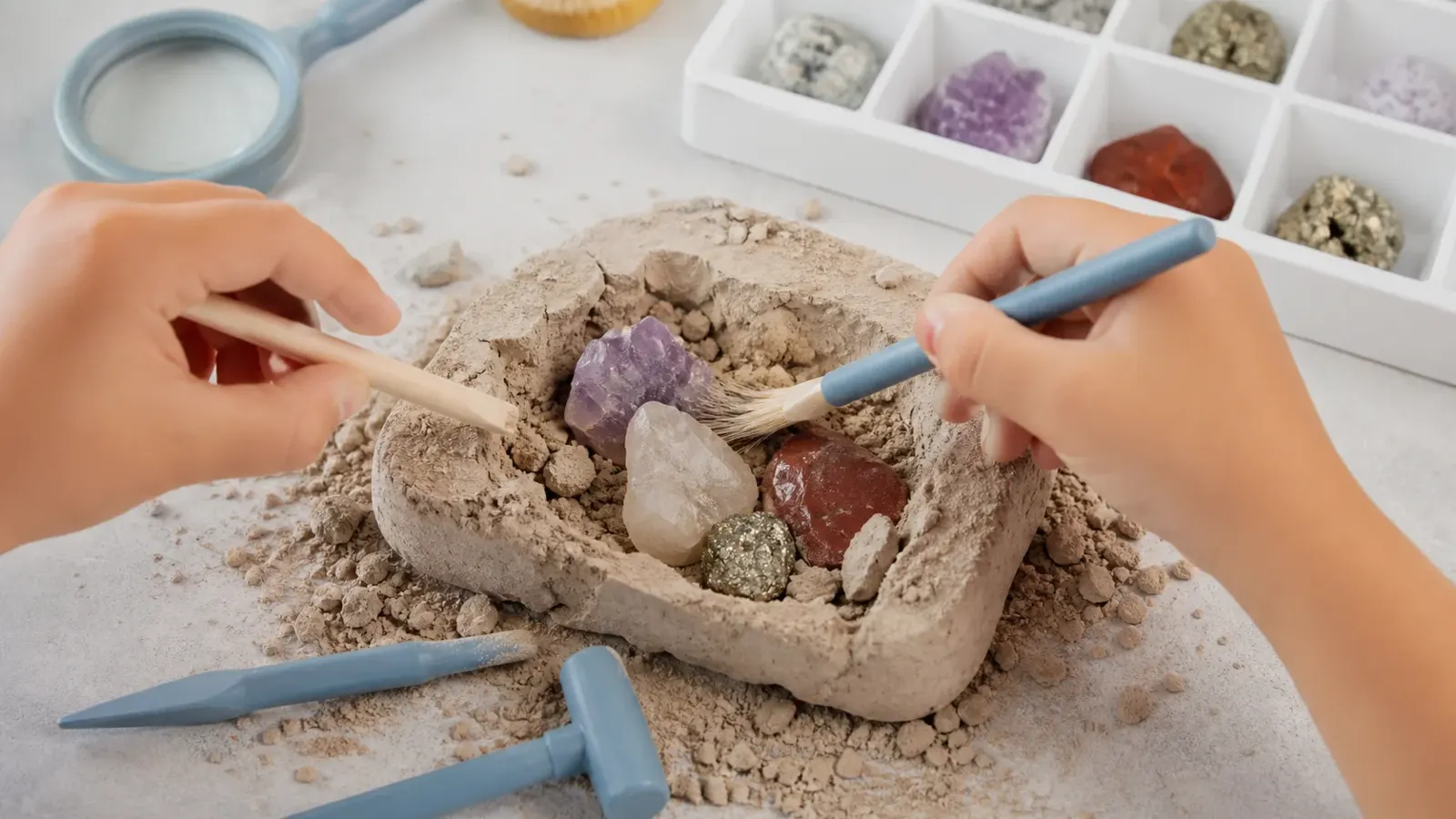
yes, they can be. Many gemstone dig kits use real natural minerals such as quartz, amethyst, agate, jasper, sodalite, hematite, tiger’s eye, and obsidian. But “real” is only part of the story. A natural stone may have been dyed, heated, coated, or filled. Some kits may also contain laboratory-grown or imitation materials.
The FTC makes the same basic distinction between natural, laboratory-created, and imitation gemstones.[1] That’s useful because it stops us from treating everything as a simple “real or fake” question.
There’s one more thing worth clearing up right away: the gemstone may be natural even though the block around it isn’t. In a typical commercial dig kit, the stones are placed inside a manufactured excavation block. The block is there to recreate the experience of digging, not to copy a real geological deposit stone for stone. K&M’s dig kit manufacturing guide explains how hidden objects, block size, stone size, and digging time are set during production.
When you find a stone in a kit, four questions matter more than “Is it real?”
- What is it?
- Did it form naturally?
- Was it treated?
- Is it actually valuable?
Are Dig Kit Gemstones Actually Real?
They can be, and there’s no mystery about how an inexpensive kit can include genuine stones. Common minerals are cheap when they’re small, cloudy, cracked, opaque, badly shaped, or simply not suitable for jewelry.
A clear, well-colored gemstone that can be cut for a ring may be valuable. A rough 15 mm chip of the same mineral might be worth very little. Both can be natural.
As one practical size example, K&M’s manufacturing guide uses roughly 12–25 mm along the longest side as a purchasing range for hidden gemstones. That’s a production example, not a safety rule, but it gives a sense of how small these specimens can be.
Common materials include quartz, amethyst, agate, jasper, aventurine, calcite, sodalite, hematite, fluorite, tiger’s eye, and obsidian. A product such as the Jumbo Gems Gem Dig Kit, for example, lists named specimens such as amethyst, tiger’s eye, and obsidian rather than calling every piece simply a “gem.”
Natural, Treated, Lab-Grown, or Imitation?
A natural gemstone formed in nature. That sounds obvious, but natural stones often look much less perfect than people expect.
Natural amethyst may be pale, cloudy, cracked, partly white, or uneven in color. Amethyst is simply the purple variety of quartz. It has the chemical formula SiO2 and a Mohs hardness of 7.[2]
So if your child’s piece of amethyst looks nothing like the polished purple stone in a product photo, that doesn’t automatically mean it’s fake. Natural specimens vary. A lot.
A treated stone is different. The material itself may be natural, but its appearance has been changed after mining. Dyeing is an easy example. Pale agate can be dyed blue, green, red, pink, or purple. The agate is still agate; the color just isn’t natural.
Agate is a banded form of chalcedony, a very fine-grained silica material. USGS includes agate and jasper among common chalcedony materials.[3]
So “natural dyed agate” is a much better description than either “real gem” or “fake gem.”
Laboratory-created gemstones are another category. They’re grown by people, not mined, but they aren’t the same as glass. Synthetic ruby, for example, is laboratory-grown corundum. Red glass only imitates ruby. FTC guidance says terms such as “laboratory-created” or “synthetic” should be used for material with essentially the same optical, physical, and chemical properties as the named mined gemstone.[4]
Then there are imitations: glass, resin, plastic, cubic zirconia, or another stone chosen because it looks similar to a more familiar gem. Some of these can look surprisingly convincing, especially after polishing.
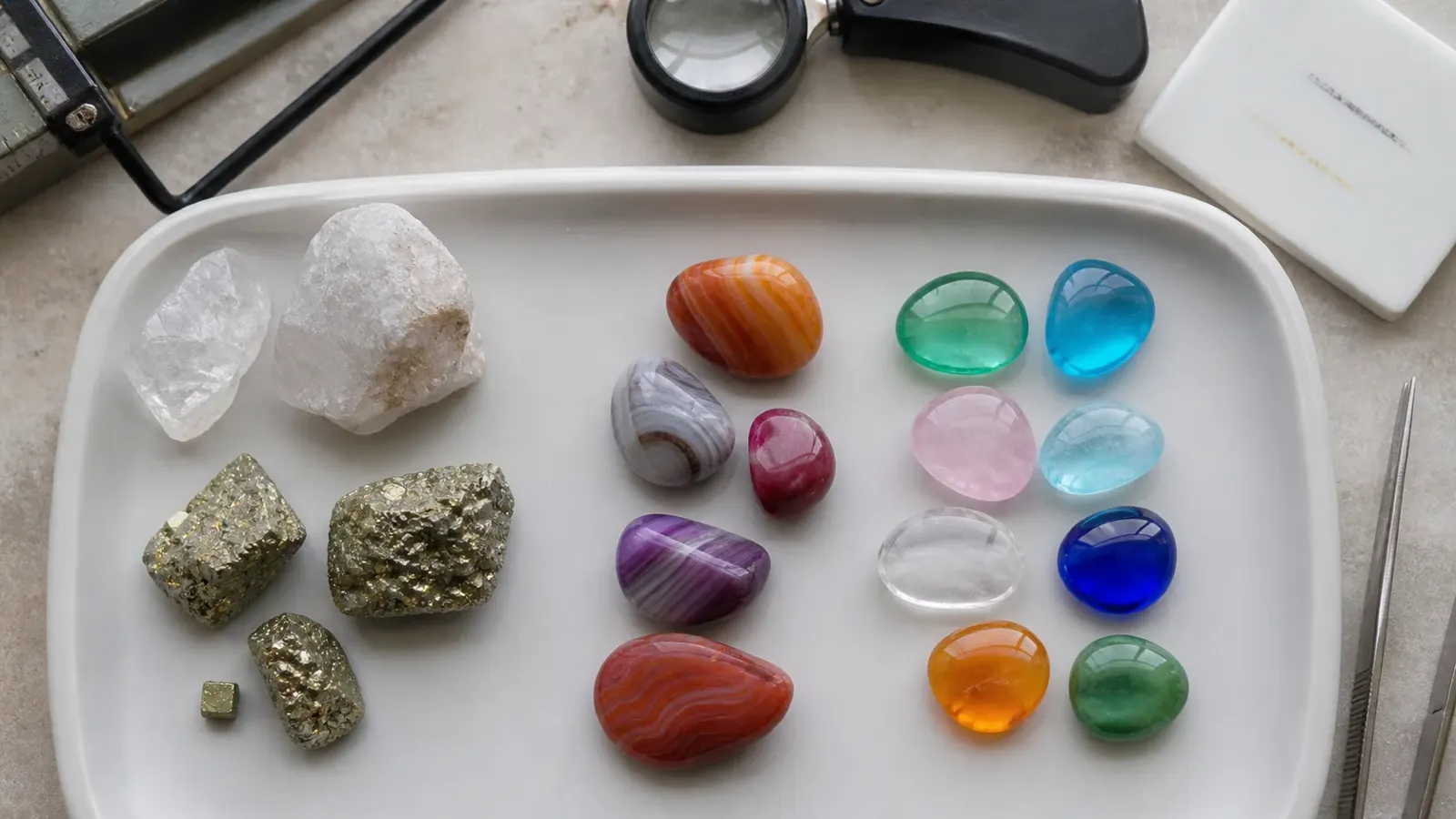
Common Stones You May Find
There’s no fixed list used by every manufacturer, but these are common and practical materials for educational kits.
| Stone or Mineral | Typical Appearance | Mohs Hardness | Useful Clue |
|---|---|---|---|
| Clear quartz | Clear to cloudy | 7 | Glassy surface, often with internal cracks |
| Rose quartz | Pale to medium pink | 7 | Usually cloudy or translucent |
| Amethyst | Light to dark purple | 7 | Purple quartz |
| Agate | Banded or patterned | About 6.5–7 | Very bright color may be dyed |
| Jasper | Red, brown, yellow, green, or mixed | About 6.5–7 | Usually opaque |
| Aventurine | Often green | About 6.5–7 | May show tiny reflective sparkles |
| Calcite | White, orange, yellow, or other colors | 3 | Much softer than quartz |
| Sodalite | Deep blue, often with white patches | About 5.5–6 | Usually opaque |
| Hematite | Gray, black, or metallic | About 5–6.5 | Feels dense; leaves a reddish-brown streak |
| Tiger’s eye | Brown and gold bands | About 7 | Silky moving band of reflected light |
| Fluorite | Purple, green, clear, or mixed | 4 | Much softer than quartz |
| Obsidian | Usually dark brown or black | About 5–5.5 | Natural volcanic glass |
The Mohs scale ranks scratch resistance, but the numbers aren’t evenly spaced. A hardness of 8 is not simply twice as hard as 4. USGS lists calcite at 3, fluorite at 4, quartz at 7, corundum at 9, and diamond at 10.[5]
Obsidian is a good reminder that not everything sold in a “crystal” or “gemstone” kit is technically a crystal. USGS describes obsidian as volcanic glass.[6]
Why Some Stones Look Almost Too Bright
Bright color isn’t proof that a stone is fake. Plenty of minerals are naturally colorful. What matters more is how the color sits in the stone.
If color is much darker inside cracks, pools in porous areas, or follows a network of fractures, dye is one possibility.
A good example is quench-crackled quartz. GIA describes natural colorless quartz that is heated and rapidly cooled so that many cracks form. Dye can then enter those cracks, creating green, red, or blue material that may resemble emerald, ruby, or sapphire.[7]
A simple 10× loupe is often enough to spot obvious clues such as concentrated dye, large inclusions, surface coatings, gas bubbles, or crack networks. It won’t solve every case, but it gives you far more information than color alone.
Heat treatment is harder. Heating can change the color or clarity of some gemstones, and there may be no obvious sign a beginner can see. Professional gem labs may use microscopes, refractometers, polariscopes, spectroscopes, ultraviolet light, and advanced analysis when necessary.[8]
Coatings are usually easier to suspect when the effect looks surface-only. Worn edges, chipped areas, or a metallic or rainbow layer that disappears where the surface is damaged can be clues. Still, natural minerals can also show rainbow effects, so don’t treat iridescence as proof by itself.
Some stones may also contain oil, wax, resin, or other fillers. These can improve appearance or make fragile material more durable. For a cheap children’s specimen, trying to prove a subtle filling treatment usually isn’t worth the effort.
Does Treatment Mean the Stone Is Fake?
No. That’s one of the biggest misunderstandings around gemstones.
| Example | What It Actually Is |
|---|---|
| Natural amethyst | Natural quartz with natural purple color |
| Dyed agate | Natural agate with added color |
| Laboratory-created ruby | Ruby material grown in a laboratory |
| Red glass | An imitation if it is being used to resemble ruby |
In the United States, FTC guidance calls for treatment disclosure when a treatment is not permanent, requires special care, or significantly affects the gemstone’s value.[9]
What About Ruby, Sapphire, and Emerald?
This is where people often become suspicious: how could a low-cost children’s kit contain ruby or sapphire?
The answer is quality.
Ruby and sapphire are both corundum, with a Mohs hardness of 9. Fine jewelry material may be transparent, strongly colored, large enough to cut, and relatively free from damaging cracks.
Low-cost corundum can look very different. It may be opaque, tiny, cracked, dull in color, mixed with other minerals, or completely unsuitable for cutting. It can still be genuine ruby or sapphire material.
The same applies to emerald. A small, cloudy, heavily included piece is not remotely the same thing, in value, as a clear emerald suitable for fine jewelry.
I’d be more cautious if a very cheap kit appeared to contain a stone that was large, transparent, strongly colored, very clean, and obviously suitable for cutting. That combination would be unusual for high-value natural material in a low-cost toy.
How to Identify a Stone at Home
You can often narrow down what a stone is. What you usually can’t do at home is prove every treatment or separate every natural gemstone from a laboratory-grown one.
Start with color, but don’t stop there.
- Purple: amethyst, fluorite, dyed quartz, or glass.
- Blue: sodalite, dyed agate, another dyed stone, or glass.
- Green: aventurine, fluorite, dyed quartz, dyed agate, or glass.
- Colorless: quartz, calcite, fluorite, or glass.
Next, look at transparency. Jasper and sodalite are normally opaque. Rose quartz is often cloudy or translucent. Quartz and fluorite may be much clearer.
Then pay attention to weight. Some minerals feel noticeably heavier than others of the same size.
| Material | Approx. Specific Gravity | What That Feels Like |
|---|---|---|
| Quartz / Amethyst | About 2.65–2.66 | A useful baseline |
| Calcite | About 2.71 | Very similar in weight to quartz |
| Fluorite | About 3.0–3.2 | A little heavier than quartz |
| Hematite | About 5.3 | Often feels surprisingly heavy |
USGS data puts quartz at about 2.65, calcite at about 2.71, and hematite at about 5.3 specific gravity.[10] GIA also reports quartz around 2.65–2.66.[11]
In plain terms, a solid piece of hematite can feel roughly twice as heavy as a similarly sized piece of quartz. That’s a useful clue when you have a dark, metallic-looking stone in your hand.
Finally, use magnification. Around 10× is enough to look for bands, bubbles, cracks, inclusions, dye concentrated in fractures, coatings, and flow-like structures. GIA documents glass as a common imitation material and notes that manufactured glass can imitate several natural gems and ornamental stones.[12]
If your stone doesn’t match the kit card exactly, there are several ordinary reasons: natural variation, different lighting, rough versus polished surfaces, mixed assortments, treatment, production-batch differences, or simply a labeling mistake.
A card is useful. It isn’t a lab report. GIA colored-stone reports treat identity, natural or synthetic status, and detectable treatments as separate questions.[13]
When a Scratch Test Helps
Scratch testing can be useful, but only when hardness actually helps separate two possible minerals.
- Calcite: Mohs 3
- Fluorite: Mohs 4
- Quartz and amethyst: Mohs 7
- Corundum, including ruby and sapphire: Mohs 9
That makes quartz much more resistant to scratching than fluorite. But hardness can’t tell you whether quartz was dyed, whether ruby is natural or synthetic, or whether a gemstone was heated.
Also, don’t scratch a polished stone just because you can. You may permanently damage it.
For hematite, a streak test is often more useful. Hematite may look gray or black but commonly leaves a red to reddish-brown streak.[14]
Popular Tests That Don’t Tell You Much
- “Real stones always feel cold.” Glass can feel cold too.
- “If it scratches glass, it’s genuine.” Plenty of hard materials scratch glass.
- “Natural stones always have flaws.” Some natural stones are clean, and some synthetic materials contain inclusions.
- “Bubbles always mean fake.” Bubbles can point toward glass, but not every glass piece has obvious bubbles.
- “If it sinks, it’s real.” Many natural and man-made materials sink.
- “A flashlight proves it’s natural.” It may show cracks or color zones, but not origin.
- “A phone app can identify any gemstone.” A photo can’t measure hardness, density, refractive properties, or many treatment clues.
Skip flame tests, hot needles, acids, bleach, solvents, grinding, or deliberately breaking a specimen. They can damage the stone and may create dust or fumes for very little useful information.
Are Dig Kit Gemstones Worth Money?
Usually not much.
Even natural gemstones can have very low resale value when they’re small, cloudy, cracked, opaque, common, or unsuitable for cutting.
One number that often confuses beginners is carat weight. 1 carat equals 0.2 gram.[15] So a 10-gram rough stone weighs 50 carats. That sounds impressive, but weight alone says almost nothing about value.
Value depends on things like rarity, size, color, transparency, condition, crystal shape, treatment, cutting potential, demand, and where the specimen came from.
Collectors also care about provenance, meaning a reliable record of where a specimen was collected. Dig-kit stones often have a mineral name but no mine-level history, so even an attractive natural specimen may have limited collector value.
Professional identification starts to make sense when a specimen is unusually large, very clear, strongly colored, suitable for cutting, tied to a serious value claim, or something you plan to resell under a specific gemstone name.
Why Genuine Stones Can Still Be Cheap
Because natural minerals are sold at many different quality levels.
Fine jewelry needs good color, useful size, enough strength to survive cutting, and often decent transparency. Educational kits don’t. They can use cloudy, opaque, fractured, irregular, or small rough pieces.
Low-grade rough may also be bought by hundreds of grams or kilograms rather than priced one stone at a time.
So yes, a cheap kit can contain real stones. It just isn’t likely to contain high-value jewelry material.
Do Polished Stones Still Count as Natural?
Yes. Polishing changes the surface, not the geological origin.
A polished piece of natural quartz is still natural quartz. The downside is that polishing can remove crystal faces, rough textures, and sharp fracture edges that might otherwise help with identification.
And a polished stone can still be dyed or coated. “Polished” tells you how the surface was finished, not whether the stone was treated.
What About Glass, Resin, and Plastic?
They’re common imitation materials because they’re cheap and easy to color.
Glass may show rounded bubbles, internal flow lines, very even color, or a molded appearance. Resin and plastic may feel unusually light, scratch more easily, or show mold seams.
GIA lists manufactured glass and plastic among materials used to imitate natural gems.[16]
You don’t need a flame or hot needle to check them. A loupe, weight comparison, surface inspection, and the product’s own material list are much safer starting points.
Can a Dig Kit Be Scientifically Useful?
Yes, if the child does more than match colors to a card.
A simple process works well:
Observe → make a guess → check useful properties → decide how confident you are.
If the stone is purple, amethyst is one possibility. Then ask whether it looks like quartz, whether it seems much softer like fluorite, and whether amethyst is actually listed in the kit.
After the digging is finished, stones can be sorted by hardness, transparency, shine, pattern, color, and relative weight. K&M’s geology and mineral kit overview shows how specimen cards, magnifiers, trays, and mineral collections can support this kind of hands-on comparison.
Gem dig kits are also different from crystal-growing kits. In a dig kit, the stone already exists and is hidden inside the block. In a crystal-growing activity, crystals form during the experiment from supplied materials. A purple crystal grown in a classroom solution isn’t natural amethyst just because it’s purple.
Are Gemstone Dig Kits Safe for Children?
The practical risks usually come from small stones, tools, sharp fragments, and loose excavation material rather than the gemstone itself.
For U.S. toys intended for children under three, the CPSC small-parts test uses a cylinder about 57.1 mm long and 31.7 mm wide. If an object fits completely inside, it counts as a small part under the rule.[17]
That doesn’t mean anything larger is automatically safe. Age grading, breakage, tool design, and other product requirements still matter.
- Follow the stated age range.
- Keep small stones away from babies and toddlers.
- Supervise younger children.
- Use eye protection if hard digging can send chips flying.
- Avoid deliberately making or breathing dust.
- Wash hands after the activity.
- Don’t put unknown stones in the mouth.
- Don’t use household chemicals or flames to identify them.
For kits sold in the U.S. or EU, age grading, small parts, material selection, labeling, and testing are also part of the wider toy safety compliance process.
How to Choose a Better Gemstone Dig Kit
Ignore big words like “REAL TREASURE” for a moment and look for useful details.
A better product description tells you which stones may be included. “Contains 12 real gems” isn’t nearly as useful as a list that names amethyst, quartz, agate, jasper, sodalite, and so on.
Treatment information matters too. “Natural dyed agate” tells you much more than “genuine blue gemstone.”
The identification guide should include more than color. Hardness, transparency, banding, natural variation, and simple identifying features make the activity much more useful.
Also check whether the assortment is fixed. A box may show ten possible stones while each kit contains only five. And, of course, check the age range, specimen size, digging tools, and supervision instructions.
A Quick Check at Home
- Read the kit list. Start with the stones that are actually supposed to be inside.
- Check color and transparency. Use them to narrow the options, not make a final call.
- Compare weight. Hematite can feel much heavier than quartz of similar size.
- Use a 10× loupe. Look for bands, bubbles, cracks, dye, and coatings.
- Use hardness only when useful. Calcite is 3, fluorite 4, quartz 7, and corundum 9.
- Try a streak test for hematite. A reddish-brown streak is a strong clue.
- Don’t rely on one trick. Several matching properties are much more useful than one dramatic test.
- Don’t damage the stone. Most kit specimens aren’t worth destructive testing or expensive lab work.
Natural vs. Treated vs. Synthetic vs. Imitation
| Category | Formed Naturally? | Same Material as the Named Gem? | Plain-English Meaning |
|---|---|---|---|
| Natural untreated | Yes | Yes | Natural stone with no major appearance-changing treatment |
| Natural treated | Yes | Yes | Natural stone that was dyed, heated, coated, filled, or otherwise changed |
| Laboratory-created | No | Essentially yes | Gem material grown in a lab |
| Imitation | Not necessarily | No | Another material used to look like the named gemstone |
Frequently Asked Questions
Why Doesn’t My Stone Match the Identification Card?
Natural stones vary in color, clarity, shape, and pattern. Lighting and polishing also change how they look. If the kit uses a mixed assortment, the card may show a typical example rather than the exact stone you found.
Can Two Boxes of the Same Kit Contain Different Stones?
Yes, if the product uses a mixed or random assortment. Check whether the manufacturer promises exact contents or only lists possible finds.
Does “Genuine Gemstone” Mean Untreated?
No. A natural stone can still be dyed, heated, coated, or filled. Specific treatment information is more useful than the word “genuine.”
Can a Phone Identify a Gemstone?
A photo can help compare color, cracks, bands, and surface features. It cannot directly measure hardness, density, refractive properties, or many treatment clues. Use it to narrow the possibilities, not to prove origin.
Conclusion
Dig-kit stones can be genuine natural minerals without being rare or expensive. A few simple numbers help: calcite is Mohs 3, fluorite 4, quartz 7, and corundum 9; quartz has a specific gravity near 2.65, while hematite is around 5.3, so hematite can feel roughly twice as heavy at the same size. A 10× loupe can reveal dye in cracks, bubbles, coatings, and inclusions. None of these clues proves natural origin on its own, but together they can narrow the answer quite well. For most small, cloudy, cracked, or opaque kit specimens, careful observation is far more useful than destructive testing or expensive laboratory analysis.