
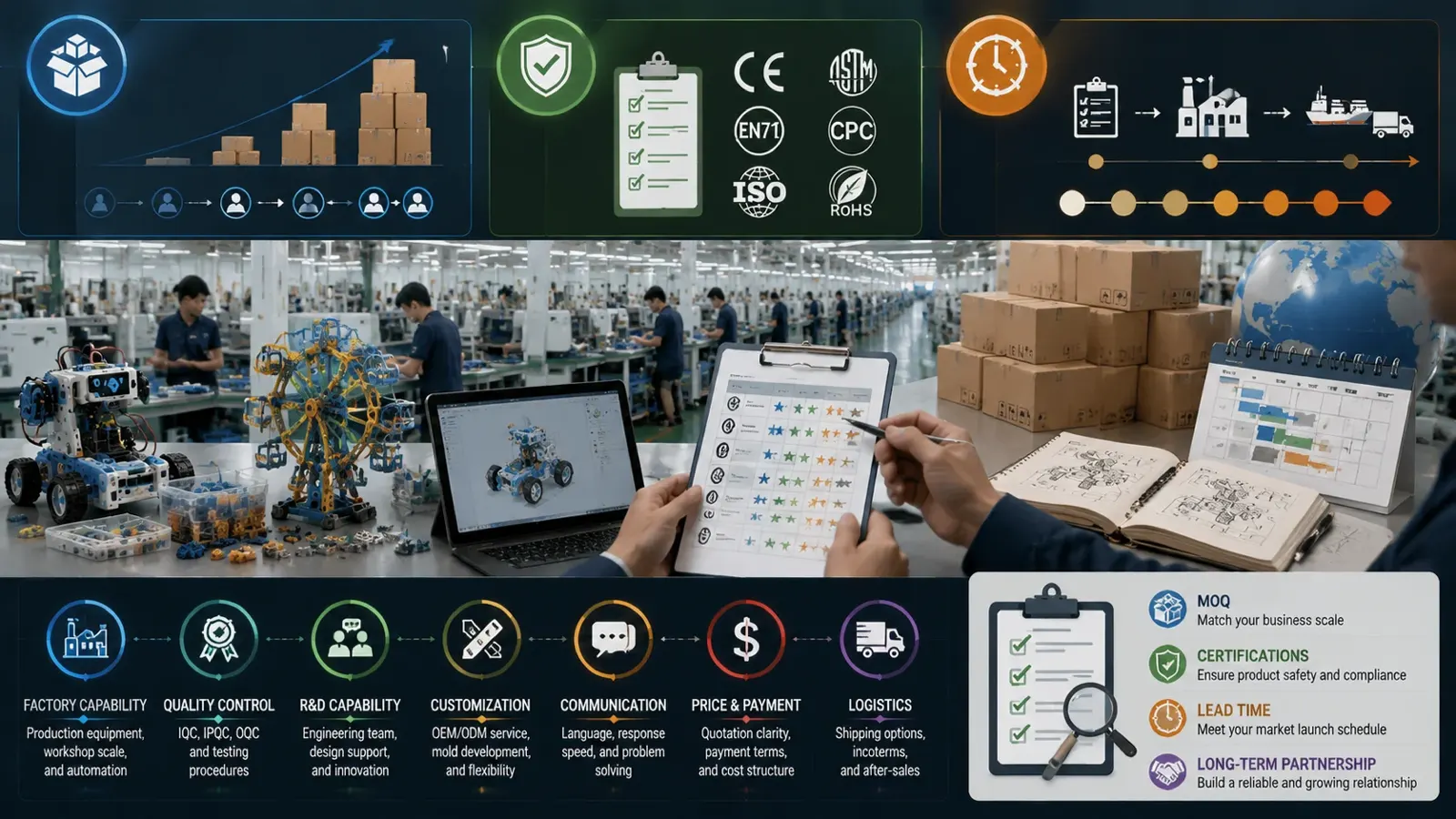
This guide gives you a practical screening framework across three dimensions: factory verification, safety certifications, and order planning.
| Screening Dimension | What You Need to Check | Main Risk It Helps Control |
|---|---|---|
| Know the Factory | STEM focus, real OEM capability, and past client cases | Trading agents, weak engineering, and fake capacity claims |
| Check Safety Proof | Certificates, test reports, and sample quality | Certification rejection, recalls, and unsafe products |
| Plan Orders Well | MOQ, lead time, price terms, and payment terms | Hidden costs, late delivery, and contract disputes |
Know the Factory
STEM Toy Focus
STEM toys are not about assembling generic plastic parts. The key question is whether the factory treats STEM products as its core business.
This affects how much the factory invests in material formulas, electronic module integration, and educational function design.
- Check whether STEM products account for more than 60% of the factory’s export records.
- Check whether the factory has an independent product engineering team.
- Make sure STEM orders are not simply placed on the same production line as plush toys or simple puzzles.
Core business does not mean occasionally taking a few custom orders.
The practical test: ask what percentage of the factory’s monthly shipments are STEM products.
We once visited a factory where the same injection molding line made engineering plastic gears in the morning and switched to standard ABS toy frames in the afternoon. Cross-contamination from mold sharing is one of the most common causes of product recalls in the U.S. and European markets.
Ask directly: what is your average monthly STEM shipment volume? Any factory below 50% STEM focus should be disqualified immediately.
There is an even more direct way to assess a factory’s STEM capability: check whether it develops its own educational components.
- Embedded sensors
- Programming modules
- Mechanical link structures
- Functional prototype development
Factories with in-house expertise in these areas usually keep investing in engineering R&D. During a site visit, ask the factory to demonstrate a functional prototype of one of its proprietary products.
A factory that can produce a complete functional prototype and run a live demonstration on the spot generally has solid incoming material inspection and assembly process controls.
Suppliers that can only offer off-the-shelf molds and standard parts are usually trading companies, not real manufacturers. They will keep adding charges for customization requests while offering no firm guarantee on delivery time.
Real OEM Work
A large proportion of so-called OEM factories on the market are actually trading agents or small family-run workshops.
To tell the difference, check these items:
- The factory holds an independent production license, and the business scope includes manufacturing, not only sales.
- The factory has its own factory floor area. A factory under 1,000 sqm is extremely unlikely to handle injection molding, painting, and assembly fully in-house.
- The factory has enough employees paying social insurance. A factory with fewer than 50 insured workers is unlikely to operate a full automated production line.
- The factory accepts third-party SGS audits.
During one due-diligence investigation, we found a target factory with only 11 workers on its social insurance roster, yet it claimed a monthly production capacity of 50,000 units. Such inconsistencies are easy to spot with basic verification.
Another hard requirement: ask whether the factory accepts third-party SGS audits. Trading agents and middlemen typically refuse.
A genuine OEM factory must have a complete three-stage quality control system:
| QC Stage | Full Name | What to Ask For |
|---|---|---|
| IQC | Incoming Quality Control | Daily incoming material inspection reports |
| IPQC | In-Process Quality Control | Process inspection logs from production |
| OQC | Outgoing Quality Control | Final inspection reports before shipment |
Do not settle for oral assurances that quality inspection is very strict. Ask to see IQC daily reports, IPQC inspection logs, and OQC inspection reports from the past three months.
These records should exist in the factory ERP system or quality gate logbooks and should be easy to verify.
A classic red flag is when the salesperson only shows you a sample exhibition hall and a decorated conference room, while the actual production workshop is at a different address. Another red flag is being told that the production line is not available for visits today.
Walk away immediately in such cases.
Past Client Cases
Requesting past client cases from an OEM factory is not about listening to sales pitches. It is about verifying whether the factory has actually served brands at the same scale as yours.
A credible client reference must include:
- The client name or a verifiable anonymous description
- The product type supplied
- Shipment volumes
- The duration of the cooperation
Factories that can demonstrate long-term partnerships with major Amazon sellers or established U.S. and European brands usually have higher service maturity.
Factories that have only supplied to WeChat merchants or Pinduoduo channels raise serious questions about their ability to fulfill large-scale orders.
We once caught a textbook case of fabricated references. A factory displayed what it claimed was an order from a major U.S. retailer, but investigation showed it was a project from the sales director’s previous employer, not the factory’s own track record.
The purchase invoice or shipment record the factory provided had a different company name.
The fix is simple: ask for the corresponding PI (Proforma Invoice) or shipping record screenshot from the factory and cross-check it against the bill of lading.
Any discrepancy will immediately surface.
When reviewing client cases, also assess whether the factory has experience with your specific product category.
Suppose you want to make a programmable robot. A factory that has only produced wooden puzzles in the past, even if it is a long-term supplier to a major European brand, is not necessarily equipped to handle electronic module assembly and sensor calibration.
The right question to ask: among your existing clients, which brands’ programming or science experiment products are manufactured here?
Request a visit to the actual production line for those products, not a showroom with samples.
- A real electronic toy factory should have ICT (In-Circuit Test) fixtures.
- It should also have chip programmers on the production line.
- If you do not see these, it is probably a just-in-time assembler rather than a true manufacturer.
Check Safety Proof
Needed Certificates
STEM toys entering different target markets require different compliance documents.
The three most critical compliance areas for the U.S. and European markets are ASTM F963, the EN71 series, and REACH.
| Market | Main Requirement | What It Means in Practice |
|---|---|---|
| U.S. | ASTM F963, CPSIA, and 16 CFR Part 1250 | Children’s toys must comply with the mandatory U.S. toy safety standard and applicable children’s product rules. |
| EU | EN71 series, REACH, and CE marking | CE is the manufacturer’s declaration that the toy meets essential safety requirements. |
| Wireless STEM toys | FCC equipment authorization for the U.S. market | Bluetooth, WiFi, and other RF functions require proper FCC authorization or approved module documentation. |
One common misconception is that having a CE mark is sufficient. CE is a declaration mark, not a replacement for proper testing and technical documentation.
For the U.S. market, ASTM F963 compliance must match the applicable CPSC requirements. For the EU market, toys may use self-verification when harmonized standards fully apply, or third-party verification through a Notified Body when required.[1]
To verify authenticity, search the certificate or report number directly on the issuing laboratory or authority website. Do not settle for a copy of the certificate that the factory shows you.
Forged certificates are not uncommon in the export trade.
Certifications are not just about whether they exist. You must also check whether they are current and whether they cover the actual materials and functions of your specific product.
A typical trap is that the factory produces a 2021 EN71 test report, but your product uses new electronic components that are not covered by that report. In that case, the report is not useful for your product.
The solution: demand a test report specifically covering your BOM (Bill of Materials).
Also watch out for the difference between product certification and material certification.
ASTM F963 testing and the Children’s Product Certificate are product-specific. Using one factory’s Type A product report to cover a Type B product is not permitted.
Free verification databases such as the CPSC database and the EU NANDO database can help you check whether a laboratory or Notified Body is valid.[2]
Test Report Details
When reviewing test reports, the word PASS in the conclusion is not enough.
Check the following details:
- Does the report number match the certificate?
- Is the testing laboratory CPSC-accepted for the U.S. market or properly accredited for the target market?
- Is the test date recent enough for your buyer and target market requirements?
- Does the report cover all materials actually used in your product, including coatings, inks, batteries, and plastic pellets?
- Do the test conditions match your target market and age grading?
For small parts testing, the U.S. and Europe use age grading and defined small-parts test methods. Products for children under 3 face stricter choking hazard controls.
We once found a factory whose ASTM report covered toys for children aged 3 and above, while the actual product packaging was labeled for ages 0-3. This mismatch would result in automatic rejection during customs or compliance inspection.[3]
One frequently overlooked detail in test reports is whether functional safety testing has been covered.
Take a programmable robot as an example. If the product contains electronic components, relying only on physical-mechanical testing under ASTM F963 is not enough.
- For rechargeable lithium batteries, evaluate IEC 62133 or the applicable battery safety standard.[4]
- For electric toys, review UL 696 when it is required by the market, buyer, retailer, or certification route.
- For STEM toys with wireless functionality, such as Bluetooth or WiFi, FCC authorization or approved FCC module documentation is required for the U.S. market.
Whether the factory can provide valid FCC documentation or work with a qualified testing partner is a non-negotiable prerequisite for wireless STEM toys.
Verification method: request the PDF of the most recent complete test report from the factory, and personally cross-check the report number on the issuing laboratory’s official website.
If the report does not appear in the lab database, it is not legitimate.
Sample Quality Check
Post-receipt sample quality inspection is the final line of defense before a formal order.
Use this standard inspection procedure:
- Appearance check: color, gloss, and print clarity must match the approved sample.
- Dimensional measurement: use digital calipers to verify critical fit dimensions against the 2D drawing tolerances.
- Functional testing: verify each specification item by item.
- Continuous operation testing: a programmable robot should run continuously for at least 72 hours without failure.
- Drop test: free-fall from 1 meter onto a hard floor surface three times, then check for housing cracks and functional abnormalities.
- Packaging simulation: perform a carton drop test to verify protection during shipping.
Any critical fit deviation exceeding plus or minus 0.5 mm warrants immediate return.
We learned this the hard way. Certain samples passed all routine tests, but during actual ocean freight, the shipping container sat at a port terminal for 15 days in high-temperature, high-humidity conditions.
Upon arrival, 30% of the circuit boards had suffered moisture damage.
Always include Highly Accelerated Stress Testing (HAST) or temperature-humidity aging tests in your sample validation protocol.
Sample inspection should also include a hands-on small-part safety test.
Use a standard small-parts test cylinder on every accessible part of the toy to confirm that children under 3 cannot swallow or choke on any component.
Also check whether the battery compartment design meets tamper-resistance requirements. The battery compartment should remain secure after the applicable torque, tension, drop, and abuse tests required by the target market and age grade.
One additional practical tip: ask the factory for actual sales records of the sample product in your target market.
Real-world user feedback from end customers in the local market is data no laboratory report can replace.
If a factory is unwilling to accept even a small trial order, that is a clear signal it lacks confidence in its own quality control.
Plan Orders Well
MOQ and Cost
MOQ (Minimum Order Quantity) is the first hurdle most new entrants to the STEM toy market face.
| Product Type | Typical MOQ Range | Notes |
|---|---|---|
| Electronic functional STEM toys | 500 to 2,000 units per SKU | Examples include programmable robots and science experiment kits. |
| Pure-plastic structural products | 200 to 500 units per SKU | Examples include building blocks and magnetic tiles. |
| Custom mold products | 1,000 or more units | MOQ depends heavily on mold cost and order volume. |
A lower MOQ is not automatically better.
An unusually low MOQ, such as under 100 units, usually signals either loose quality control or a factory that uses low MOQs as a bait-and-switch tactic to recover margins through unit pricing.
What you should negotiate is not the MOQ figure alone, but the tiered pricing attached to it.
- Unit price at 500 sets
- Unit price at 1,000 sets
- Unit price at 2,000 sets
Comparing these three price points reveals the factory’s real cost structure.
Do not negotiate on unit price alone.
Clarify mold cost amortization, which is typically spread over 3 to 5 years based on order volume. Also clarify whether packaging costs are included in the unit price and whether an ECCM quote is provided separately.
The most common source of cost disputes is hidden fees. These are costs that may not appear clearly on the quote but materialize unexpectedly at payment.
Clarify these items upfront:
- Packaging material costs, including color boxes, outer cartons, and instruction manuals
- Whether all packaging materials meet export standards
- Whether certification costs are amortized into the unit price, typically 3% to 8%
- The proportion and pricing of spare parts
- Whether the factory follows the common practice of 1 to 2 spare-part sets per 100 units for defective units
- Sample fee policies
- Whether sample fees are credited against future orders
- The exchange rate clause
One more critical item is the exchange rate clause.
How long is the quote valid? If the quote is based on a 6.8 exchange rate and the payment is made when the rate is 7.2, who bears the bank fees and exchange losses?
Put it in writing in the contract.
Lead Time Steps
Planning lead times for STEM toys is more complex than for ordinary toys because multiple systems must be coordinated.
| Lead-Time Step | Typical Time Required |
|---|---|
| Mold fabrication and debugging for new custom products | 30 to 45 days |
| First article sample approval | 7 to 14 days |
| Mass production scheduling | 15 to 30 days, depending on order volume |
| Product QC and packaging | 7 to 10 days |
| Inspection and shipment preparation | 5 to 7 days |
From order placement to container loading and dispatch, normal lead time is 45 to 75 days.
In peak season, from July to November, it can extend to 90 to 120 days.
A critical risk point is electronic components such as MCUs, sensors, and Bluetooth modules. These often depend on imported components.
The 2021 to 2023 chip shortage taught us that core electronic components must be locked in six months in advance. Procurement should not start only after the order is placed.
To assess factory reliability, ask for the on-time delivery rate over the past six months.
- A rate above 95% is acceptable.
- Anything below 90% warrants caution.
The most overlooked elements in lead-time planning are buffer time and inspection time.
Many brand owners assume that as soon as the goods are ready, they can be shipped. In reality, after the factory completes production, you still need to arrange third-party inspection, especially if you do not have your own resident QC inspector.
Scheduling with agencies like SGS or BV typically takes 3 to 5 business days. The container cannot be released until inspection is complete.
If quality issues are found and rework is needed, add another 7 to 14 days.
We recommend specifying two milestones in the contract:
- The factory estimated completion date (ETD)
- The latest shipping date
Keep a minimum buffer of 15 working days between them.
Additionally, include a clause stating that the contract is automatically voided if delivery is not completed by a specified date.
This creates real accountability. Without it, verbal delivery commitments are essentially meaningless.
Clear Price Terms
The most common pitfall in export pricing is the trade term, also known as Incoterms.
For STEM toys exported to the U.S. and Europe, common arrangements include:
| Trade Term | How It Works | Key Risk for Buyers |
|---|---|---|
| FOB Shenzhen, Guangzhou, or Ningbo | The factory delivers to the named port, and risk transfers to the buyer at the point of loading. | Destination costs are not included. |
| CIF Los Angeles or New York | The seller adds marine insurance and freight to the destination port. | Import duties, customs clearance, and inland delivery are still buyer-side costs. |
| DDP (Delivered Duty Paid) | The factory bears most costs and risks through to the named destination. | The quote may look higher, but hidden costs are clearer. |
The most common mistake new brands make is focusing only on the FOB price while ignoring destination port clearance duties, last-mile delivery, and Amazon FBA inbound fees.
These costs are excluded from FOB.
While a DDP quote may appear higher on the surface, it makes hidden costs explicit and makes margin calculations easier.[5]
The practical approach is to ask the factory to quote both FOB and DDP prices at the same time.
Use the FOB price plus estimated logistics costs as a cross-check against the DDP quote. Whichever gives you a clearer picture is the better negotiation starting point.
Payment terms are equally important in negotiations.
| Client Type | Common Payment Term | Risk Level |
|---|---|---|
| New clients | T/T 30% deposit plus 70% against copy of Bill of Lading (Shipment BL Copy) | Standard and manageable |
| Established clients with good credit | T/T 30% deposit plus 70% against BL copy, or occasionally L/C at sight | Better buyer protection |
| New entrants asked to pay 100% in advance | T/T 100% in advance | High risk and strongly discouraged |
One practice we strongly advise against for new entrants is T/T 100% in advance.
A reliable OEM factory normally should not require 100% prepayment for mass production. That is often a warning sign of a trading agent or a weak supplier, not a strong manufacturer.
Additionally, three items must be explicitly stated in the contract:
- The currency for settlement. We recommend USD or EUR to avoid high-volatility currencies.
- Which party bears bank transfer fees. The buyer typically covers the sending bank fees, and the seller covers the receiving bank fees.
- The penalty clause for late payment. Industry standard is 0.03% per day in late payment interest.
Selecting a STEM toy OEM factory is ultimately about choosing a supply chain partner, not just a manufacturer that can deliver products.
The effort you invest upfront in certification verification, sample testing, and contract negotiation will save you from major pitfalls down the road.
Use the three dimensions in this guide: Know the Factory, Check Safety Proof, and Plan Orders Well.
Build a scoring sheet. Each dimension is worth 10 points, for a total of 30.
Any factory scoring below 20 should be eliminated outright.
Remember: a factory that consistently adds value to your brand is the one worth building a long-term relationship with.